
TL;DR:
- Peer-to-peer fundraising enables supporters to create personal pages and expand outreach beyond traditional campaigns. It primarily acts as a supporter acquisition tool, with key success metrics including new donor rates and fundraiser retention. Early momentum within the first 48 hours is critical for campaign success and long-term growth.
Peer-to-peer fundraising (P2P) is a model where your supporters create personal fundraising pages on your nonprofit’s behalf, extending your reach into networks you could never access through a single campaign page alone. To get started immediately: (1) choose a campaign model (rolling, time-based, or giving day), (2) recruit a committed core group of 10–25 fundraisers from your board, recurring donors, and past event participants, and (3) schedule your launch with a 48-hour activation plan that seeds early donations before you go public. GoFundMe Pro reports that a significant share of first-time nonprofit supporters make their initial gift through a P2P campaign, which makes this model one of the most cost-efficient donor acquisition channels available to nonprofits today.
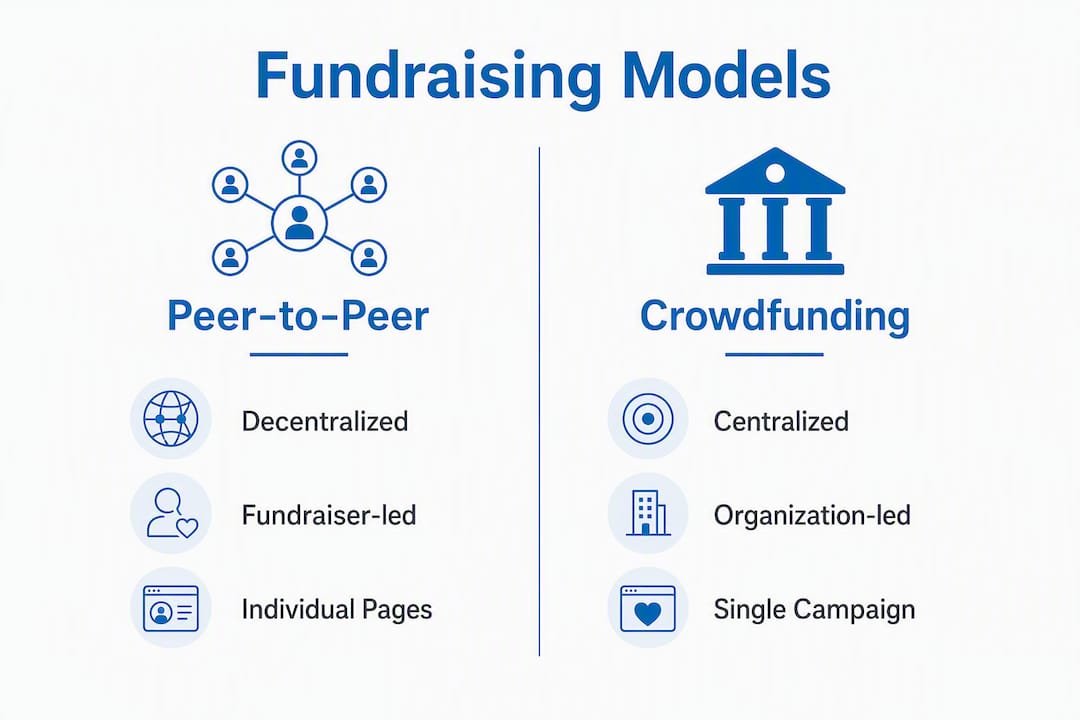
Table of Contents
- What is peer-to-peer fundraising and how does it differ from crowdfunding?
- Which campaign model fits your goal?
- Why P2P fundraising works: the case for nonprofits
- How to launch a P2P campaign: a step-by-step checklist
- How to choose the right P2P fundraising platform
- Creative P2P fundraising ideas across event and digital formats
- How to design fundraiser pages that actually convert
- How to recruit, onboard, and support volunteer fundraisers
- A 10-day launch plan that prioritizes the first 48 hours
- Tracking, reporting, and turning new donors into long-term supporters
- Common P2P mistakes and how to fix them fast
- Why the first 48 hours determine your campaign’s outcome
- Volunteer management strategies built for P2P campaigns
- Legal and regulatory considerations for P2P campaigns
- Data privacy and security in P2P fundraising
- Key Takeaways
- The metric most nonprofits get wrong in P2P campaigns
- How Americannexusmarketing helps nonprofits run campaigns that compound
- Useful sources and further reading
- FAQ
What is peer-to-peer fundraising and how does it differ from crowdfunding?
P2P fundraising is decentralized by design: each supporter builds and shares their own personal campaign page, while a traditional crowdfunding campaign directs everyone to one central page owned by the organization. That structural difference changes everything about how money moves, who does the asking, and how far the campaign travels.

In crowdfunding, your organization controls the narrative and the ask. In P2P, your fundraisers carry the message into their own social circles, adding personal credibility that no organizational email can replicate. The result is exponential reach rather than linear reach.
P2P vs. crowdfunding at a glance
| Dimension | Peer-to-peer fundraising | Crowdfunding |
|---|---|---|
| Who makes the ask | Individual supporters on personal pages | The organization on one central page |
| Page structure | Many personal pages, one parent campaign | Single campaign page |
| Best fit | Donor acquisition, events, giving days | Project funding, capital campaigns |
| Typical duration | Extended or open-ended; often recurring | Fixed window (30–60 days typical) |
| Reach mechanism | Fundraiser’s personal network | Organization’s existing audience |
Common P2P use cases
Annual walk/run/ride events where participants solicit pledges from friends and family
Giving days (e.g., Giving Tuesday) with a time-boxed, high-urgency push
Memorial and tribute campaigns where donors fundraise in someone’s honor
Employee and corporate team fundraisers tied to workplace giving programs
Birthday and milestone fundraisers driven by individual social sharing
Virtual fitness or challenge campaigns that run on a rolling basis
Which campaign model fits your goal?
P2P campaigns commonly run longer or open-ended compared with traditional crowdfunding timelines, which means the model you choose determines your staffing load, your automation needs, and your donor acquisition arc.
Rolling (evergreen) model. Always-on campaigns where supporters can create pages at any time. Best for organizations with a steady stream of motivated advocates, memorial giving, or birthday fundraisers. The tradeoff: lower urgency means you need consistent coaching and automation to keep fundraisers active. Recommended cadence: monthly check-in emails, quarterly leaderboard resets, and a year-end push.
Time-based model. A defined campaign window, typically 2–8 weeks, with a hard close date. Best for annual events, capital campaign supplements, or seasonal appeals. The urgency of a deadline drives faster activation. Recommended cadence: 2–4 week pre-launch recruitment, a strong launch day, weekly mid-campaign updates, and a final 48-hour push.
Giving day (intensive) model. A 24-hour or single-day campaign, often tied to Giving Tuesday or a local giving day. Best for organizations with an existing warm audience and a matching gift to deploy. The model demands the most pre-launch preparation but delivers the fastest revenue concentration. Recommended cadence: 4–6 week pre-launch, a day-of real-time leaderboard, and a same-day thank-you sequence.
Model selection matrix
| Primary objective | Recommended model |
|---|---|
| Ongoing donor acquisition | Rolling/evergreen |
| Annual event fundraising | Time-based |
| Fast revenue concentration | Giving day |
| Community engagement and retention | Time-based or rolling |
| Corporate/employee giving | Time-based or giving day |
Why P2P fundraising works: the case for nonprofits
The core advantage of P2P is structural: your fundraisers are the acquisition channel. Every personal page is a warm referral from someone the donor already trusts, which compresses the cost and friction of acquiring a new supporter.
- Expanded reach. Each fundraiser brings their own network. A campaign with 50 active fundraisers, each reaching about 30 contacts, can reach hundreds or even thousands of people your organization has never met.
- Higher first-time donor conversion. Because the ask comes from a peer rather than an institution, conversion rates on personal pages tend to outperform cold organizational appeals.
- Lower acquisition cost. Fundraisers absorb the outreach effort, reducing your cost per new donor compared with paid acquisition channels.
- Deeper engagement. Fundraisers who solicit on your behalf develop a stronger personal connection to your mission, increasing their own retention as donors and volunteers.
- Retention potential. New donors acquired through a trusted peer referral often show stronger second-gift rates than donors acquired through direct mail or paid ads.
Measuring only total dollars raised misses the real value. Track new-donor acquisition rate and fundraiser retention alongside revenue, because those metrics reveal whether the campaign is building long-term organizational capacity or just generating a one-time spike.
Pro Tip: Set a separate KPI for new-donor acquisition rate from the start. If your campaign raises $50,000 but 80% came from existing donors, the P2P model underperformed its core purpose. Aim for a significant share of gifts from first-time donors, as this demonstrates strong donor acquisition through the P2P model.

How to launch a P2P campaign: a step-by-step checklist
A strong launch is built in the weeks before the campaign goes live, not on launch day itself. A 2–6 week pre-launch phase that builds a warm list of committed fundraisers converts materially better than activating everyone at once on day one.
Set measurable goals. Define total dollars raised, number of active fundraisers, and new-donor acquisition rate. Tie each goal to a specific campaign model and timeline.
Choose your platform. Evaluate platforms on fees, CRM integrations, mobile experience, and support. (See the platform section below for a full criteria checklist.)
Design the campaign structure. Decide whether you want individual pages only, team pages with a leaderboard, or a hybrid. Set suggested ask amounts and a default donation amount. Establish any matching gift or challenge mechanic.
Build your recruitment list. Identify 10–25 high-probability fundraisers: board members, recurring donors, past event participants, and staff volunteers. Prioritize people who already know and support the mission.
Prepare the fundraiser toolkit. Create email templates, social media images and captions, sample page copy, a short training video (under 5 minutes), and a one-page FAQ. The easier you make it to fundraise, the higher your activation rate.
Run a pre-launch sign-up phase. Open a reservation or early sign-up goal 2–4 weeks before launch. Confirm commitments individually, not by mass email.
Execute the launch-day playbook. On day one, seed the campaign with board self-donations and organizational matching. Activate your leaderboard. Send a personal text or call to each committed fundraiser. Monitor for technical issues in the first 2 hours.
Run the 48-hour activation sprint. The first 48 hours set the social proof baseline. Push leaderboard updates, celebrate early fundraisers publicly, and deploy any timed matching gift to drive urgency.
Sustain with mid-campaign check-ins. At the campaign midpoint, send a personal coaching email to every fundraiser who has raised less than 25% of their goal. Offer to help them customize their page or draft a social post.
Close and celebrate. Send a final-push email 48 hours before close. After close, thank every fundraiser individually and share the campaign results with the full community.
Pro Tip: Budget for a dedicated campaign coordinator for the first 48 hours. This is not a task to delegate to a volunteer on launch day. Staff coverage during the launch window is the single highest-leverage investment you can make in a P2P campaign.
How to choose the right P2P fundraising platform
Platform selection is a procurement decision, not a software preference. The wrong platform costs you in transaction fees, lost donor data, and staff hours spent on manual workarounds.
Selection criteria
- Pricing and fees. Confirm the platform fee (percentage of each transaction), payment processing fee, and any monthly or annual subscription cost. Ask whether fees are deducted before or after funds are transferred.
- Fundraising features. Individual pages, team pages, leaderboards, goal auto-adjust, coaching email automation, and suggested ask amounts are the core feature set to verify.
- CRM and email integrations. Confirm native integrations with your CRM (HubSpot, Salesforce, Bloomerang, Bonterra) and your email platform. Ask about API access and UTM parameter capture.
- Mobile donor experience. Test the checkout flow on a mobile device. Confirm saved payment methods, Apple Pay/Google Pay support, and one-click social sharing.
- Reporting and attribution. Ask whether the platform captures fundraiser IDs, UTM parameters, and donor-level data in an exportable format.
- Support and training. Confirm onboarding support, a fundraising coach or customer success resource, and documentation for fundraisers.
Platform comparison overview
GoFundMe Pro highlights features like leaderboards, coaching emails, goal auto-adjust, and mobile-optimized pages as core to its P2P offering. Below is a functional comparison of five platforms commonly evaluated by U.S. nonprofits. Confirm current fees and integrations directly with each vendor before signing.
| Platform | Best for | Fundraising features | CRM integrations | Support |
|---|---|---|---|---|
| Bloomerang | Small-to-mid nonprofits with existing donor database | Individual pages, team pages, giving day tools | Native CRM, email, reporting | Onboarding + customer success |
| Bonterra | Mid-to-large nonprofits needing full suite | Individual/team pages, leaderboards, coaching emails | Salesforce, HubSpot, native CRM | Dedicated fundraising coach |
| GoFundMe Pro | Organizations prioritizing donor UX and social sharing | Individual pages, leaderboards, mobile checkout, social sharing | Select CRM integrations; confirm API | Platform support + documentation |
| Classy | Event-based and giving day campaigns | Individual/team pages, leaderboards, event registration | Salesforce, HubSpot, Mailchimp | Onboarding, help center, live support |
| DonorDrive | Walk/run/ride events and endurance fundraising | Team pages, leaderboards, fitness integrations, coaching | Select CRM and email integrations | Dedicated event support |
Vendor checklist: questions to ask before you sign
- What is the total cost per transaction (platform fee + processing fee combined)?
- Can donor data be exported in full, including fundraiser attribution, at any time?
- Does the platform capture UTM parameters and pass them to our CRM?
- What happens to funds if a campaign is canceled or a donor requests a refund?
- Is there a contract lock-in period, and what are the exit terms?
- What onboarding and training resources are available for our fundraisers, not just our staff?
Creative P2P fundraising ideas across event and digital formats
The strongest campaigns match the idea to the organization’s audience and operational capacity. Pick 2–3 ideas that fit your calendar, your volunteer base, and your mission, rather than trying to run everything at once.
Event-based ideas
- Charity walk or run. Participants collect pledges before the event. Works for health, community, and education nonprofits. Best fit: annual time-based campaign.
- Cycling challenge. Participants ride a set distance and solicit per-mile pledges. Best fit: annual event or giving day.
- Gala fundraiser with table captains. Each table captain runs a personal P2P page and recruits their guests. Best fit: time-based campaign tied to an event date.
- Golf tournament. Participants fundraise for their foursome entry. Best fit: annual event.
- Triathlon or endurance race. Participants use DonorDrive-style platforms with fitness tracking integration. Best fit: annual event.
Virtual and fitness challenge ideas
- Virtual 5K. Participants run anywhere and share results on social media. Best fit: giving day or rolling campaign.
- Step challenge. Teams compete to log the most steps over 30 days. Best fit: time-based campaign.
- Plunge or cold-water challenge. Participants complete a challenge and tag friends to donate. Best fit: giving day or viral social campaign.
- Read-a-thon or game-a-thon. Participants collect pledges per hour of reading or gaming. Best fit: rolling or time-based campaign.
- Fitness class fundraiser. Instructors host a class and direct participants to their P2P page. Best fit: rolling campaign.
Social-first and digital ideas
- Birthday fundraiser. Supporters replace birthday gifts with donations to your cause. Best fit: rolling/evergreen campaign.
- Livestream fundraiser. A host streams on YouTube or Twitch and drives donations in real time. Best fit: giving day or time-based campaign.
- Social media challenge. A branded hashtag challenge drives shares and donations. Best fit: giving day.
- Tribute or memorial campaign. Donors fundraise in honor of a loved one. Best fit: rolling campaign.
- Alumni giving challenge. Alumni compete by class year on a leaderboard. Best fit: giving day or annual campaign.
Workplace and corporate ideas
- Employee giving campaign. Staff create pages and compete on a company leaderboard. Best fit: time-based campaign with corporate match.
- Corporate team challenge. Departments compete to raise the most. Best fit: giving day.
- Vendor or partner match challenge. A corporate partner matches employee donations dollar-for-dollar. Best fit: giving day or time-based campaign.
- Lunch-and-learn fundraiser. A company hosts an event and directs attendees to a P2P page. Best fit: time-based campaign.
- Skills-based volunteer fundraiser. Professionals offer a service (consulting, design) in exchange for donations. Best fit: rolling campaign.
How to design fundraiser pages that actually convert
High-converting fundraiser pages combine a short emotional story, a clear impact statement, suggested ask amounts with an anchoring default, and a frictionless mobile checkout. The UX principles are the same ones consumer brands use to reduce cart abandonment.
Core page elements
- Headline. Personal and specific. “Help me run 26 miles for kids who need it” outperforms “Support my fundraiser.”
- Short personal story. 3–5 sentences connecting the fundraiser’s motivation to the mission. Authenticity matters more than polish.
- Impact statement. One line showing what a donation does: “$50 provides a week of meals for one child.”
- Suggested ask amounts. Three tiers work best. Research on crowdfunding pricing shows that anchoring and tiering influence giving behavior, so set your default at the middle tier to pull the average gift upward.
- Progress thermometer. Visible goal progress creates social proof and urgency.
- Social sharing prompts. One-click share to Facebook, Instagram, and text message, placed immediately after the donation confirmation.
Sample page copy snippets
Snippet A (walk/run):
“I’m running 13 miles on [date] to support [Org Name]’s after-school programs. Last year, they served 400 kids in our community. Every $50 covers one child’s supplies for a month. Will you help me reach my $500 goal?”
Snippet B (birthday fundraiser):
“This year, instead of gifts, I’m asking for something that matters more. [Org Name] changed my life, and I want to help them reach 100 more families. Even $25 makes a real difference.”
Suggested ask-amount tiers
| Tier | Amount | Impact label |
|---|---|---|
| Entry | $25 | “Covers one family’s supplies” |
| Default (anchored) | $50 | “Provides a week of meals” |
| Stretch | $100 | “Sponsors a child for a month” |
Technical checkout checklist
- Mobile-optimized page with large tap targets and minimal form fields
- Apple Pay and Google Pay enabled
- Saved payment method option for returning donors
- Automated tax receipt delivered within 5 minutes of donation
- Donor data (name, email, gift amount, fundraiser ID) captured and synced to CRM
How to recruit, onboard, and support volunteer fundraisers
Recruiting fundraisers who already know and support the mission is the single most reliable predictor of early campaign momentum. Board members, recurring donors, and past event participants are your first-tier targets because they require the least persuasion and deliver the highest activation rate.
Recruitment priority order
- Board members and organizational leadership
- Recurring donors (monthly or annual givers)
- Past event participants and volunteers
- Staff and alumni
- Corporate partners and workplace contacts
Fundraiser toolkit checklist
- Two pre-written email templates (initial ask + follow-up)
- Three social media captions with image assets sized for Instagram, Facebook, and LinkedIn
- Sample fundraiser page copy (headline + story + impact statement)
- A short training video (under 5 minutes) covering how to set up and share their page
- A one-page FAQ covering common donor questions and tax receipt information
- Recognition tiers or incentives (milestone badges, public leaderboard, thank-you gifts)
Sample recruitment email
Subject line: “I need your help for [Campaign Name] — 5 minutes is all it takes”
Body outline:
- One sentence on why you’re asking this person specifically (“You’ve been one of our most committed supporters for three years.”)
- One sentence on the campaign goal and timeline
- One sentence on what you’re asking them to do (create a page, set a $500 goal, share with 10 people)
- A direct link to sign up and a deadline to respond
Support cadence
| Touchpoint | Timing | Channel |
|---|---|---|
| Pre-launch welcome | 1 week before launch | Email + personal call |
| Launch day activation | Day 0 | Text message + email |
| 48-hour check-in | Day 2 | Email with leaderboard update |
| Mid-campaign coaching | Campaign midpoint | Personal email to lagging fundraisers |
| Final push | 48 hours before close | Email + text |
| Thank-you and results | Within 24 hours of close | Email + social post |
Bonterra’s guidance emphasizes mid-campaign check-ins as a critical lever for sustaining momentum, particularly for fundraisers who set up a page but haven’t yet shared it.
A 10-day launch plan that prioritizes the first 48 hours
Campaign execution playbooks consistently show that coordinated, multi-channel sequencing outperforms single-channel launches. The goal of the first 48 hours is to reach visible momentum before the broader public sees the campaign.
- Day -10 to -3 (Pre-launch). Finalize fundraiser pages, confirm commitments from your core group, and brief all fundraisers with the toolkit. Send a pre-launch email to your warm list announcing the campaign date.
- Day -2. Send a personal reminder to every committed fundraiser. Confirm that their pages are live and their goals are set. Brief your board on the matching gift or challenge mechanic.
- Day -1. Seed the campaign with 3–5 board self-donations. This creates visible progress before the public launch and establishes social proof.
- Day 0 (Launch). Send the launch email to your full list at 9 AM. Post on all owned social channels. Activate the leaderboard. Text every committed fundraiser. Monitor the checkout flow for technical issues.
- Day 1. Share the first leaderboard update on social media. Send a personal thank-you to every fundraiser who has already raised money. Post a donor milestone update (“We’ve already raised $X in 24 hours!”).
- Day 2 (48-hour mark). Send a 48-hour momentum email to your full list. Highlight the top fundraiser. Deploy any timed matching gift if not already active.
- Days 3–7 (Mid-campaign). Send weekly updates to your list. Post 2–3 times per week on social. Send individual coaching emails to fundraisers below 25% of their goal.
- Day 8. Deploy a mid-campaign challenge or matching gift to re-energize the campaign.
- Day 9. Send a “48 hours left” email and social post. Activate any final matching gift.
- Day 10 (Close). Send a final-push email at 8 AM. Post a countdown on social. Close the campaign at the stated time and send a same-day thank-you to all donors and fundraisers.
Tracking, reporting, and turning new donors into long-term supporters
The fundraiser is the acquisition channel, which means your CRM tagging discipline determines whether you can actually measure what worked. Sloppy attribution at the campaign level makes it impossible to calculate true cost per new donor or to build a stewardship sequence that references how the donor arrived.
Metrics checklist
- Number of active fundraisers (pages created vs. pages with at least one donation)
- Average amount raised per active fundraiser
- New-donor acquisition rate (first-time donors as a percentage of total donors)
- Donor retention rate from the previous P2P campaign
- Conversion rate on fundraiser pages (visitors to donors)
- Social share rate per fundraiser page
CRM tagging and integration checklist
| Data point | How to capture | Where to store |
|---|---|---|
| Fundraiser ID | Platform export or API | CRM contact record |
| UTM parameters | URL builder on all links | CRM campaign field |
| Gift-to-fundraiser attribution | Platform export | CRM gift record |
| Donor source (P2P campaign name) | CRM tag or custom field | CRM contact record |
| First-time donor flag | CRM logic rule | CRM contact record |
A well-structured CRM and email integration is what separates organizations that convert P2P donors into recurring givers from those that treat every campaign as a one-time event.
Three-step stewardship email sequence
Email 1 (within 24 hours of gift): Thank the donor by name, reference the fundraiser who brought them in, and confirm their tax receipt. Keep it under 150 words.
Email 2 (Day 7): Share a specific impact update from the campaign (“Because of you and 312 other donors, we’ve already served 50 families this month”). Include one soft ask to follow the organization on social media.
Email 3 (Day 30): Introduce a recurring giving option with a specific monthly amount tied to an impact statement (“$10/month keeps one child in our after-school program for a year”). Link to a drip campaign workflow that continues the relationship beyond the initial gift.
Common P2P mistakes and how to fix them fast
Most P2P campaigns that underperform share the same structural problems, and most of those problems are visible before launch day if you know what to look for.
Dos and don’ts
- Do recruit and confirm fundraisers before the campaign goes live.
- Do provide a complete toolkit so fundraisers never have to create their own assets.
- Do monitor platform fees in total (platform + processing), not just the headline rate.
- Don’t launch without a seed list of committed donors ready to give on day one.
- Don’t assume fundraisers will activate without coaching. Most need at least two personal touchpoints.
- Don’t set a single suggested donation amount. Tiered asks consistently outperform single-amount prompts.
Troubleshooting table
| Problem | Quick fix |
|---|---|
| Low fundraiser activation (pages created but no donations) | Send a personal coaching email with a pre-written social post they can copy and paste |
| Slow donor flow after day 3 | Deploy a timed matching gift or a leaderboard challenge to re-create urgency |
| Technical checkout failures | Test the full checkout flow on mobile immediately; contact platform support and post a workaround for donors |
| Leaderboard not updating | Confirm platform sync settings; manually refresh and notify top fundraisers |
| High page abandonment rate | Simplify the page setup flow; offer a 1:1 setup call for first-time fundraisers |
| Fundraiser dropout mid-campaign | Send a personal check-in call, not an email; offer to lower their goal to a more achievable number |
Red flags that signal a structural problem
A fundraiser retention rate below 30% from one campaign to the next suggests your toolkit or coaching cadence is failing, not your audience. A checkout abandonment rate above 60% on mobile points to a platform UX problem that no amount of email coaching will fix.
Why the first 48 hours determine your campaign’s outcome
Early momentum predicts overall campaign success: seed pledges and visible early donations create social proof that accelerates additional giving from people who want to join a movement already in progress. The Rhode Island Small Business Development Center notes that campaigns reaching 30% of their funding goal in the first week are significantly more likely to succeed overall, which translates directly to P2P: your pre-seeded board donations and committed fundraiser pages are not just optics. They are the conversion infrastructure.
Pro Tip: Assign one staff member to monitor the campaign dashboard from 8 AM to 8 PM on launch day. Set up automated coaching emails to fire at the 24-hour and 48-hour marks. Do not rely on manual follow-up alone during the launch window.
Staffing and automation checklist for launch day
- One staff member assigned to real-time dashboard monitoring
- Automated 24-hour coaching email queued for all fundraisers who have not yet shared their page
- Automated 48-hour momentum email queued for the full donor list
- Leaderboard update scheduled for social media at 12 PM and 6 PM on day one
- Overnight monitoring assignment confirmed (who checks the dashboard at 10 PM?)
Translating early momentum into long-term metrics
Track new-donor acquisition rate at the 48-hour mark, not just at campaign close. If fewer than 20% of day-one donors are first-time givers, your seed list is too heavily weighted toward existing supporters and your public reach is underperforming. Adjust your social promotion and fundraiser coaching in real time.
Volunteer management strategies built for P2P campaigns
Managing P2P volunteers is categorically different from managing event-day volunteers. Your fundraisers are operating independently, in their own networks, on their own schedules, and the quality of your management system determines whether they feel supported or abandoned.
Segmentation by engagement level
Divide your fundraiser pool into three tiers at the start of the campaign:
- Tier 1 (Champions). Fundraisers who have already raised more than 50% of their goal by day 3. Give them public recognition, a leaderboard spotlight, and a stretch goal challenge.
- Tier 2 (Active). Fundraisers who have set up their page and made at least one share but haven’t yet received a donation. Send a personal coaching email with a specific action (“Send this text to 5 friends today”).
- Tier 3 (Inactive). Fundraisers who created a page but have not shared it. This group needs a personal phone call, not another email.
Goal-setting and accountability
Set individual fundraiser goals collaboratively, not unilaterally. A fundraiser who agrees to a $500 goal is more likely to hit it than one who was assigned $500 without input. Use a pre-launch conversation to confirm the goal, the timeline, and the specific actions the fundraiser will take in the first 48 hours.
Recognition and incentive structures
Public leaderboards drive competition among high-performers, but they can demoralize mid-tier fundraisers who see themselves falling behind. Balance public leaderboards with private milestone recognition: a personal email when a fundraiser hits $100, $250, and $500 creates momentum without public comparison pressure. Non-monetary incentives (a handwritten note from the executive director, a behind-the-scenes mission update, a named recognition in the campaign close email) often outperform gift cards for mission-driven volunteers.
Offboarding and retention
The campaign close is the highest-leverage moment for volunteer retention. Within 24 hours of close, send every fundraiser a personalized results summary showing exactly how much they raised, how many donors they brought in, and what that means in mission impact. Fundraisers who receive this kind of specific, attributed recognition are significantly more likely to participate in the next campaign.
Legal and regulatory considerations for P2P campaigns
P2P fundraising in the United States operates within a compliance framework that most nonprofits underestimate until something goes wrong. Address these requirements before your campaign goes live, not after.
Charitable solicitation registration
Most U.S. states require nonprofits to register before soliciting donations from residents of that state. Because P2P campaigns spread through social networks without geographic boundaries, a campaign that starts in one state can quickly trigger registration requirements in 40 or more states. The Unified Registration Statement (URS) simplifies multi-state registration, but confirm your current registration status with legal counsel before launching a national P2P campaign.
Fundraiser agreements and disclosures
Your volunteer fundraisers are soliciting on your behalf. Provide each fundraiser with a written agreement that covers: what they are authorized to say about the organization, how donations will be used, and what they cannot promise donors. Include a disclosure statement on every fundraiser page that identifies the organization as the recipient of funds and confirms its tax-exempt status.
Tax receipting and donor acknowledgment
Donors who give through a fundraiser’s personal page are giving to your organization, not to the fundraiser. Your organization is responsible for issuing IRS-compliant gift acknowledgment letters for donations of $250 or more. Confirm that your platform generates these automatically and that the acknowledgment identifies your organization’s legal name and EIN.
Platform terms and fund flow
Read the platform’s terms of service carefully, particularly the sections covering fund disbursement timing, refund policies, and what happens to funds if a campaign is suspended. Some platforms hold funds for 5–10 business days after campaign close. Factor this into your cash flow planning.
Unrelated business income
If your P2P campaign includes a component where donors receive a tangible benefit in exchange for their gift (a ticket to an event, a product, a service), the IRS may treat part of the gift as a quid pro quo contribution, which changes the tax receipt language and may implicate unrelated business income tax (UBIT). Consult a nonprofit tax advisor before adding any reward or benefit tier to a P2P campaign.
This section is general information, not legal or tax advice. Confirm your organization’s specific compliance obligations with a qualified nonprofit attorney or CPA.
Data privacy and security in P2P fundraising
Every P2P campaign generates donor data across multiple touchpoints: the platform, your CRM, your email system, and your fundraisers’ personal sharing activity. Managing that data responsibly is both a legal obligation and a donor trust issue.
Data you collect and who controls it
Clarify with your platform vendor which party controls donor data: your organization or the platform. Some platforms retain donor data and restrict your ability to export or use it outside their system. Negotiate data ownership and export rights before signing any contract.
Fundraiser data handling
Your volunteer fundraisers should never have access to individual donor payment information. Confirm that your platform restricts fundraiser visibility to aggregate totals (how much their page has raised, how many donors) rather than donor names, email addresses, or payment details.
CRM data security
Donor data exported from your P2P platform and imported into your CRM should be transferred via encrypted file or direct API integration. Avoid emailing CSV files containing donor information. Confirm that your CRM vendor is SOC 2 compliant and that your team uses role-based access controls to limit who can view or export donor records.
State privacy laws
California’s Consumer Privacy Act (CCPA) and a growing number of state-level privacy laws impose specific obligations on organizations that collect personal data from residents of those states. If your P2P campaign reaches donors in California, Virginia, Colorado, or other states with active privacy legislation, confirm that your data collection practices, opt-out mechanisms, and retention policies comply with those laws.
Fundraiser training on data privacy
Include a one-page data privacy guide in your fundraiser toolkit. Fundraisers should know: do not collect donor payment information directly, do not share donor names or gift amounts publicly without consent, and direct all donor questions about tax receipts to the organization rather than answering them personally.
Key Takeaways
Peer-to-peer fundraising delivers its highest return when you treat the fundraiser as the acquisition channel, invest in pre-launch recruitment, and build the CRM infrastructure to measure new-donor acquisition from day one.
| Point | Details |
|---|---|
| Choose the right model first | Match rolling, time-based, or giving day to your primary objective before selecting a platform. |
| Pre-launch recruitment is the campaign | Recruit and confirm 10–25 committed fundraisers 2–6 weeks before launch; activation rates drop sharply without pre-committed participants. |
| First 48 hours set the outcome | Seed donations and visible early momentum create social proof that drives the rest of the campaign. |
| Vet platforms on fees and data rights | Confirm total transaction cost, CRM integration, and data export rights before signing any platform contract. |
| Americannexusmarketing integrates the full stack | Americannexusmarketing connects P2P campaign execution with CRM setup, marketing automation, and stewardship sequences to convert new donors into long-term supporters. |
The metric most nonprofits get wrong in P2P campaigns
Most organizations measure a P2P campaign by total dollars raised and call it a success or a failure on that number alone. That framing misses the actual value proposition of the model.
P2P fundraising is not primarily a revenue tool. It is a donor acquisition infrastructure. The dollars are a byproduct of the real output: new supporters who arrived through a trusted peer referral and who, if stewarded correctly, will give again. An organization that raises $40,000 from 200 first-time donors has built something more durable than one that raises $80,000 from 50 existing major donors through a P2P wrapper.
The second thing most organizations underinvest in is CRM tagging discipline at the campaign level. Without fundraiser-level attribution in your donor records, you cannot calculate cost per new donor, you cannot identify which fundraisers drove the highest-quality gifts, and you cannot build a stewardship sequence that references how the donor arrived. That attribution gap compounds over multiple campaigns, making it progressively harder to improve.
The third overlooked variable is fundraiser retention. The best predictor of your next P2P campaign’s performance is how many of this campaign’s fundraisers agree to participate again. That number is almost entirely a function of how well you recognized and communicated with them during and after the campaign, not how much they raised.
How Americannexusmarketing helps nonprofits run campaigns that compound
Running a P2P campaign without a connected CRM and automation layer is like building a pipeline with no collection tank. Americannexusmarketing gives mission-driven nonprofits the infrastructure to capture every donor relationship a P2P campaign generates and convert it into long-term organizational revenue.
The agency’s core services for P2P campaigns include fundraising strategy and campaign architecture, HubSpot CRM setup and fundraiser attribution tagging, automated email campaign flows for fundraiser coaching and donor stewardship, marketing automation for the launch window and post-campaign sequences, and AI-driven outreach and segmentation to sustain donor engagement beyond the campaign close. A typical initial engagement begins with a scoping call, followed by a 2–6 week campaign plan that covers platform selection, CRM integration, and a launch-day playbook. Implementation options range from a one-time setup to ongoing managed campaign execution.
To request a campaign plan or book a scoping call, visit Americannexusmarketing.
Useful sources and further reading
- Peer-to-Peer Fundraising Platform for Nonprofits | GoFundMe Pro — Platform documentation covering P2P features including leaderboards, coaching emails, mobile checkout, and donor acquisition data. Use to verify feature availability and platform positioning.
- Peer-to-peer vs. crowdfunding | FundraiseUp — Structural comparison of P2P and crowdfunding models, with UX and attribution guidance. Useful for the definition and page-design sections.
- Peer-to-Peer Fundraising: Complete Nonprofit Guide | Zeffy — Practitioner guide covering campaign duration, recruitment, and toolkit best practices. Useful for campaign planning and fundraiser management.
- Peer-to-peer fundraising guide | Bonterra — Operational guidance on recruitment, mid-campaign check-ins, and coaching cadence from a major nonprofit platform vendor.
- Crowdfunding: 11 Elements of a Successful Campaign | RI SBDC — Academic and practitioner synthesis on early momentum, pricing tiers, and social proof in crowdfunding campaigns. Directly applicable to P2P launch strategy.
- Follow the money: Pricing techniques in crowdfunding | Ben-Gurion University — Academic research on anchoring and tiering in crowdfunding reward structures. Use to support suggested ask-amount design.
- Understanding crowdfunding timeline | SendFromChina NewsCenter — Industry discussion of campaign momentum arcs and the conversion impact of early funding. Supports the first-48-hours framework.
- The Ultimate Crowdfunding Campaign Execution Playbook | Fundpop — Execution playbook covering multi-channel sequencing and campaign arc tactics. Useful for the promotion and launch strategy section.
- Peer-to-Peer Fundraising | Funraise — Platform feature documentation for P2P tools. Useful for platform evaluation and feature checklist verification.
- Americannexusmarketing — Agency landing page for nonprofits seeking CRM setup, campaign execution, and marketing automation services tailored to P2P fundraising.
FAQ
What is an example of a peer-to-peer fundraising campaign?
A charity walk where participants each create a personal fundraising page and solicit pledges from friends and family is the most common P2P example. Organizations like the American Cancer Society’s Making Strides walk use this model to reach millions of donors through individual fundraiser networks.
How much does GoFundMe take from donations?
GoFundMe Pro’s fee structure for nonprofits differs from its consumer product; confirm the current platform fee and payment processing fee directly with GoFundMe Pro, as rates are not publicly listed as a flat universal figure and vary by plan.
What is the 80/20 rule in fundraising?
The 80/20 rule in fundraising holds that roughly 80% of donations come from 20% of donors. In a P2P campaign, this translates to a small number of high-performing fundraisers driving the majority of revenue, which is why identifying and coaching your top-tier fundraisers early is a higher-leverage activity than trying to activate every participant equally.
What are the 3 C’s of fundraising?
The 3 C’s most commonly referenced in nonprofit fundraising are Cultivation (building the relationship before the ask), Conversion (making the ask and securing the gift), and Continuity (retaining the donor through stewardship). In a P2P context, your fundraisers handle conversion while your organization owns cultivation and continuity through the post-campaign stewardship sequence.
How do you measure the success of a P2P campaign beyond total dollars raised?
Track new-donor acquisition rate, average amount raised per active fundraiser, fundraiser retention rate, and conversion rate on fundraiser pages. These metrics reveal whether the campaign built long-term organizational capacity, not just short-term revenue.