


46% of all Google searches in the United States have local intent as of 2026, making local SEO crucial for small businesses aiming to attract nearby customers. That means nearly half the searches happening right now are people looking for a business, product, or service near them. Local SEO for small business is how you show up for those searches, specifically by optimizing your Google Business Profile, website content, and local citations to attract nearby customers through both Google Maps and AI-powered answer engines like ChatGPT and Google AI Overviews.
Here is what a complete local SEO strategy covers:
- Google Business Profile (GBP): Your single most powerful local visibility asset
- Three ranking pillars: Proximity, relevance, and prominence
- NAP consistency: Identical name, address, and phone number across every platform
- Local keyword research: Finding terms your nearby customers actually use
- On-page signals: Location pages, schema markup, and title tags
- Reviews and citations: The trust signals that separate winners from also-rans
- AI answer engine optimization: Structuring content so ChatGPT and Perplexity cite you
- Performance tracking: Measuring what actually moves the needle
Table of Contents
- The three pillars of local SEO success
- How to optimize your Google Business Profile for maximum local SEO
- Preparing your local SEO strategy for AI-powered answer engines
- How Americannexusmarketing helps small businesses excel in local SEO
- How to find local keywords that bring you customers
- On-page SEO techniques specific to local SEO
- Mobile optimization for local search
- Tracking and measuring local SEO performance
- Americannexusmarketing: local SEO results without the guesswork
- Key takeaways
The three pillars of local SEO success
Google’s local ranking rests on three factors: proximity, relevance, and prominence. Understanding each one tells you exactly where to spend your time.
Proximity is how close your business is to the person searching. You cannot move your location, but you can build service-area pages for every neighborhood or city you serve, which extends your geographic reach in organic results.
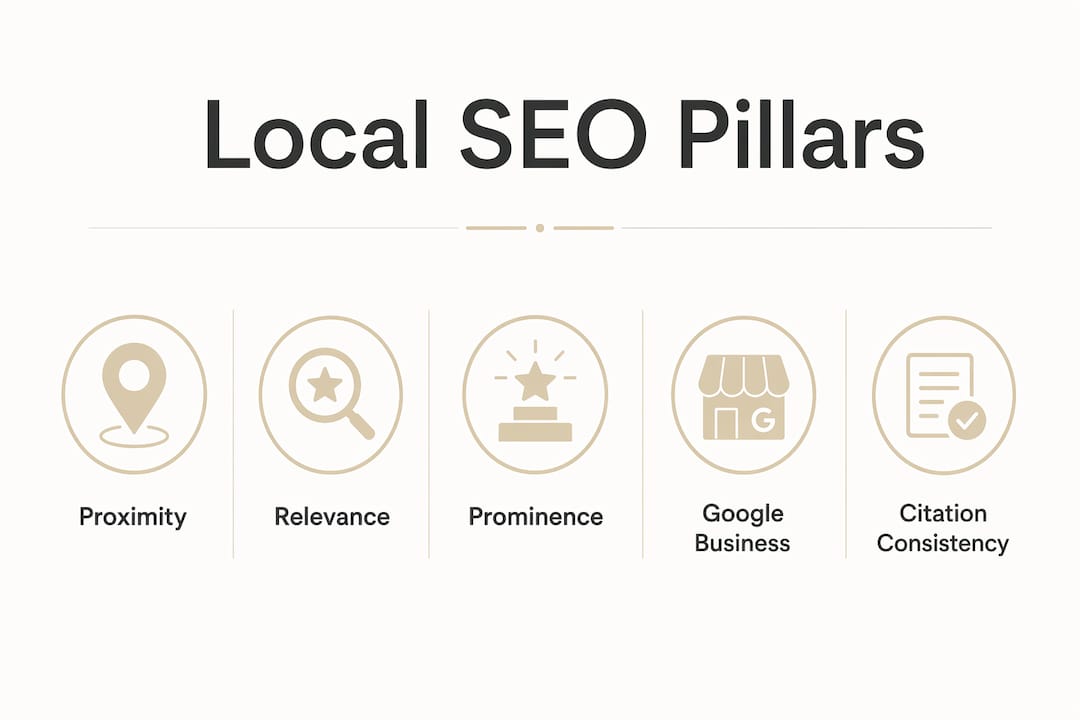
Relevance is how well your business matches what someone searched for. Google reads your GBP categories, your website content, and your service descriptions to judge this. A plumber who lists “emergency pipe repair” as a specific service will beat one who only lists “plumbing” for that query.
Prominence is where most small businesses fall short. It is built from reviews, local citations, backlinks from local news sites and chambers of commerce, and your overall online reputation. A business with 80 recent five-star reviews and a mention in the local newspaper will consistently outrank a competitor with a cleaner website but no community presence.
- Build prominence actively: ask for reviews after every positive interaction
- Pursue local authority links from chambers of commerce, community organizations, and local press
- Fix citation inconsistencies before they compound into ranking problems
How to optimize your Google Business Profile for maximum local SEO
Your GBP is the engine behind your Local Pack placement. A half-finished profile is the single most common reason small businesses get outranked by competitors with worse websites.
Claim and verify first. Google will not show an unverified profile prominently. Once verified, choose your primary category carefully. It is your strongest relevance signal, and it must reflect your core service, not a broad umbrella term.

The Services section is underused by most businesses. Listing each service separately with its own name and description dramatically improves your chances of matching niche queries. A web designer who lists “nonprofit web design,” “e-commerce website design,” and “website maintenance” as distinct services will appear for searches that a generic “web design” label misses entirely.
Photos and posts drive engagement. Businesses with photos receive more direction requests and clicks. Post GBP updates weekly. Even a short sentence linking to a recent project or service update signals to Google that your business is active. Weekly GBP posts and fresh content also feed AI models that crawl your profile to understand your business entity.
- Write a 250–300 word business description that includes your city and primary services naturally
- Keep hours accurate, wrong hours are a top reason customers lose trust
- Respond to every review, positive and negative, within 48 hours
Preparing your local SEO strategy for AI-powered answer engines
Local SEO now requires dual optimization: ranking in Google Maps and the Local Pack, and getting cited by AI answer engines like ChatGPT, Perplexity, Claude, and Google AI Overviews. These are not two separate strategies. The same entity signals, content quality, and authority factors that help you rank in Google also influence AI citations.
Answer Engine Optimization (AEO) is the practice of structuring content so AI models can extract and cite it. Write for questions, not just keywords. Instead of a page titled “Plumbing Services Denver,” write content that answers “How much does it cost to fix a leaking pipe in Denver?” with a direct, specific answer in the first paragraph.
Add FAQ sections to every service page. Use clear H2 and H3 headings that mirror natural language questions. Include schema markup, specifically LocalBusiness, Service, and FAQPage types, so both Google and AI models can parse your page structure without guessing.
- Create dedicated location pages for each city or neighborhood you serve, with unique content per page
- Add descriptive filenames and alt text to photos so multimodal AI models understand your offerings
- Aim for 1,500+ words per service page; AI models favor depth over thin content
Pro Tip: Track your visibility in both traditional Google rankings and AI search separately. Test your core queries in ChatGPT, Perplexity, and Google AI Overviews monthly. Note which competitors get cited and what content they have that you do not.
How Americannexusmarketing helps small businesses excel in local SEO
Getting local SEO right requires consistent execution across GBP, website content, citations, and reviews simultaneously. Most small business owners have the knowledge but not the bandwidth.
Americannexusmarketing builds data-driven local SEO programs tailored to small businesses across the United States. Their approach covers GBP optimization, citation management, local content creation, and review strategy, all tracked through web analytics so you see exactly what is moving. Clients see measurable improvements in website traffic and conversion rates, not just ranking positions.
How to find local keywords that bring you customers
Local keyword research starts with your services, not a tool. List every service you offer, then add geographic modifiers: city names, neighborhood names, and “near me” variants. A tax preparer in Phoenix should target “tax preparer Phoenix AZ,” “tax help Scottsdale,” and “CPA near me” as separate keyword targets, each assigned to its own page.
Use Google Keyword Planner or Google Autocomplete to surface what local searchers actually type. Pay attention to intent-specific modifiers like “affordable,” “open late,” or “emergency,” because those phrases signal a buyer who is ready to call. Even keywords with 50–100 monthly searches are worth targeting in a local niche where the competition is thin and the conversion rate is high.
On-page SEO techniques specific to local SEO
Your website reinforces or undermines every signal your GBP sends. The two must tell the same story.
Title tags should follow this structure: [Service] in [City, State] | [Business Name]. Your H1 on each page should include your primary service and city. NAP information belongs in your footer on every page, formatted in text Google can index, not embedded in an image.
NAP consistency across your website, GBP, Yelp, Facebook, Apple Maps, and every directory listing is non-negotiable. “John’s Plumbing” in one place and “Johns Plumbing LLC” in another creates conflicting signals that weaken your trust score with Google. Run an NAP audit at least twice a year.
Add LocalBusiness schema markup to your homepage and contact page. At minimum, include your business name, address, phone number, hours, and geo coordinates. This structured data helps both Google and AI models understand your business entity without ambiguity.
Mobile optimization for local search
Most local searches happen on smartphones, often right before someone walks through a door or picks up the phone. A slow or hard-to-navigate mobile site loses that customer before they ever read your content.
Your site should load in under three seconds on mobile. Use Google’s PageSpeed Insights to identify what is slowing you down, typically uncompressed images or render-blocking scripts. Make your phone number a tap-to-call link. Put your address and hours above the fold on your contact page so a user on the go does not have to scroll.
Embed a Google Map on your location page. It reinforces your geographic relevance to Google and gives mobile users a one-tap path to directions.
Tracking and measuring local SEO performance
You cannot improve what you do not measure, and generic rank trackers showing national averages are useless for local businesses. Track local SEO performance separately for Map Pack rankings and organic rankings, using tools with ZIP code or city-level granularity like Google Search Console, which is free, or dedicated local rank trackers.
Monitor GBP Insights monthly: direction requests, phone calls, and website clicks from your profile tell you whether your optimization is translating into customer actions. Watch review velocity too. A business with 50 recent reviews will outperform one with 200 stale reviews from three years ago.
For AI search visibility, test your top 20 queries in ChatGPT and Perplexity quarterly. Note which competitors appear and what content they have that earns the citation. Then fill that gap.
Americannexusmarketing: local SEO results without the guesswork
Small business owners who want real local search growth without spending months learning the technical details have a direct path: work with Americannexusmarketing.
Americannexusmarketing delivers custom local SEO programs built around your specific market, services, and goals. No generic templates. No black-box reporting. You get GBP optimization, citation cleanup, local content strategy, and performance dashboards that show exactly where your visibility is growing. For small businesses that need measurable results from their marketing budget, this is the done-for-you alternative to piecing it together alone. Visit americannexusmarketing.com to get a custom local SEO plan for your business.
Key takeaways
A fully optimized Google Business Profile, combined with consistent NAP citations, location-specific website pages, and a steady review strategy, is the foundation every small business local SEO plan must build on before anything else.
| Point | Details |
|---|---|
| GBP is your top priority | Claim, verify, and fully complete your Google Business Profile before any other tactic. |
| Prominence requires active effort | Reviews, local backlinks, and citations build the prominence that separates ranked businesses from invisible ones. |
| AI search demands structured content | Write service pages that answer specific questions directly; add FAQ sections and schema markup so AI models can cite you. |
| NAP consistency is foundational | Your name, address, and phone number must match exactly across every directory, social profile, and your website. |
| Americannexusmarketing | Offers done-for-you local SEO programs covering GBP, citations, content, and performance tracking for small businesses. |