


Personalization in marketing is no longer a nice differentiator. It’s the baseline expectation. Fast-growing companies generate up to 40% more revenue from personalization than slower-growing peers, and 87% of brands plan to increase their personalization investments over the next year. The shift driving this is generative AI, which has moved personalization from “insert first name here” into real-time, context-aware experiences that adapt across every touchpoint. Platforms like StackAdapt, Campaign Monitor, and the data infrastructure pioneered by companies like Amazon New York’s corporate operations have set a new standard for what tailored customer experiences look like at scale.
What’s changed most in 2026 is the expectation gap. Customers don’t just want relevant emails. They expect every interaction, from a display ad to a support chat, to reflect who they are and where they are in their journey. Brands that close that gap see measurable returns. Those that don’t lose trust fast.
Key reasons personalization has become a strategic priority:
- Consumers expect brands to recognize their preferences, context, and lifecycle stage, not just their purchase history
- Generative AI now enables micro-segment-level content creation at a speed and cost that was previously impossible
- Third-party cookie deprecation has pushed brands toward first-party and zero-party data strategies
- Disconnected data across marketing, sales, and service creates fragmented experiences that actively damage brand trust
How personalization in marketing depends on customer segmentation
Segmentation is the prerequisite. You cannot personalize for an audience you haven’t defined. The most effective segmentation in 2026 goes well beyond age and zip code. Behavioral segmentation groups customers by what they actually do, such as pages visited, products browsed, and emails opened. Firmographic segmentation targets B2B audiences by company size, industry, and revenue. Lifecycle segmentation identifies where a customer sits in their relationship with your brand, whether they’re a first-time visitor, an active buyer, or someone at risk of churning.

The real unlock is first-party and zero-party data. First-party data captures what customers do on your owned channels. Zero-party data is what they tell you directly, through preference surveys, onboarding quizzes, or interactive tools. 83% of consumers will share zero-party data if it results in a genuinely personalized and valuable experience. That’s a significant signal about where trust lives.
Siloed data is the single most common reason personalization fails at scale. A unified customer profile, one record that consolidates CRM data, behavioral signals, purchase history, and support interactions, is what makes segmentation actionable rather than theoretical.
Segmentation techniques that drive real personalization:
- Behavioral: based on browsing patterns, cart abandonment, email engagement, and purchase frequency
- Demographic and firmographic: age, location, company size, and industry for B2B audiences
- Lifecycle stage: new visitor, active customer, lapsed buyer, or churn risk
- Predictive: AI-powered models that forecast next purchase, churn probability, or upsell readiness
How generative AI transforms dynamic content personalization
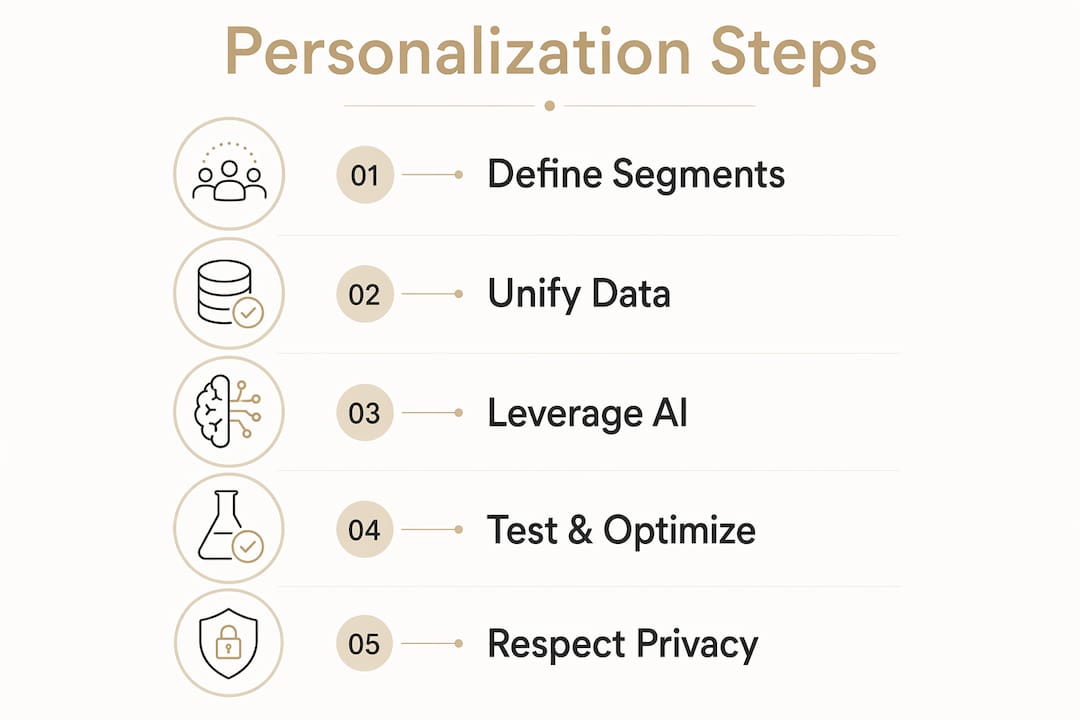
Generative AI has removed the production bottleneck that made true personalization expensive. Brands now require a tech stack that feeds real-time behavioral data to AI models, enabling content creation at the micro-segment level rather than the broad demographic level. That means one core asset, say a case study, can be remixed into five industry-specific landing pages in minutes.

The technology stack underneath this has three layers. First, a unified data platform or customer data platform (CDP) that consolidates signals from every channel. Second, an AI decision engine that evaluates customer context, including sentiment, intent, and behavioral history, to determine the next best action. Third, real-time delivery infrastructure that executes across email, display, web, and support simultaneously.
| Approach | Method | Adaptability | Content scale |
|---|---|---|---|
| Static rule-based | Manual if/then logic | Low | Limited |
| AI agentic orchestration | Real-time context signals | High | Micro-segment level |
AI-assisted dynamic creative optimization automatically adjusts headlines, visuals, and offers based on audience attributes and context, cutting manual update cycles significantly. StackAdapt’s PageContext AI, for example, analyzes page-level language and themes to place ads where the content is genuinely relevant, not just pages that briefly mention a keyword.
Pro Tip: Before integrating a generative AI layer, audit your data infrastructure first. AI personalization is only as good as the data feeding it. A fragmented CRM and an unconnected email platform will produce inconsistent outputs no matter how capable the AI model is.
Privacy-conscious data strategy matters here too. With third-party cookies declining, contextual targeting and zero-party data collection have become the primary privacy-compliant paths to personalization. Progressive profiling, asking one high-value question per visit rather than a long form upfront, builds rich customer profiles without friction.
Real-world marketing personalization examples that show measurable results
The most instructive examples share a common thread: they replaced generic outreach with context-aware triggers.
Campaign Monitor’s email personalization capabilities illustrate how AI-powered optimization moves beyond subject line tokens. Marketers using their platform can build automated sequences that adapt based on engagement signals, sending different content to someone who opened three emails versus someone who hasn’t engaged in 30 days. Email remains the foundational personalization channel, with 47% of brand marketers citing personalized email campaigns as their primary method for driving results.
That shift from “what” to “when and why” is where the performance gains live. Effectiveness of purchase-history-based recommendations has dropped by 24% as consumers now view that type of retargeting as lazy at best. The brands seeing real lift are those using AI agents to evaluate customer sentiment before triggering any message. An agent that detects a frustrated support ticket and pauses a sales email sequence is preventing churn, not just personalizing content.
On the service side, 78% of customers prioritize instant resolution over human interaction, which means AI-powered service agents that deliver tailored responses based on a customer’s full history are now a retention tool, not just a cost-cutting measure. Context-driven efficiency also reduces average handle time, letting teams serve more customers without adding headcount.
Common pitfalls these examples reveal:
- Personalizing the message without unifying the data first produces inconsistent experiences across channels
- Over-relying on purchase history alone signals “lazy” personalization to today’s consumers
- Triggering promotional messages to customers with active complaints destroys trust faster than no personalization at all
Best practices for building effective personalized marketing strategies
The most durable personalization programs start narrow and scale from proven wins, not from launching everything simultaneously.
Start with one high-leverage moment. The highest-impact personalization opportunities align with lifecycle transitions, specifically when a visitor becomes a known contact or when a new customer begins onboarding. Automating a single “next best action” trigger at one of these moments creates measurable lift quickly. Once you validate it with metrics like lower bounce rate or faster time-to-value, replicate the pattern across the rest of the lifecycle.
Unify your customer data before personalizing anything. Personalization built on siloed data produces fragmented experiences. A unified customer profile that connects CRM records, behavioral data, purchase history, and support interactions is the foundation every other tactic depends on.
Build a value exchange for zero-party data. Customers will share preferences when they trust you and see a clear benefit. Interactive onboarding surveys, preference centers, and quizzes outperform passive tracking because the data is accurate and consensual.
Pro Tip: Track personalization effectiveness with KPIs that reflect business outcomes, not just engagement. Reduced customer acquisition cost, increased average order value, improved retention rate, and decreased churn are the metrics that justify continued investment. Open rates and click-through rates tell you what happened; these metrics tell you why it mattered.
Avoid intrusive personalization. Two-thirds of consumers have experienced a personalized interaction that felt inaccurate or invasive, and many disengaged as a result. The line between “this brand knows me” and “this brand is watching me” is crossed when personalization lacks context or relevance. Use data to serve the customer’s current need, not to demonstrate how much you’ve collected.
Americannexusmarketing applies these principles directly for small businesses and e-commerce brands, building data-driven personalization programs grounded in first-party data strategies and measurable KPIs. The methodology prioritizes transparency and iterative scaling, starting with high-impact journey moments and expanding from there.
Americannexusmarketing builds custom personalization strategies for businesses that want real results, not generic campaigns. If you’re ready to move beyond batch-and-blast marketing and build experiences that actually convert, reach out to the team today.
Key Takeaways
Personalization in marketing drives measurable revenue growth when it combines unified customer data, AI-powered decisioning, and context-aware triggers across the full customer lifecycle.
| Point | Details |
|---|---|
| Revenue impact | Fast-growing companies generate up to 40% more revenue from personalization than slower-growing peers. |
| Data foundation | Unified customer profiles that connect CRM, behavioral, and support data are the prerequisite for effective personalization. |
| Zero-party data | 83% of consumers will share preferences directly when the exchange offers genuine value. |
| AI and content scale | Generative AI enables micro-segment content creation, turning one asset into multiple tailored variations quickly. |
| Start small | Personalizing one high-leverage lifecycle moment first creates measurable lift and a replicable pattern for scaling. |
Article generated by BabyLoveGrowth