
Measuring AI search visibility requires three things working together: a repeatable prompt set, multi-engine sampling across ChatGPT, Gemini, Perplexity, and Google AI Overviews, and a consistent read on Visibility Score, citation share, and prompt coverage. Without all three, you are measuring noise, not presence. Start today by running a free diagnostic, then capture your baseline before your next campaign cycle.
- Semrush AI Search Visibility Checker: Free check plus an enterprise toolkit reporting per-engine mentions, citation share, and a composite Visibility Score. Best for teams that want SEO and AI visibility in one workflow.
- Searchable: An analytics platform tracking citations across multiple AI engines with a growth command center. Best for brands that want engine-specific analytics tied to optimization workflows.
- SE Ranking AI Visibility Tracker: Monitors brand mentions and linked citations in AI answers with alerts and scheduled reporting. Best for agencies and mid-size brands that need routine monitoring without heavy setup.
Run a free check with Semrush or start a Searchable trial this week. Capture your first prompt set before you optimize anything.
Table of Contents
- Which AI search visibility platforms should you use?
- How do you choose between a tool, a vendor add-on, or an agency?
- What does AI visibility actually measure, and what moves it?
- Key Takeaways
- Why the “just pick a tool” advice misses the point
- Americannexusmarketing can build your AI visibility measurement program
- Useful sources for methods, tools, and official guidance
- FAQ
Which AI search visibility platforms should you use?
The table below compares the three leading platforms on the dimensions that matter most to marketing operations teams.
| Platform | AI engines covered | Metrics & outputs | Volume & cadence | Actionability | Integrations / reporting | Pricing / free tier |
|---|---|---|---|---|---|---|
| Semrush AI Search Visibility Checker | ChatGPT, Gemini, Perplexity, Google AI Overviews | Visibility Score (0–100), citation share, per-engine mention counts, linked mentions | Large prompt database; historical depth via enterprise toolkit | Automated recommendations, content prompts, gap analysis | CSV export, API, integrates with Semrush SEO suite | Free diagnostic check; enterprise toolkit via paid plan |
| Searchable | Multiple AI engines (engine list published on platform) | Citation analytics, mention tracking, engine-specific share | Growth-workflow cadence; analytics dashboard | Growth command center with optimization workflows | Dashboard reporting; marketing stack integrations | Free trial available |
| SE Ranking AI Visibility Tracker | ChatGPT, Perplexity, Gemini, Google AI Overviews | Brand mention counts, linked citations, citation share | Scheduled monitoring; alert-based cadence | Automated alerts, reporting templates | CSV export, reporting integrations | Trial available; subscription-based |
Semrush AI Search Visibility Checker
Semrush publishes its methodology openly, which is the first trust signal worth noting. The free diagnostic surfaces per-engine mention counts, top-cited pages, and a composite Visibility Score immediately, making it the fastest way to establish a baseline. The enterprise AI Visibility Toolkit extends that into historical tracking, competitive benchmarking, and content-gap prompts. Because it sits inside the broader Semrush platform, teams already using it for traditional SEO work can correlate classic ranking data with AI citation data in a single workflow. The published methodology and sample reports also satisfy procurement requirements for methodology transparency.

Searchable
Searchable positions itself as an analytics-first platform, with engine-specific citation breakdowns that let you see exactly where your brand appears and where it does not. The growth command center connects measurement to optimization tasks directly, which reduces the gap between “we saw a drop in citation share” and “here is what to fix.” For brands running multi-channel campaigns where AI citation share is a KPI alongside paid and organic, that closed loop is the practical differentiator.
SE Ranking AI Visibility Tracker
SE Ranking’s strength is operational reliability. Scheduled monitoring and automated alerts mean your team gets notified when citation share drops or a competitor gains a linked mention, without anyone manually pulling reports. For agencies managing multiple brand accounts, or mid-size marketing teams with limited analyst bandwidth, that alert-first design keeps AI visibility on the radar without requiring a dedicated monitoring role.

Pro Tip: Before committing to any platform, request a sample report or run the free check with your own brand name and three to five competitor names. The output quality of that first report tells you more about data depth than any feature comparison.
How do you choose between a tool, a vendor add-on, or an agency?
The right answer depends on four variables: your team’s internal capability, how frequently you need data, how many AI engines you must cover, and who owns the prompt set long-term.
- Assess internal capability first — If your marketing ops team can build and maintain a prompt library, schedule weekly checks, and interpret citation drift, a self-serve platform like Semrush or SE Ranking is sufficient. If that capability does not exist, a managed service or agency is the faster path to consistent measurement.
Questions to ask any vendor before you buy
- What is the size of your prompt library, and how often is it updated?
- Which AI engines do you cover, and how do you handle engine-specific citation drift?
- Can I export raw data via CSV or API for BI integration?
- Do you publish your scoring methodology, and can I see a sample report?
- What is your typical data refresh cadence?
Red flags that should stop a purchase
- Blended or opaque scoring with no per-engine breakdown.
- Single-engine focus presented as “AI visibility” broadly.
- No published methodology or sample report available before purchase.
- Update cadence slower than biweekly for a dynamic measurement category.
Realistic timelines and cost expectations
- 30 days (in-house, tool-based): Platform onboarding, prompt set construction, first baseline report. Cost: tool subscription plus 8–12 hours of analyst time.
- 90 days (tool-based, optimizing): First optimization cycle complete, citation share trending, competitive benchmarks established.
- 180 days (agency-managed): Full measurement-to-optimization loop running, entity authority work underway, cross-engine correlation analysis available.
Agency-managed programs cost more upfront but compress the 30-day onboarding to roughly one to two weeks because the prompt library and methodology are already built.
What does AI visibility actually measure, and what moves it?
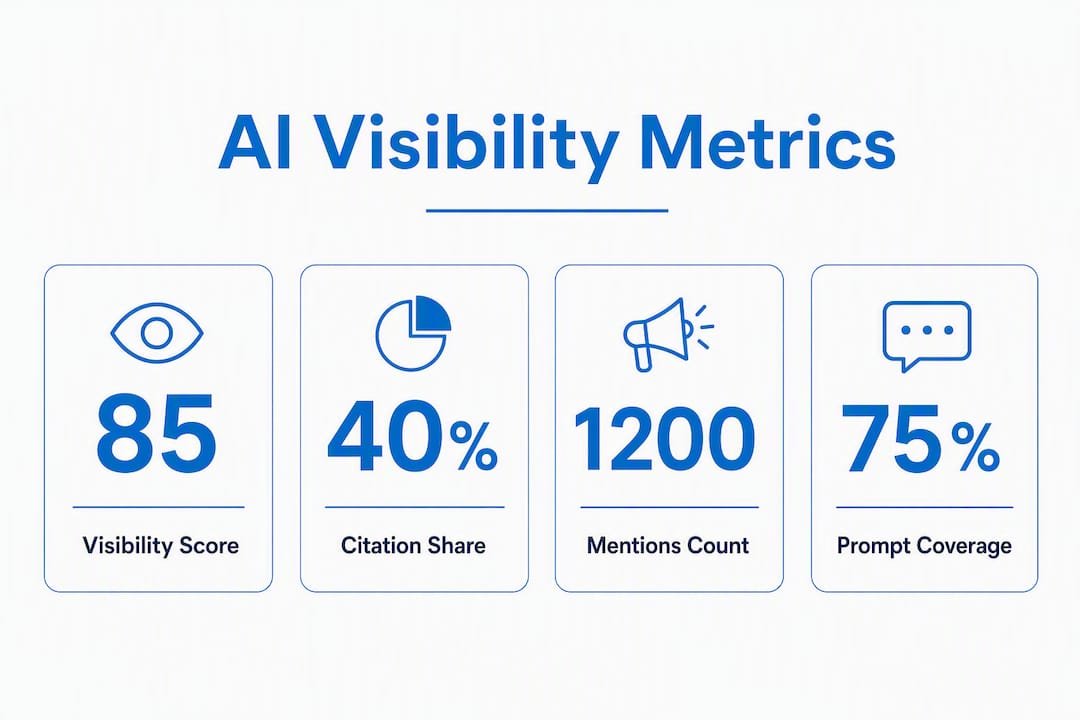
AI visibility measures how often and how prominently your brand appears inside synthesized, AI-generated answers across engines such as ChatGPT, Gemini, Perplexity, and Google AI Overviews. The standard metric set includes Visibility Score (a 0–100 index), citation share (your brand’s proportion of citations within a defined prompt set), mention counts, prompt coverage (the percentage of prompts where your brand appears at all), and ranked presence within answers.
Statistic: Semrush research found that AI Overviews appeared on a notable share of searches by late 2025, and that ChatGPT often cites pages that are not ranked in the traditional top spots, meaning extractability and proof can outperform classic rank for AI citation.
That last point reshapes priorities. A page ranked 15th organically can earn more AI citations than a page ranked 3rd if it contains a quotable statistic, a clear definition, or a structured comparison. Thinking in terms of “conversation presence” rather than page rank is the more useful mental model for this measurement category.
The five pillars that drive citation gains
- Retrievability. Your pages must be crawlable, indexed, and technically clean. Google’s guidance states that generative AI features rely on core Search ranking and quality systems, so crawlability and indexability remain the primary eligibility gates. Fix these before anything else. Our technical SEO checklist covers the baseline requirements.
- Content alignment and extractability. AI systems pull passages, not pages. Write in short, self-contained paragraphs with a clear claim in the first sentence. Add sourced statistics, named examples, and direct definitions that can be lifted verbatim into a generated answer.
- Competitive differentiation. Citation share is a zero-sum metric within any prompt. If a competitor’s page answers the prompt more directly, it gets cited instead of yours. Audit the top-cited pages for your priority prompts and identify the specific passage or data point that earns the citation.
- Authority signals and corroboration. AI systems prefer claims corroborated across multiple trusted sources. Off-site mentions, press coverage, and third-party citations all raise the probability that your brand’s claims get included. A single authoritative page matters less than a consistent signal across several trusted domains.
- Entity mapping and structured data. Gemini builds on Google’s Knowledge Graph, so entity consistency across your site, your Google Business Profile, and third-party listings directly affects citation probability. Use schema.org markup for organization, product, and FAQ entities, and keep naming consistent everywhere your brand appears.
Tactical checklist for measurable gains
- Identify your top 20 priority prompts and run them across all four major engines weekly.
- Add at least one sourced statistic and one direct definition to every page in your priority set.
- Audit internal linking to surface your most-cited pages to crawlers efficiently.
- Implement Organization and FAQ schema on your highest-traffic pages.
- Build or commission two to three third-party mentions per month for your priority topics.
- Review citation drift biweekly and update your prompt set quarterly as products change.
Pro Tip: Different engines favor different content signals. ChatGPT responds well to community-sourced and extractable passages; Perplexity rewards freshness and live citations; Gemini rewards entity consistency. Tune your priority pages to the engine where your citation gap is largest first.
Key Takeaways
Measuring and improving AI search visibility requires a repeatable prompt set, multi-engine tracking, and five operational pillars: retrievability, extractability, differentiation, authority, and entity consistency.
| Point | Details |
|---|---|
| Baseline first | Run a free Semrush check or Searchable trial to capture your Visibility Score and citation share before any optimization work. |
| AI Overviews reach | Semrush research found AI Overviews appeared on a notable share of searches by late 2025, making AI citation a measurable channel, not a future concern. |
| Extractability beats rank | ChatGPT often cites pages outside the traditional top 10; quotable passages and sourced statistics drive citation more reliably than position alone. |
| Governance is the gap | Assign prompt-set ownership explicitly; without it, measurement degrades within 90 days regardless of which platform you use. |
| Americannexusmarketing’s role | For mission-driven B2B teams without in-house measurement capability, Americannexusmarketing offers managed AI visibility audits, prompt-set construction, and optimization implementation. |
Why the “just pick a tool” advice misses the point
Most guidance on AI visibility monitoring stops at the tool comparison. Pick Semrush, set up SE Ranking, try Searchable. That advice is not wrong, but it skips the harder question: what happens after the dashboard shows a citation gap?
The measurement is the easy part. The work is in the response: rewriting a page so a specific passage becomes extractable, building the third-party corroboration that makes a claim trustworthy to an AI system, or restructuring an FAQ so Gemini can pull a clean answer. Those tasks require content judgment, technical SEO execution, and sometimes a digital PR component. A tool surfaces the gap; it does not close it.
For nonprofits and mission-driven B2B organizations specifically, the stakes are higher than they appear. When a donor or program officer asks an AI engine about your organization’s area of work, your absence from the generated answer is a missed credibility signal, not just a traffic loss. The organizations that will win AI citation share in the next 18 months are the ones that treat measurement as the start of an operational loop, not the end of a reporting cycle.
The other underappreciated point: prompt governance. Most teams build a prompt set once, run it for a quarter, and let it drift as products and campaigns change. Citation data tied to stale prompts is worse than no data because it creates false confidence. Treat your prompt library as a living document with a named owner and a quarterly review cycle.
Americannexusmarketing can build your AI visibility measurement program
Self-serve tools give you the data. Acting on it at the speed mission-driven organizations need is a different challenge entirely.
Americannexusmarketing audits your current AI citation footprint across ChatGPT, Gemini, Perplexity, and Google AI Overviews, builds a prompt set calibrated to your programs and donor audiences, and implements the content and technical changes that close the gaps the data surfaces. The first deliverable is a baseline report with a prioritized gap list your team can act on in week one. For nonprofits and B2B organizations that cannot afford a six-month ramp to measurement maturity, that compressed timeline is the concrete difference. Learn more about our SEO consulting services for mission-driven B2B or contact us directly to request your baseline audit.
Useful sources for methods, tools, and official guidance
These sources cover methodology, tool documentation, and official guidance. Use them to validate measurement approaches and dig into engine-specific behavior.
- Semrush blog: AI search optimization — Research on AI Overview frequency and citation behavior; useful for benchmarking your measurement against broader search trends.
- Google: Guide to optimizing for generative AI features on Google Search — Primary source for Google’s official position on crawlability, indexability, and content quality as eligibility gates for generative features.
- Rankscale: What Is AI Visibility? Definition, Metrics & How to Improve — Covers metric definitions (Visibility Score, citation share, prompt coverage) and monitoring cadence guidance.
- Search Engine Land: How to boost your AI search visibility — Five-factor framework for tactical optimization; useful for the content and authority pillars.
- Conductor: AI visibility overview — Frames the shift from page rank to conversation presence; useful for stakeholder education.
- schema.org — Reference for Organization, FAQ, and Product structured data markup; use when implementing entity consistency work.
| Source | Best for | Type |
|---|---|---|
| Semrush AI Visibility Checker | Free diagnostic and sample report | Tool / methodology |
| Google generative AI guide | Crawlability and eligibility requirements | Official guidance |
| Rankscale AI visibility guide | Metric definitions and monitoring cadence | Methodology reference |
| Search Engine Land five factors | Tactical content and authority levers | Practitioner guide |
| schema.org | Structured data implementation | Technical reference |
FAQ
What is AI search visibility?
AI search visibility measures how often and how prominently your brand appears in AI-generated answers across engines such as ChatGPT, Gemini, Perplexity, and Google AI Overviews. It is tracked through metrics including Visibility Score, citation share, and prompt coverage.
How do you run a free AI visibility check?
Use the Semrush AI Search Visibility Checker, which provides a free diagnostic showing per-engine mention counts, top-cited pages, and a composite Visibility Score with no subscription required.
Which metrics matter most for tracking AI citation performance?
The core metrics are Visibility Score (0–100), citation share, mention counts, and prompt coverage. Together, these form the standard vocabulary for benchmarking and reporting AI visibility performance.
Does traditional SEO still matter for AI visibility?
Yes. Google states that generative AI features rely on core Search ranking and quality systems, making crawlability and indexability the primary eligibility gates for appearing in AI-generated answers.
When should a brand hire an agency instead of using a self-serve tool?
Hire an agency when your team lacks the bandwidth to maintain a prompt library, when you need cross-engine correlation analysis, or when closing citation gaps requires content rewriting, technical SEO execution, and digital PR work simultaneously. Americannexusmarketing provides managed AI visibility programs built specifically for mission-driven B2B organizations.
Recommended
- SEO in 2026: How Search Really Works Now and What Has Changed – American Nexus Marketing
- How first-party data and AI are reshaping enterprise demand generation in a cookieless era – American Nexus Marketing
- Best AI SEO Tools for 2026: Top Picks for Marketers
- Janitor AI: What 130 Million Monthly Users Tell Marketers – American Nexus Marketing