
TL;DR:
- Donor segmentation divides supporter bases into groups based on shared traits to improve messaging. Building five core segments—recent donors, recurring givers, lapsed donors, major prospects, and interest-based donors—quickly enhances engagement and efficiency. Effective segmentation relies on clean CRM data, automation, and clear thresholds for sustainable, targeted outreach.
Donor segmentation is the practice of dividing your supporter base into distinct groups based on shared characteristics, so you can send the right message to the right person at the right time. If you need to act immediately, build these five segments first: recent donors (gave within the last 12 months), monthly/recurring givers, lapsed donors (no gift in 13–36 months), major-donor prospects (cumulative lifetime giving above your organization’s threshold), and program/interest-based donors (gave specifically to one cause area). These five tracks alone will sharpen your stewardship, lift email open rates, and reduce the wasted effort of one-size-fits-all appeals.
Here is the CRM-ready shortlist to get you started:
- Recent donors:
Last Gift Date >= 12 months ago AND Lifetime Giving < [major-donor threshold] - Monthly givers:
Recurring Gift Status = Active - Lapsed donors:
Last Gift Date between about one to three years ago AND Recurring Gift Status ≠ Active - Major-donor prospects:
Lifetime Giving >= $[threshold] OR Largest Single Gift >= $[threshold] - Program/interest-based:
Tag = [Program Name] OR Campaign Source = [Program Appeal]
Within the first month of running targeted communications to these five groups, most teams see measurable improvements in open rates and a reduction in unsubscribes, because donors stop receiving appeals that have nothing to do with why they gave in the first place.
Table of Contents
- Why donor segmentation matters for nonprofit fundraising
- What data and systems do you need to segment donors effectively?
- What are the most useful donor segment types?
- How do you use each segment in campaigns and stewardship?
- How do you implement RFM scoring, layering, and automation?
- How do you measure segment performance and improve over time?
- A 7-step checklist to build your first donor segments in one month
- Why origin-story segmentation and layering outperform demographics alone
- Key Takeaways
- What most agencies get wrong about donor segmentation
- Americannexusmarketing builds the segmentation infrastructure nonprofits need
- Further reading and useful tools
- FAQ
Why donor segmentation matters for nonprofit fundraising
The core argument is straightforward: personalized messages tied to donor behavior produce measurable increases in giving, while generic appeals accelerate disengagement. When supporters receive communications that do not speak to their interests, giving history, or preferred engagement style, they are more likely to disengage entirely, according to Blackbaud’s donor segmentation research.
Segmentation addresses three concrete fundraising problems at once. First, it improves email performance. Segmented campaigns consistently outperform batch-and-blast sends on open rates, click-through rates, and conversion, because the message matches the recipient’s relationship with your organization. Second, it raises donor retention. Retention is the single most controllable lever in nonprofit revenue growth, and donors who receive relevant stewardship are far more likely to give again. Third, it makes your team more efficient. Focusing your highest-touch outreach on your most responsive segments means your major-gifts officer spends time on prospects who are actually ready, not on donors who gave $25 three years ago and never heard from you again.
The resource-allocation argument deserves particular attention for small and mid-size nonprofits. A development team of two or three people cannot write twelve different appeal letters. But they can maintain three to five communication tracks, each with a distinct tone and ask, and rotate templates across campaigns. That is a realistic workload, and it produces far better results than sending the same letter to your $10 first-time donor and your $5,000 loyal supporter.
What data and systems do you need to segment donors effectively?
Reliable segmentation starts with clean, consolidated data, not with sophisticated software. Before you configure a single segment query, confirm that your CRM holds these fields for every donor record:
- Last Gift Date (the single most important field for lifecycle segmentation)
- Gift Frequency (number of gifts in a rolling 12-month or 24-month window)
- Lifetime Giving Amount (cumulative total across all campaigns)
- Acquisition Source (how the donor first gave: event, direct mail, online, peer-to-peer)
- Program/Fund Interest (which fund or cause area they have supported)
- Engagement Events (email opens, event attendance, volunteer activity)
- Communication Preferences (email, direct mail, phone, SMS)
- Recurring Gift Status (active, paused, cancelled)
Beyond the fields themselves, your CRM needs four functional capabilities to make segmentation work at scale: dynamic segment queries that update automatically as records change, automation triggers that fire when a donor crosses a threshold (first gift received, lapse date reached), tags or custom attributes for interest and origin data, and merge fields that pull donor-specific values into email templates.
Siloed engagement data across email, events, and payment processors is one of the most common causes of automation failure. If your event attendance lives in a spreadsheet, your email opens in Mailchimp, and your gifts in a separate donor database, your segments will always be incomplete. Consolidating into a single CRM, whether that is Bloomerang, Blackbaud Raiser’s Edge NXT, HubSpot, or another platform with nonprofit-specific fields, is the prerequisite step.

Pro Tip: Don’t wait for perfect data before you start segmenting. An 80% clean dataset with five well-defined segments will outperform a 100% clean dataset with no segments. Prioritize Last Gift Date, Lifetime Giving, and Recurring Status first, then layer in engagement and interest data over the following quarter.
For small teams, the minimum viable data set is three fields: Last Gift Date, Gift Amount, and Email Address. You can build meaningful lifecycle segments from those three alone and add behavioral and interest dimensions as your data matures.
What are the most useful donor segment types?
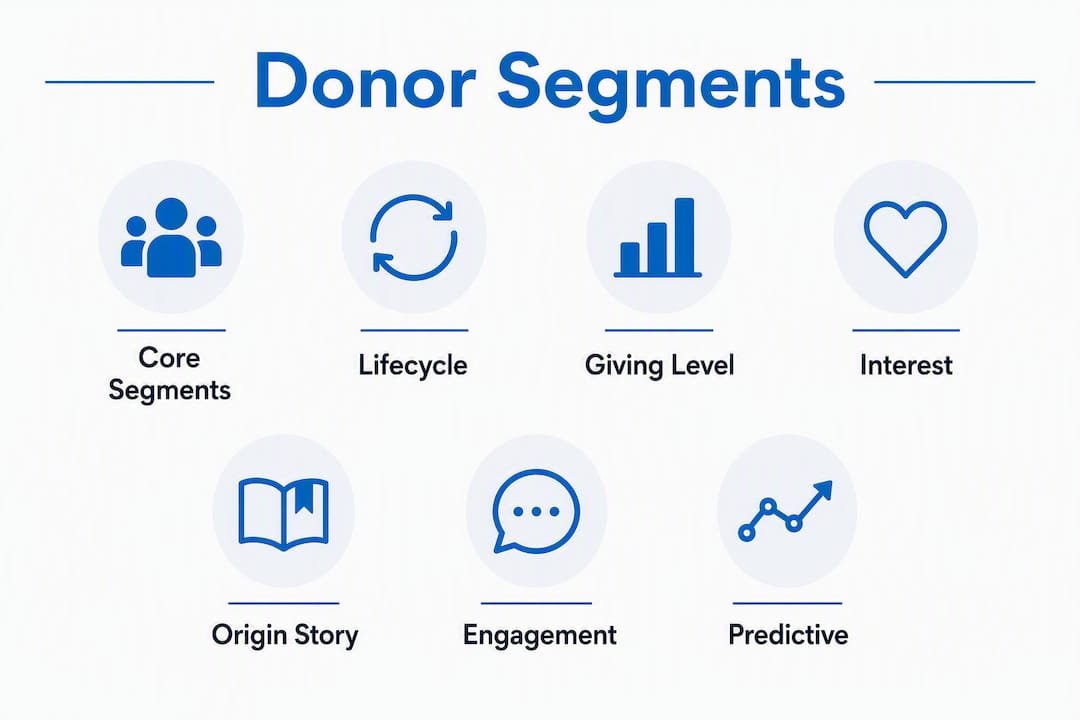
Five segmentation methods map directly to common fundraising uses: demographic, psychographic, giving history, engagement, and predictive analytics. In practice, giving history and engagement are where most nonprofits should start, because the data already exists in your CRM and the communication logic is clear.
Lifecycle segments
These are the foundation of any segmentation program. They track where a donor is in their relationship with your organization.
| Segment | Definition | Sample CRM Query |
|---|---|---|
| First-time donor | Gave exactly once, within about the past year | Gift Count = 1 AND Last Gift Date >= 12 months ago |
| Active recurring | Has an active recurring gift | Recurring Gift Status = Active |
| Active one-time | 2+ gifts, last gift within about a year, no recurring | Gift Count >= 2 AND Last Gift Date >= 12 months ago AND Recurring = No |
| Lapsed | Last gift 13–36 months ago | Last Gift Date between about one to three years ago |
| Deeply lapsed | No gift in more than three years ago | Last Gift Date > 36 months ago |
| Major-donor prospect | Lifetime giving above threshold | Lifetime Giving >= $[threshold] |
Giving-level segments
Thresholds vary by organization size. A community foundation might define “major donor” at $25,000; a grassroots nonprofit might set it at $1,000. The table below shows how to calibrate thresholds by organizational scale.
| Giving Level | Small Org (under $1M budget) | Mid-Size Org ($1M–$5M) | Large Org ($5M+) |
|---|---|---|---|
| Entry/small | Under $100 | — | — |
| Major prospect | $1,000+ | — | $5,000+ |
| Leadership/planned | $5,000+ | — | $25,000+ |
Interest and affinity segments
These group donors by the program area or cause they have supported. A donor who gave exclusively to your environmental education fund should not receive an appeal for your workforce development program without a clear bridge message. Tag records at the point of acquisition and update them when a donor gives to a new fund.
Origin-story segments
Grouping donors by their acquisition channel, whether that is a gala, a Facebook fundraiser, a peer-to-peer campaign, or an email click, is one of the highest-impact and most underused segmentation dimensions. A donor who came in through a peer-to-peer challenge has a fundamentally different relationship with your organization than one who responded to a direct mail appeal. Their follow-up messaging should reflect that difference.
Engagement segments
These use behavioral signals rather than giving data. Donors who open every email but have not given in six months are a distinct opportunity from donors who never open anything. Segment by email engagement tier (active opener, occasional opener, non-opener) and use that to adjust channel and frequency, not just message content.
Predictive segments
Predictive analytics and AI models can surface upgrade and major-donor prospects by scoring donors on likelihood to give again, likelihood to increase gift size, and lapse risk. These models work best when combined with human review from your major-gifts team. Explore AI marketing tools for nonprofits if your organization is ready to layer predictive scoring onto your existing segments.
Layering two criteria produces higher relevance without multiplying your segment count. For example: Active one-time donor AND Program Interest = Education gives you a focused upgrade ask tied to a specific cause, without creating a separate campaign for every possible combination.
How do you use each segment in campaigns and stewardship?
Segments are only useful when they map to a specific communication track. Here is how the core segments connect to campaign types:
First-time donors → Welcome/onboarding series. Send a three-part email sequence within the first 30 days: a thank-you with impact data, a story about the program they funded, and a soft invitation to learn more or sign up for updates. Do not ask for a second gift until day 45 at the earliest.
Active recurring donors → Stewardship and upgrade track. These donors are your most loyal segment. Communicate quarterly with impact reports, give them early access to events, and make an annual upgrade ask framed around what an additional $X per month would fund. Never send them a standard acquisition appeal.
Lapsed donors → Reactivation campaign. A two-step sequence works well: a “we miss you” message acknowledging the gap and referencing their last gift, followed by a specific, low-barrier ask (often at or below their previous gift amount). Personalize the subject line with their first name and the program they last supported.
Major-donor prospects → High-touch stewardship. Email is a supporting channel here, not the primary one. Use segmentation to flag these records for personal outreach by your major-gifts officer. Email communications should be personal in tone, reference their history with the organization, and avoid mass-appeal language.
Program/interest-based donors → Targeted appeals. Match the appeal to the fund they care about. If your annual fund appeal goes to everyone, create a version for education donors that leads with education impact data and a specific education-program ask.
Deeply lapsed donors → Reactivation or suppression decision. After 36 months of no engagement, test a single reactivation message. If there is no response, suppress from future appeals to protect deliverability and reduce cost.
Personalization that scales
Personalize the elements that move the needle: the donor’s name, their last gift amount, the program they funded, and the specific ask amount (set at 1.2–1.5x their previous gift). Standardize everything else. You do not need a unique email template for every segment; you need a modular template with three or four variable content blocks that swap based on segment tag.

For subject-line guidance and cadence planning tied to segmented audiences, the email marketing performance data from Americannexusmarketing covers what actually moves open rates for mission-driven organizations.
How do you implement RFM scoring, layering, and automation?
Start with a layered approach: RFM scoring as the analytical backbone, plus one behavioral or interest axis. That combination gives you personalization at scale without building dozens of one-off campaigns.
RFM scoring basics
RFM stands for Recency, Frequency, and Monetary value. Score each dimension on a 1–3 scale (3 = best), then sum the scores to rank donors.
| Dimension | Score 3 | Score 2 | Score 1 |
|---|---|---|---|
| Recency | Gift within about a year | Gift about one to two years ago | Gift more than two years ago |
| Frequency | Three or more gifts in roughly two years | Two gifts in roughly two years | One gift in roughly two years |
| Monetary | Top 20% of donors by lifetime giving | — | Bottom 20% |
A donor scoring 9 (3+3+3) is your highest-priority retention and upgrade target. A donor scoring 3 (1+1+1) is a lapse or suppression candidate. RFM remains one of the strongest predictors of future giving and is a practical first analytic step for any nonprofit CRM.
Automation triggers to configure
Static segments are a liability. A donor who makes their first recurring gift should move from “first-time donor” to “active recurring” automatically, not after your next manual data pull. Configure these triggers in your CRM:
- First gift received → Enroll in welcome email series; assign “First-Time Donor” tag
- Recurring gift created → Remove from one-time donor segment; assign “Active Recurring” tag; enroll in recurring stewardship track
- No gift for 13 months → Move from “Active” to “Lapsed”; trigger reactivation sequence
- Gift amount crosses major-donor threshold → Flag for major-gifts officer review; remove from mass appeal list
- Email engagement drops to zero for 6 months → Move to low-frequency track; test re-engagement subject line
Bloomerang and Blackbaud both offer native automation rules and dynamic segment queries that can handle most of these triggers without custom development. Bloomerang’s constituent timeline makes it straightforward to see when a donor crosses a lifecycle threshold, while Blackbaud Raiser’s Edge NXT supports more complex query logic for larger organizations with layered segment needs.
Pro Tip: Build your automation triggers before you build your email templates. If the trigger logic is wrong, the best-written email goes to the wrong person. Confirm each trigger fires correctly on a test record before going live.
For a detailed workflow on building drip sequences tied to CRM triggers, the automated email drip campaign guide from Americannexusmarketing walks through the full setup.
Tool selection criteria for nonprofits
When evaluating CRM and email platforms for segmentation, prioritize these capabilities over feature count:
- Dynamic segment queries that update in real time (not nightly batch jobs)
- Native automation triggers tied to gift and engagement events
- Integration with your payment processor (Stripe, PayPal, Classy, DonorBox)
- Merge fields for personalization at the template level
- Reporting by segment (not just by campaign)
How do you measure segment performance and improve over time?
The five KPIs that matter most for evaluating donor segments are retention rate, response rate, conversion rate, average gift size, and lifetime value (LTV) per segment. Track each at the segment level, not just the campaign level, so you can see whether a segment is trending toward health or toward churn.
| KPI | What it measures | Review cadence |
|---|---|---|
| Retention rate | % of donors who gave again in the next 12 months | Annually, by segment |
| Response rate | % of donors who responded to a specific appeal | Per campaign |
| Conversion rate | % of lapsed donors reactivated | Per reactivation campaign |
| Average gift | Mean gift amount within the segment | Quarterly |
| LTV per segment | Total revenue per segment over a defined period | Annually |
A/B testing within segments
Test one variable at a time within a segment. For first-time donors, test subject lines in the welcome series (personal tone vs. impact-focused). For lapsed donors, test ask amounts (previous gift amount vs. a lower entry point). Set a minimum sample size before drawing conclusions, and define your success threshold before you run the test, not after.
The testing matrix below covers the highest-yield variables for each core segment:
- First-time donors: Subject line tone, send timing (day 3 vs. day 7 post-gift), impact story format
- Recurring donors: Upgrade ask framing (monthly amount vs. annual equivalent), event invitation vs. impact report
- Lapsed donors: Ask amount (match vs. reduce), subject line (acknowledgment of gap vs. urgency), channel (email vs. direct mail)
- Major-donor prospects: Personalization depth (name only vs. name + program history), call-to-action (meeting request vs. report download)
When to retire or combine segments
A segment that consistently produces a response rate below your organization’s baseline for two consecutive campaigns is a signal to investigate. Either the segment definition is too broad, the messaging is misaligned, or the donors in that group have genuinely disengaged. Options: tighten the query criteria, test a different channel, or merge the segment into a broader lifecycle bucket and suppress the lowest-engagement records.
A 7-step checklist to build your first donor segments in one month
This checklist is designed for a team of one to three people. Complete it in four weeks and you will have a functioning segmentation program, not a perfect one, but a working one.
Week 1, Day 1–3: Audit your CRM fields. Confirm that Last Gift Date, Lifetime Giving, Gift Count, Recurring Status, and Email Address are populated for at least 80% of records. Flag gaps for cleanup.
Week 1, Day 4–5: Define your segment thresholds. Decide what “major donor,” “lapsed,” and “active” mean for your organization’s budget and donor base. Write these definitions down and share them with your team.
Week 2, Day 1–3: Build your five starter segment queries. Use the CRM query logic from the opening section of this article. Test each query against your live database and confirm the record counts look reasonable.
Week 2, Day 4–5: Create three to six email templates. Build a welcome series template, a stewardship/impact update template, and a reactivation template. Each should have variable content blocks for donor name, last gift amount, and program area.
Week 3, Day 1–3: Configure automation triggers. Set up the four core triggers: first gift, recurring gift created, 13-month lapse, and email non-engagement at six months. Test each trigger on a dummy record.
Week 3, Day 4–5: Schedule your first segmented campaign. Pick one segment (lapsed donors or first-time donors are the highest-ROI starting points) and schedule a campaign for the following week.
Week 4: Review results and document your governance rules. After the first campaign sends, pull response rate and open rate by segment. Document who owns each segment, how often thresholds are reviewed, and when automation triggers are audited.
Minimum viable segmentation for very small teams: If you have no dedicated data staff, start with two segments only: active donors (gave in the last 12 months) and lapsed donors (no gift in 13+ months). Send different versions of your next appeal to each group. That single split will produce measurably better results than a single send and give you the data to justify building more segments next quarter.
Why origin-story segmentation and layering outperform demographics alone
Demographics are a helpful starting point but rarely enough on their own. A donor’s age, location, or household income tells you relatively little about why they give or what message will move them. Their origin story, meaning how they first connected with your organization, and their behavioral history tell you far more.
Capturing a donor’s origin story at the point of acquisition is straightforward: record the campaign source, the event name, or the peer-to-peer fundraiser that drove the first gift. A donor who came in through a Facebook fundraising challenge has a social motivation and likely a peer connection to your cause. Their follow-up sequence should reference that context, acknowledge the community aspect of their giving, and invite them into a social or peer engagement opportunity before making a transactional ask.
Here is how origin-story segmentation changes the follow-up in practice:
- Gala attendee: First follow-up references the event experience, includes a photo or recap, and invites them to next year’s event before making an annual fund ask.
- Peer-to-peer participant: Follow-up acknowledges their fundraiser, thanks them for bringing new donors, and invites them to become a recurring supporter or team captain next cycle.
- Direct mail responder: Follow-up mirrors the appeal’s tone and program focus, confirms their gift’s impact, and sets up the next direct mail touchpoint.
- Online/organic donor: Follow-up is digital-first, includes a program impact video or link, and moves them into an email nurture sequence.
Layering RFM with an interest or origin axis reduces campaign overhead while increasing relevance. Instead of building a separate campaign for every combination, you build modular templates with swappable content blocks, then let your CRM’s merge fields and segment tags do the personalization work.
Pro Tip: Capture origin data in a dedicated CRM field at the point of acquisition, not as a free-text note. A structured field (dropdown or tag) is queryable; a note is not. If you are migrating historical records, use campaign source codes from your payment processor to backfill the field.
To automate donor movement between layered segments, configure a trigger that fires when a donor’s RFM score changes by more than one point. That keeps your segments current without requiring a monthly manual audit.
Key Takeaways
Effective donor segmentation requires clean CRM data, dynamic automation, and a focused set of three to six segments that map directly to your communication tracks and fundraising goals.
| Point | Details |
|---|---|
| Start with five core segments | Build recent donors, monthly givers, lapsed, major-donor prospects, and program-interest groups first. |
| RFM is your analytic foundation | Score donors on recency, frequency, and monetary value to rank retention and upgrade priorities. |
| Automate segment movement | Configure CRM triggers so donors move between lifecycle buckets automatically, not on a manual schedule. |
| Measure five KPIs per segment | Track retention rate, response rate, conversion rate, average gift, and LTV at the segment level quarterly. |
| Americannexusmarketing accelerates setup | The agency configures HubSpot segmentation, automation triggers, and campaign flows for nonprofits ready to move fast. |
What most agencies get wrong about donor segmentation
The conventional wisdom says to segment more, and to segment earlier. Build more groups, get more specific, personalize every touchpoint. In practice, that advice produces the opposite of what it promises.
Over-segmentation is one of the most common failure modes in nonprofit fundraising. Teams that build 20 or 30 micro-segments quickly discover they cannot produce 20 or 30 distinct communication tracks. The segments sit idle, the data goes stale, and the automation triggers fire into empty workflows. The result is worse than no segmentation at all, because the team has invested significant time in a system they cannot maintain.
The more useful frame is operational sustainability. How many distinct communication tracks can your team actually write, test, and optimize on a quarterly basis? For most nonprofits, that number is three to six. Build to that capacity first, prove the model works, and expand only when you have the staff bandwidth and the data quality to support additional segments.
There is also a subtler problem with demographic-first segmentation. Age and geography are easy to query, so teams default to them. But a 45-year-old donor in Chicago who came in through a peer-to-peer campaign has more in common with a 28-year-old in Atlanta who came in the same way than with a 45-year-old who responded to a direct mail appeal. Origin story and behavioral history are harder to capture but far more predictive of what message will resonate.
The teams that get segmentation right are not the ones with the most sophisticated CRM configuration. They are the ones who defined their thresholds clearly, automated the movement between segments, and reviewed performance quarterly without letting the system go stale.
Americannexusmarketing builds the segmentation infrastructure nonprofits need
Nonprofits that want to move from batch-and-blast to genuinely targeted fundraising often face the same bottleneck: the strategy is clear, but the CRM configuration, automation logic, and campaign architecture take weeks to build correctly. Americannexusmarketing closes that gap directly.
Working exclusively with mission-driven organizations, Americannexusmarketing configures HubSpot as a nonprofit CRM, builds dynamic segment queries tied to your giving thresholds and program areas, and sets up the automation triggers that move donors between lifecycle buckets without manual intervention. The agency then maps those segments to campaign flows and email sequences built for stewardship, reactivation, and upgrade, so your team inherits a working system rather than a blank template.
Services aligned to donor segmentation work include:
- HubSpot CRM setup with nonprofit-specific fields, segment queries, and automation workflows
- Segmentation strategy and threshold definition based on your donor base and budget
- Campaign execution: welcome series, reactivation sequences, and major-donor stewardship tracks
If your organization is ready to build a segmentation program that your team can actually maintain, contact Americannexusmarketing to discuss your CRM setup and campaign architecture.
Further reading and useful tools
The sources and resources below support the strategies covered in this article. Each is annotated for how it applies to your segmentation work.
| Resource | What it covers | Why it helps |
|---|---|---|
| Blackbaud: Donor Segmentation | Foundational definition and segmentation rationale for nonprofits | Good starting reference for teams new to the practice |
| DonorPerfect: Donor Segmentation Checklist | RFM scoring, checklist format, and layering guidance | Practical checklist to run alongside the implementation steps in this article |
| Anedot: Donor Segmentation Strategy | Automation triggers and lifecycle movement | Covers the technical side of dynamic segments and CRM trigger configuration |
| FundraisingCoach: 5 Ways to Segment Donors | Five segmentation methods with campaign use cases | Useful for mapping segment types to specific fundraising goals |
| GoodUnited: Segment Donors for Nonprofits | Origin-story segmentation and acquisition-channel grouping | The best available guide to capturing and using origin data |
| AFP: Fundraising Effectiveness Project | Sector-wide donor retention benchmarks | Use to set realistic retention rate targets by organization size |
| Nonprofit Quarterly: Donor Retention | Retention economics and the cost of donor churn | Supports the resource-allocation argument for investing in segmentation |
| Americannexusmarketing: Email Campaign Process Flow | Step-by-step campaign flow tied to segmented audiences | Internal resource for building the email sequences that run on top of your segments |
A note on data privacy and ethical segmentation: Segment only on data your donors have knowingly provided or that is a direct record of their giving behavior. Do not purchase demographic overlays without reviewing your organization’s privacy policy and applicable state laws. The CAN-SPAM Act governs commercial email in the United States; the AFP Code of Ethical Standards provides additional guidance on donor data stewardship. When in doubt, err toward transparency: tell donors how you use their information and give them clear preference controls.
This article provides general informational guidance on donor segmentation practices. It is not legal or compliance advice. Confirm your data practices with a qualified legal professional and review applicable federal and state regulations for your organization.
FAQ
What are the four main types of donor segmentation?
The four most common types are demographic (age, location, household income), psychographic (values, motivations, interests), giving history (recency, frequency, gift size), and engagement-based (email activity, event attendance, volunteer behavior). Most nonprofits get the best results by combining giving history with engagement or interest data rather than relying on demographics alone.
What are the five stages of donor development?
Donor development typically moves through five stages: acquisition (first gift), cultivation (building the relationship), solicitation (making the ask), stewardship (acknowledging and reporting impact), and upgrade or planned giving (deepening the commitment). Segmentation supports each stage by ensuring the communication matches where the donor is in that progression.
What are the three broad categories of donors?
Donors are generally grouped into three categories: new or first-time donors, active or recurring donors, and lapsed donors. Major donors and planned-giving prospects are often treated as a fourth category requiring dedicated, high-touch stewardship separate from mass communications.
What are the four pillars of donor relations?
The four pillars of donor relations are acknowledgment (timely, personal thank-yous), recognition (honoring donors publicly or privately according to their preference), communication (regular, relevant updates on impact), and stewardship (demonstrating that the gift was used as intended). Segmentation makes all four pillars more effective by ensuring each pillar is delivered in a way that matches the donor’s history and preferences.
How does Americannexusmarketing help nonprofits with donor segmentation?
Americannexusmarketing configures HubSpot as a nonprofit CRM, builds dynamic segment queries and automation triggers, and maps those segments to campaign flows for stewardship, reactivation, and upgrade. The agency works exclusively with mission-driven organizations and delivers a working segmentation system rather than a generic template.