
How to Build a Drip Campaign Workflow That Converts
Why an Automated Email Drip Campaign Is the Smartest Marketing Move You Can Make
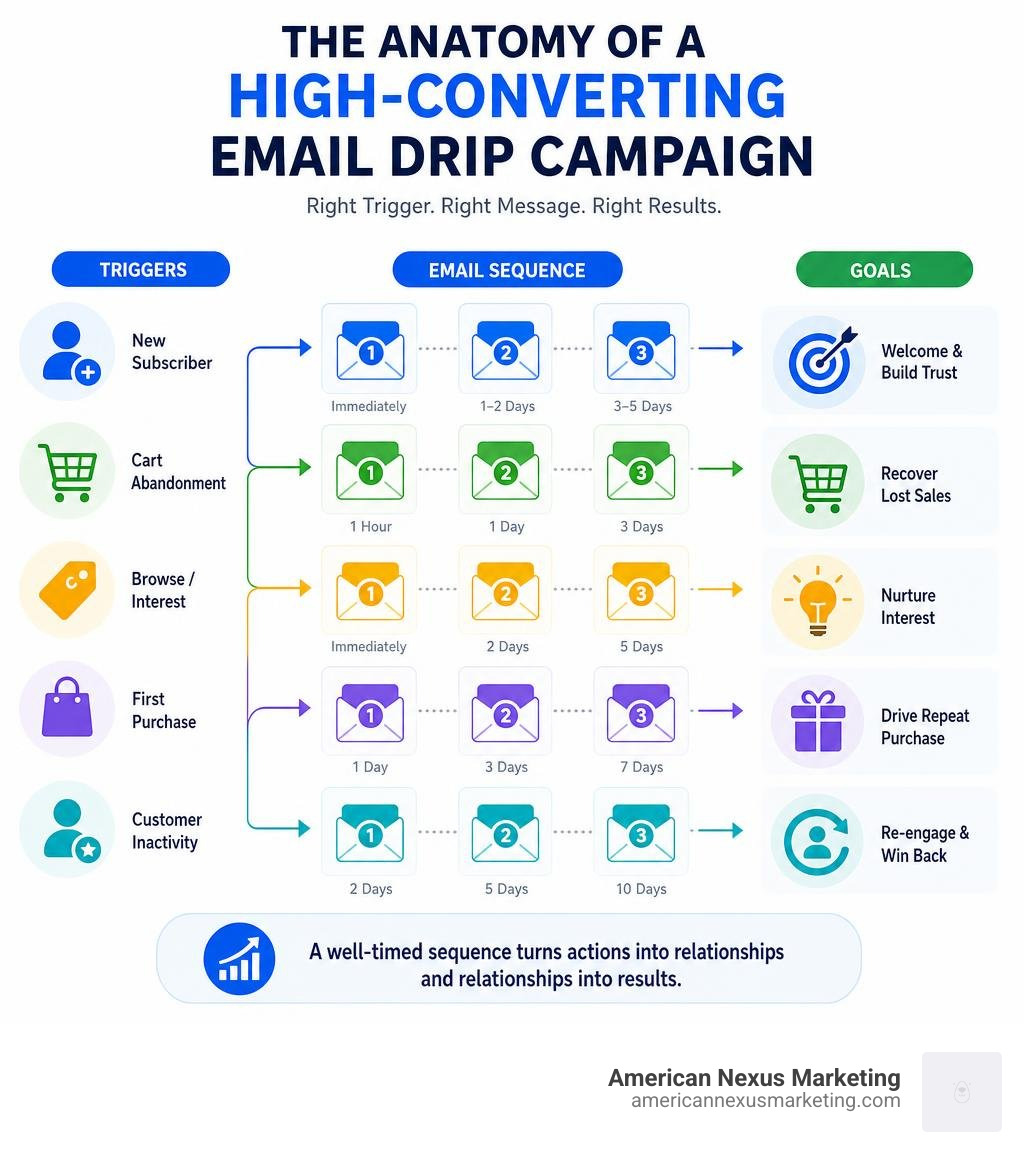
An automated email drip campaign is a series of pre-written emails sent to subscribers automatically, triggered by a specific action — like signing up for a newsletter, abandoning a cart, or making a purchase.
Here’s the short answer if that’s all you need:
- What it is: A sequence of emails sent on autopilot based on what a subscriber does
- How it works: A trigger (e.g., a sign-up or purchase) fires the first email, then the rest follow on a preset schedule
- Why it works: Emails arrive at the right moment, with the right context — so they feel personal, not spammy
- Who it’s for: Any business that wants to nurture leads, onboard customers, or recover lost sales without doing it manually every time
The numbers back this up. Automated emails generate $2.87 in revenue per send, compared to just $0.18 for a manual campaign. That’s a 16x difference — from the same subscriber list.
And yet most small business owners are still sending one-off blasts and wondering why nothing sticks.
The problem isn’t your product or your list. It’s the approach. A single email rarely converts. But a well-timed sequence that builds trust, delivers value, and creates urgency? That consistently outperforms a one-shot campaign by 3 to 5 times.
This guide will show you exactly how to build one — without a complicated tech stack or a marketing team.
What is an Automated Email Drip Campaign?
To understand an automated email drip campaign, think of it as a slow, steady release of highly relevant information. Just like drip irrigation in agriculture delivers water directly to the roots of a plant exactly when needed, drip marketing delivers the right message to your subscriber’s inbox at the precise moment they are most likely to engage.
At its core, a drip campaign is a set of automated marketing emails sent to people who take specific actions on your website. Rather than blasting your entire list with the same generic message, you set up a workflow once. When a user meets your criteria, the system “drips” pre-written emails to them over a preset schedule.
This entire process relies heavily on behavioral triggers. A trigger is an action taken by the user—such as downloading an ebook, signing up for a trial, abandoning a shopping cart, or completing a purchase—that automatically kicks off the campaign. Because these emails are tied directly to user actions, they are incredibly personalized, timely, and contextual.
Furthermore, as privacy regulations tighten and third-party tracking cookies become obsolete, drip campaigns have emerged as an excellent tool for gathering high-value first-party data directly from users. By watching which emails in a sequence your subscribers open and which links they click, you build a rich, privacy-compliant profile of their interests and preferences.
How Drip Campaigns Differ from Traditional Email Newsletters
Traditional email newsletters are manual broadcasts. They are typically sent to your entire list at a specific time of your choosing—for example, every Tuesday morning. While newsletters are great for sharing time-sensitive announcements, company news, or holiday sales, they lack behavioral context. A new subscriber who signed up ten seconds ago receives the exact same newsletter as a loyal customer who has been with you for five years.
Drip campaigns, on the other hand, are:
- Automated and Sequential: Once you build the workflow, it runs 24/7. Subscribers receive a logical progression of emails (Email 1, then Email 2 three days later, then Email 3) based on their unique sign-up date.
- Trigger-Based: They only start when a user takes a specific action, ensuring immediate relevance.
- Highly Segmented: Instead of emailing everyone, drip campaigns target specific subgroups of your audience based on their behaviors and demographics.
- Strictly Opt-In: Because these campaigns target active, opted-in subscribers who have recently interacted with your brand, they naturally maintain lower unsubscribe rates and higher overall engagement.
The Psychology Behind the Automated Email Drip Campaign
Why are these sequences so effective? It comes down to human psychology.
A study of 2,000 people found that half of us are engaged in “a never-ending search for products, services, and content to support behavior changing.” Whether someone is trying to organize their business, learn a new skill, or improve their fitness, they are actively looking for guides and tools to help them transition.
An automated email drip campaign acts as that supportive guide. By breaking down complex information into bite-sized, sequential steps, you help subscribers manage their cognitive load. Instead of overwhelming them with a 50-page manual on day one, you send them one helpful tip today, another actionable strategy in two days, and a case study next week.
This steady cadence builds context, trust, and momentum. By the time you introduce a call-to-action to purchase your product or service, the subscriber doesn’t feel like they are being aggressively sold to. Instead, they view your offer as the natural next step in their behavior-changing journey.
Key Benefits of Nurturing Leads on Autopilot
As a solo founder or small business owner, your time is your most valuable asset. You cannot manually email every single lead who downloads a PDF or visits your pricing page. Implementing an automated drip campaign allows you to scale your communication without losing the human touch.
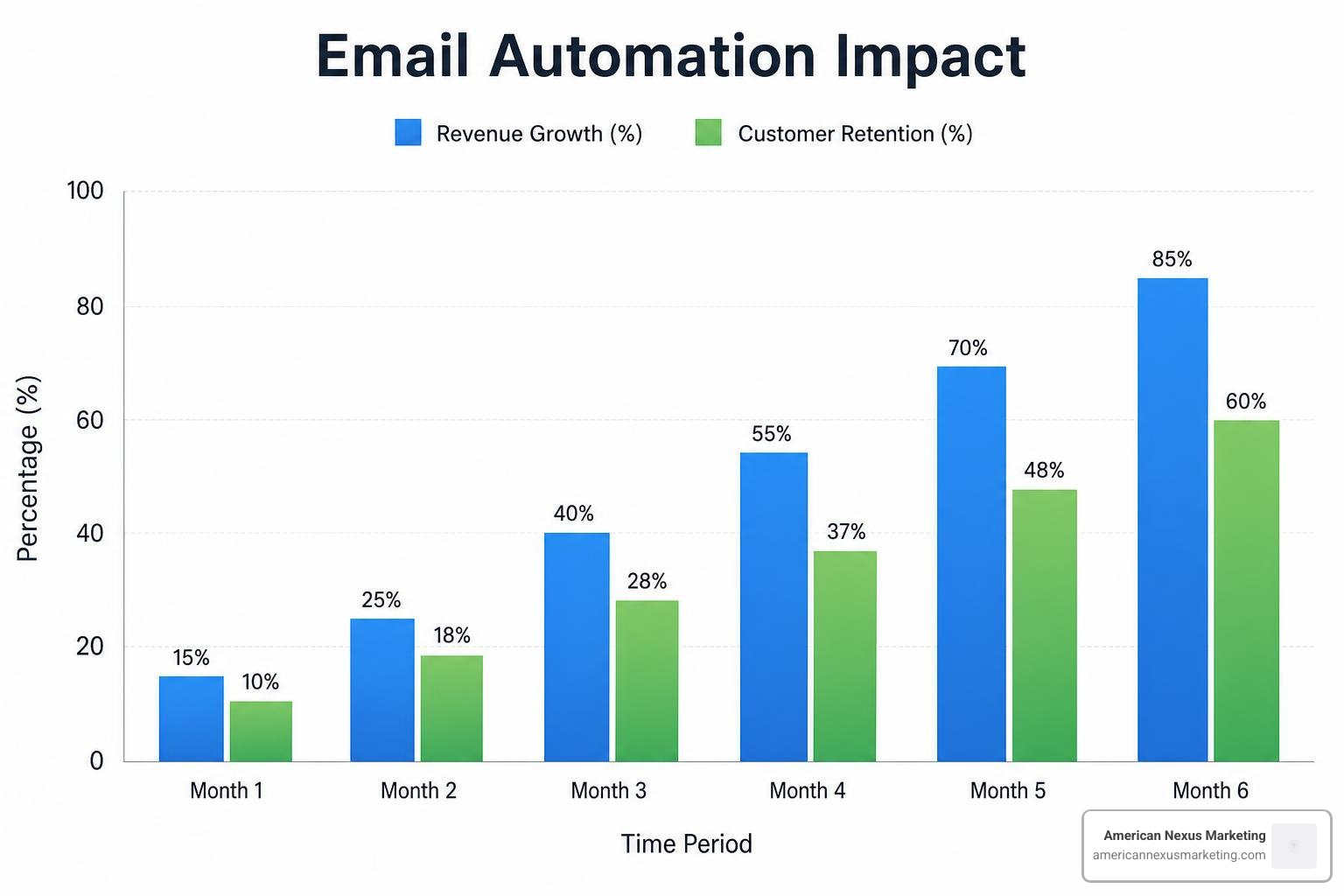
The benefits of this hands-off approach are massive:
- Dramatically Higher Engagement: Drip emails can generate a 119% increase in click rate compared to standard, one-off broadcast emails.
- Efficient Lead Nurturing: You can gently guide cold prospects down your sales funnel by educating them on their pain points and your solutions, all while you sleep.
- Improved Customer Retention: Onboarding drips ensure that new customers actually use your product, reducing buyers’ remorse and churn.
- Reduced Manual Effort: You write the copy and set up the logic once, and the workflow runs indefinitely, freeing you up to focus on high-level strategy.
For solo creators, authors, and small teams who want to avoid the “feature bloat” and hefty price tags of enterprise marketing suites, tools like Drippery’s minimalist drip campaign tool make it incredibly easy to get started. It focuses strictly on drip series, allowing you to turn your best writing into an automated sequence without paying for complex landing page builders or advanced enterprise databases you will never use.
Maximizing Revenue with an Automated Email Drip Campaign
If you want to boost your bottom line, automation is the single most effective lever you can pull. According to industry data, a tiny fraction of email sends—just 2%—drive an astonishing 37% of total email revenue. What makes up that 2%? You guessed it: automated, trigger-based emails.
Because these messages are highly targeted, they boast incredible conversion rates. While a standard manual broadcast might yield a few cents per recipient, automated emails generate an average of $2.87 in revenue per send.
By mapping your drip sequences to the natural progression of your sales cycle, you strike when the iron is hot. When a prospect is actively researching a solution, your automated email lands in their inbox with the exact answer they need, driving up open rates, click-through rates, and ultimately, sales.
Step-by-Step Guide to Setting Up Your First Sequence
Building your first campaign doesn’t have to be intimidating. By breaking the process down into actionable steps, you can have a high-converting workflow live in an afternoon.
Here is our tried-and-true framework for launching a successful sequence:
- Set Clear Campaign Objectives: Before writing a single word, define what success looks like. Is your goal to get a trial user to upgrade to a paid account? To drive registration sales for an upcoming event? Or to nurture a cold lead into booking a consultation call?
- Define and Segment Your Target Audience: Use your CRM data to identify exactly who should receive this campaign. Be highly specific. Instead of targeting “all business owners,” target “engineering managers at startups who are still using basic spreadsheets to track projects.”
- Map Out the Customer Journey: Visualize the steps your subscriber needs to take to reach your goal. What barriers or objections will they face along the way?
- Draft the Sequence Together: Write all the emails in your sequence at the same time. This ensures a consistent narrative flow and prevents you from repeating yourself.
- Set Up the Tech and Triggers: Input your emails into your chosen email automation platform, configure your delays, and set your active triggers.
- Maintain List Hygiene: Regularly monitor your bounce and unsubscribe rates. A clean list ensures your emails land in the primary inbox, not the spam folder.
If you struggle with writer’s block or don’t know how to structure your copy, you can jumpstart the writing process using SwiftCopy’s free AI email sequence generator. It allows you to generate complete 3-to-7 email sequences for onboarding, sales, or re-engagement in a single click, ensuring your campaigns are structured around proven copywriting frameworks.
Choosing Triggers and Segmenting Your Audience
The magic of a drip campaign lies in its relevance, which is controlled by your triggers and segmentation.
Triggers generally fall into two categories:
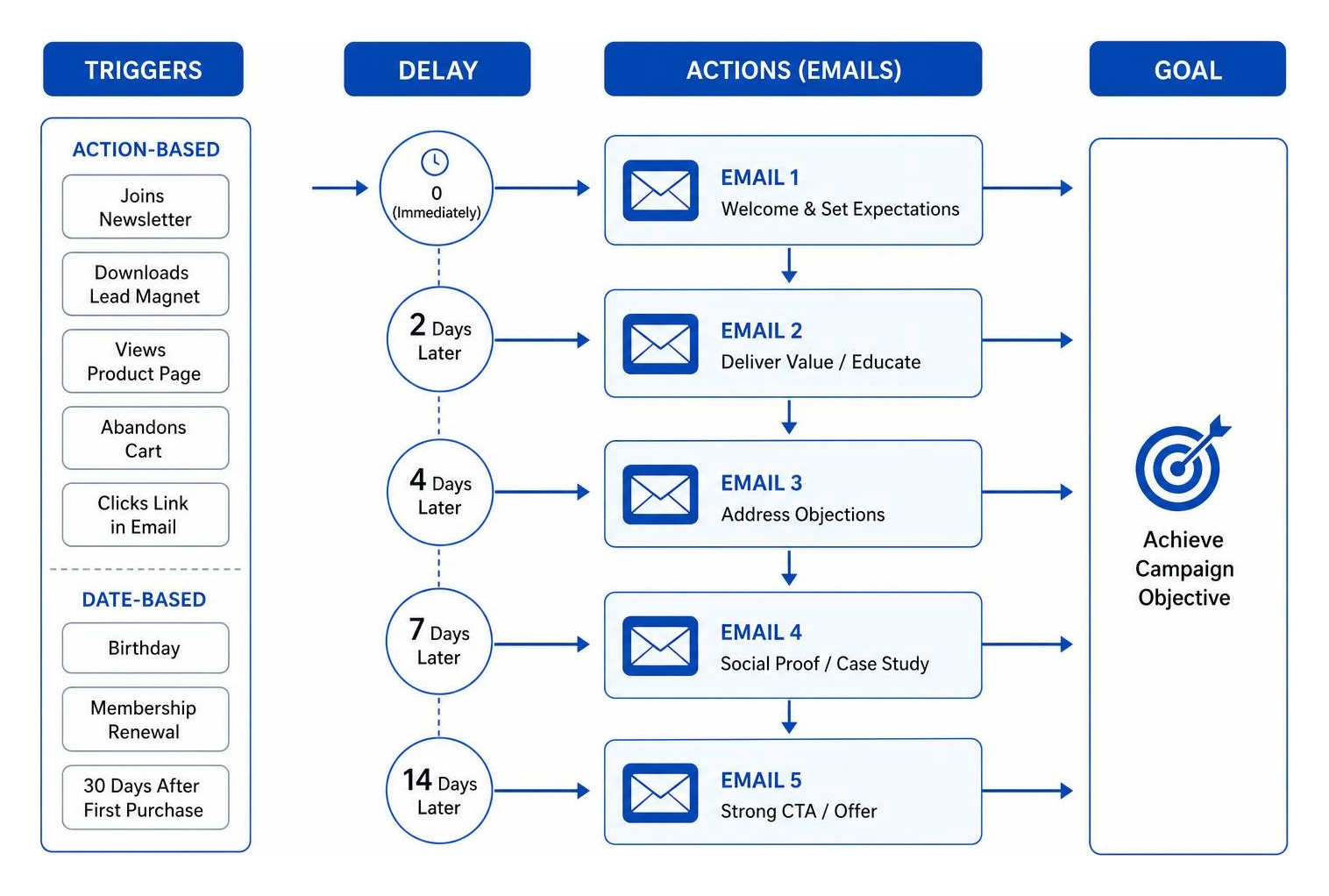
- Action-Based Triggers: Fired when a user does something specific. Examples include clicking a link in a previous email, downloading a lead magnet, viewing a specific product page, or abandoning a shopping cart.
- Date-Based Triggers: Fired based on a calendar event or timeline. Examples include a subscriber’s birthday, a membership renewal date, or 30 days after their first purchase.
Once you have your trigger, apply segmentation to refine who actually gets the emails. For example, if your trigger is “abandoned cart,” you can segment your audience so that high-value carts (over $100) receive a special discount code, while lower-value carts receive a simple, helpful reminder.
Writing and Structuring Your Email Sequence
When writing your emails, remember this golden rule: every single email must be designed to stand completely on its own. Subscribers will miss, skip, or skim earlier emails in your sequence. If Email 3 relies entirely on the reader remembering a specific detail from Email 1, the chain breaks. Always provide immediate context and value in every send.
Additionally, each email should do exactly one job. Do not try to introduce your team, explain your pricing, share a blog post, and ask for a phone call all in one 200-word email. If your goal for Email 2 is to get the subscriber to watch a quick tutorial video, make that the only call-to-action (CTA) in the email. Multiple CTAs cause decision paralysis, which kills conversion rates.
To create a seamless, cohesive story across your sequence, use a narrative flow. You can even add a P.S. at the bottom of your emails to tease the topic of the next scheduled message, building anticipation and boosting future open rates.
For businesses looking to build highly customized, behavior-driven sequences—especially SaaS platforms or developers who need to send onboarding, trial, and transactional messages from one unified place—Sequenzy’s developer-friendly email platform provides a powerful, clean API architecture designed to handle complex user journeys with ease.
Best Practices for Timing, Frequency, and Content Flow
How often should you email your subscribers? Send too many, and they will hit the unsubscribe button in a fit of inbox rage. Send too few, and they will forget who you are entirely.
The key is to use a momentum-building pattern. Subscribers are warmest and most engaged immediately after the initial trigger (like signing up). Therefore, you should use a tighter cadence at the beginning of your campaign (sending every 1 to 3 days), and then transition to a wider, weekly cadence as time goes on.
Here is a quick reference table comparing common sequence types and their recommended send delays:
| Campaign Type | Total Emails | Timing and Cadence (Day Offsets) | Primary Focus |
|---|---|---|---|
| Welcome Series | 5 emails | Day 0, Day 2, Day 4, Day 6, Day 9 | Introduce brand, deliver lead magnet, set expectations |
| SaaS Onboarding | 5 emails | Day 0, Day 2, Day 5, Day 10, Day 14 | Drive to “aha moment”, overcome usage barriers |
| Sales Nurture | 5-7 emails | Day 0, Day 3, Day 7, Day 14, Day 21 | Build trust, share case studies, handle objections, make the ask |
| E-commerce Recovery | 4 emails | Day 0 (within 2 hrs), Day 1, Day 3, Day 7 | Recover abandoned cart, offer collection alternatives |
| Re-engagement | 3 emails | Day 0, Day 3, Day 7 (Breakup email) | Win back inactive users, clean list of unengaged contacts |
To avoid triggering spam filters, keep your copy clean. Limit promotional language (like “FREE,” “BUY NOW,” or “GUARANTEED”), avoid excessive exclamation points, and maintain a healthy text-to-image ratio.
Most importantly, never guess what works. Use A/B testing to experiment with different subject lines, send times, and email copy. Let your audience’s behavior tell you exactly how they want to be communicated with.
Frequently Asked Questions About Drip Marketing
What is the ideal length for an automated email drip campaign?
The ideal length depends entirely on your campaign goals and the complexity of your offer. A simple re-engagement campaign or a quick promotional sequence works best with 3 emails. Onboarding campaigns and standard lead-nurturing sequences typically require 5 emails to properly educate the user. For high-ticket B2B sales or complex product launches, a sequence of 7 or more emails spaced out over several weeks may be necessary to build sufficient trust and address all potential buying objections.
How do you prevent subscribers from feeling spammed?
To prevent inbox fatigue, rely on behavioral triggers rather than fixed schedules. If a subscriber makes a purchase on Day 2 of your sales sequence, set up automatic rules to immediately remove them from that nurture sequence so they don’t keep receiving promotional emails for a product they just bought.
Additionally, avoid being overly intrusive. For example, in abandoned cart sequences, instead of saying, “We saw you looking at this exact red shirt 10 minutes ago,” take a softer approach. Send a beautifully designed email showcasing your entire holiday collection or highlighting your brand’s quality standards. It achieves the same goal without making the subscriber feel like they are being watched.
How do you measure the success of a drip campaign?
Look beyond basic open rates. To measure the true impact of your campaign, track:
- Click-Through Rates (CTR): Are subscribers actually engaging with your content and taking action?
- Conversion Rates: What percentage of subscribers completed the ultimate goal of the sequence (e.g., booked a call, signed up for a trial, made a purchase)?
- Revenue Tracking: If your platform supports it, track the direct revenue generated per email send to see exactly which messages are driving your business growth.
- Unsubscribe and Bounce Rates: Keep a close eye on these to ensure your list hygiene remains healthy and your deliverability stays high.
Conclusion
Building an automated email drip campaign is like hiring a tireless, 24/7 sales representative who speaks directly to your customers’ needs at the exact moment they are listening. For small businesses and solo founders, it is the ultimate way to scale your marketing, nurture relationships, and generate consistent revenue without burning out.
You don’t need a massive budget or a team of developers to get started. By defining your audience, focusing on a single goal per email, and setting up smart, behavior-based triggers, you can build a workflow that converts readers into lifelong fans on autopilot.
Ready to take your digital marketing to the next level? Compare the best all-in-one marketing platforms for 2026 to find the perfect tools to power your automation strategy, simplify your workflows, and grow your business this year.
Pingback: Email Campaign Process Flow: Proven Guide