
Six Simple Ways to Improve Your Site’s SEO Ranking Today
Why Your Website Isn’t Getting Found (And How to Fix It)
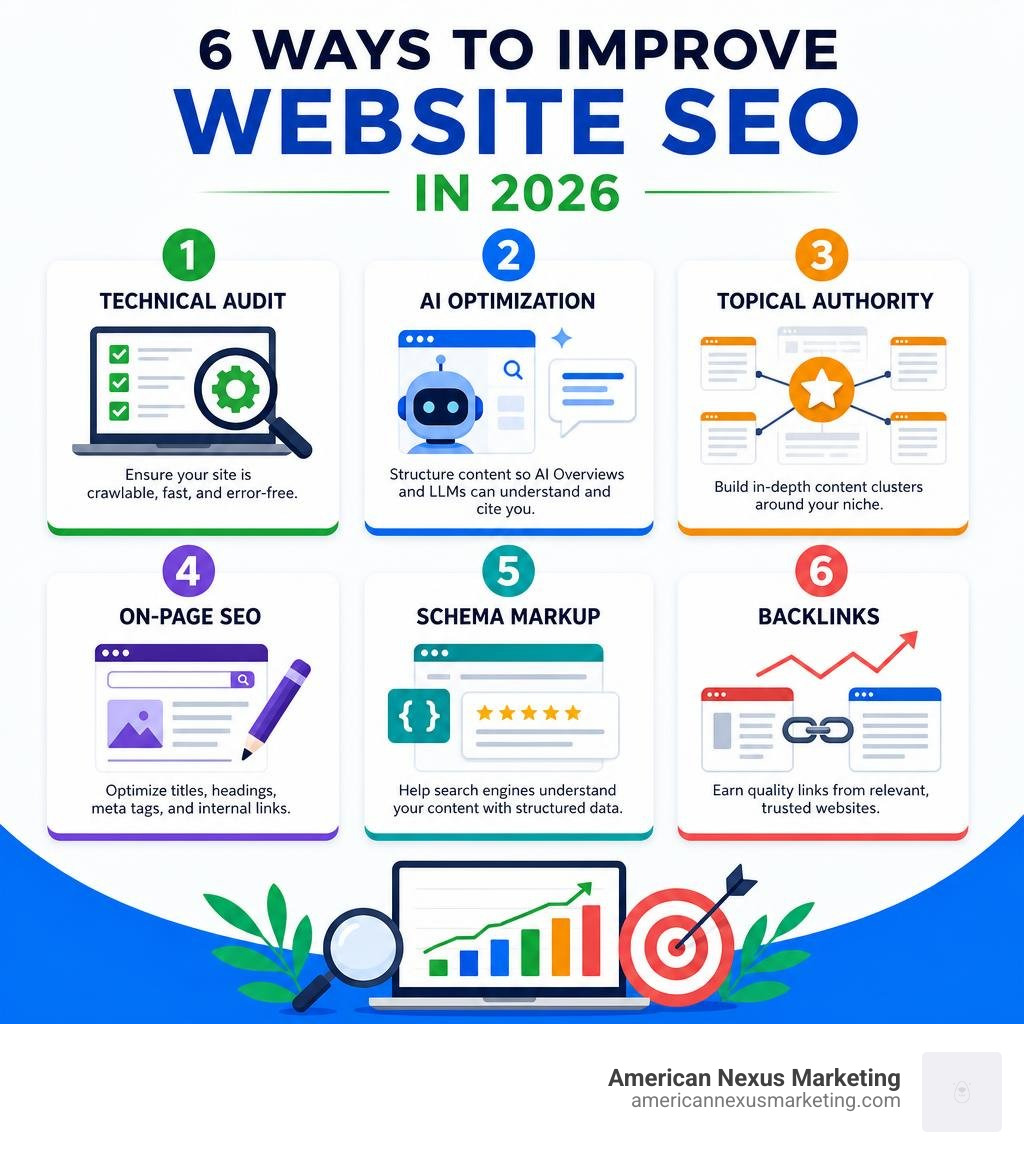
To improve the SEO of your website, focus on these six core actions:
- Fix technical foundations — make sure Google can crawl and index your pages
- Optimize for AI search — structure content so AI Overviews and LLMs can cite you
- Build topical authority — create focused content clusters around your niche
- Master on-page SEO — optimize titles, headings, meta tags, and internal links
- Add schema markup — help search engines understand your content with structured data
- Earn quality backlinks — get real sites to link to and mention your brand
Most small business websites have the same problem: good work, invisible online.
You might have a clean-looking site. You might even be posting content. But if Google can’t crawl your pages properly, or your content doesn’t answer questions clearly, you won’t rank — no matter how good your product or service is.
Here’s what makes 2026 different from even a few years ago: getting found now means showing up in two places. Traditional search results, and AI-generated answers. Tools like Google’s AI Overviews now appear in over 50% of all searches — up from just 6.49% in January 2025. And the visitors who arrive from AI search convert at 4.4 times the rate of regular organic traffic.
The good news? You don’t need a big budget or a technical background to make real progress. The six steps in this guide are practical, prioritized, and written for real business owners — not SEO agencies.
1. Audit Technical Foundations to Improve SEO of Website
If you build a beautiful house on quicksand, it will sink. The same goes for your website. You can write the most brilliant, helpful articles in your industry, but if search engines cannot access them, your efforts are wasted. A website with poor technical foundations will consistently be outranked by a technically sound website with average content.
Let’s look at how to audit your technical setup without needing a computer science degree. For a deeper look at real-world technical fixes, check out this practical 30-day technical SEO case study.
Crawlability and Indexation
Before worrying about keywords, we must make sure Google can actually “see” our pages. Google uses automated programs called crawlers (or spiders) to discover and index pages. Here is our quick-start checklist to ensure your crawlability is intact:
- Google Search Console (GSC) is non-negotiable: If you haven’t verified your site on GSC, do it today. We highly recommend using the DNS record verification method. It is the most durable method because it survives theme changes, plugin updates, and website redesigns.
- Inspect your URLs: Use GSC’s URL Inspection Tool to see exactly how Googlebot renders your pages. Ensure that Google sees the same content your human visitors see. Avoid JavaScript-only navigation without server-rendered HTML fallbacks, as Googlebot may fail to render hidden links.
- Submit your XML Sitemap: Your sitemap is a roadmap of your site’s most important pages. Submit your sitemap URL to GSC. Make sure it only contains “200 OK” status code URLs—remove redirecting pages, broken pages (404s), or pages you have hidden from search engines.
- Configure your Robots.txt correctly: Your robots.txt file tells search engines where they are allowed to go on your site. Remember: robots.txt controls crawling, not indexing. If another site links to a blocked page, Google may still index it. If you want to permanently hide a page, use a
noindexmeta tag instead. - Welcome the AI bots: In 2026, you want to make sure you aren’t blocking the engines that drive AI answers. Ensure your robots.txt explicitly allows crawlers like GPTBot, ClaudeBot, and PerplexityBot. We also recommend placing an
llms.txtfile at your domain root—this plain-text file helps large language models quickly read and understand your site’s permissions and core offerings.
How Core Web Vitals Help Improve SEO of Website
Google uses Core Web Vitals as direct ranking factors. These metrics measure the real-world user experience of your site: how fast it loads, how responsive it is, and how stable the layout is as it loads.
Improving these metrics is no longer just about traditional SEO rankings—it is now a major factor in whether AI engines choose to cite your content. Let’s look at the three core metrics:
- Largest Contentful Paint (LCP): This measures loading performance. To provide a good user experience, LCP should happen within 2.5 seconds of when the page first starts loading (aim for under 1.8 seconds if you can). Compress your images to WebP format and implement lazy loading to speed this up.
- Interaction to Next Paint (INP): This measures page responsiveness—how fast your site reacts when a user clicks a button or menu. Your INP should be under 200 milliseconds. You can optimize this by minimizing heavy third-party JavaScript files (like bloated chat widgets or tracking scripts).
- Cumulative Layout Shift (CLS): This measures visual stability. Have you ever gone to click a link on a mobile page, only for the page to suddenly shift, causing you to click an ad by mistake? That is bad CLS. Your CLS score should be under 0.1. You can fix this by adding explicit width and height attributes to your images and ad blocks.
Why does speed matter so much for modern search? Consider this statistic: Pages with a First Contentful Paint (FCP) under 0.4 seconds average 6.7 AI citations, while those over 1.13 seconds average only 2.1. That is a 3x gap in citation frequency!
Additionally, Google uses mobile-first indexing. This means Google ranks your site based on how the mobile version performs, not the desktop version. Ensure your mobile tap targets (buttons and links) are spaced at least 48px apart so users don’t accidentally click the wrong element, and make sure your text is easily readable on small screens without needing to zoom.
2. Optimize for Generative Engine Optimization (GEO) and AI Overviews
The search landscape is changing rapidly. To improve the SEO of your website in 2026, you must optimize for both traditional search engines and generative AI engines. This practice is known as Generative Engine Optimization (GEO).

Traditional SEO vs. GEO
Traditional SEO focuses on optimizing for specific keywords, securing high domain authority backlinks, and matching search intent to rank in the top 10 blue links. GEO, on the other hand, optimizes for how large language models (LLMs) synthesize, extract, and cite information.
Let’s look at the key strategic differences:
| Optimization Factor | Traditional SEO | Generative Engine Optimization (GEO) |
|---|---|---|
| Primary Goal | Rank in the organic top 10 blue links | Earn citations in AI Overviews & LLM answers |
| Key Metric | Organic Position & Click-Through Rate (CTR) | Citation Frequency & AI Referral Traffic |
| Authority Focus | Raw Domain Authority (DA / DR) | Verifiable E-E-A-T & Brand Search Volume |
| Content Structure | Keyword-optimized headings | Direct answers, structured data, high factual density |
The opportunity for smaller websites here is massive. By early 2026, only 17–38% of AI Overview citations come from pages that also rank in the organic top 10 for that query (down from 75% just eight months earlier).
Even more encouraging: 47% of AI Overview citations come from pages outside the organic top 5, and domain authority now has near-zero correlation with citation probability (r=0.18). This means a highly focused, helpful article on a small website can easily beat a massive, high-authority competitor in AI answers.
Google uses a “fan-out” query process where it breaks a user’s search into multiple sub-queries, retrieves content for each, and synthesizes the final answer. To earn these citations, your brand needs recognition. Brand search volume—people searching for your business name directly—is the strongest single predictor of AI citation frequency (with a correlation of 0.334).

Structuring Content for AI Extraction
AI engines select content based on semantic completeness (r=0.87) and verifiable E-E-A-T signals (r=0.81). In fact, 96% of AI Overview content comes from sources with verifiable E-E-A-T signals (such as named author bios, real credentials, and authoritative external references).
To make your content easily extractable by AI engines, use these formatting best practices:
- Use Direct-Answer Openings: Start your main sections with a clear, direct answer to the user’s query (about 40-60 words) immediately following your heading.
- Increase Factual Density: AI-cited articles cover 62% more facts than non-cited ones. Avoid fluff, unnecessary introductions, and repetitive sentences.
- Write In-Depth Guides: Content length still matters for depth. Articles over 2,900 words average 5.1 AI citations versus 3.2 for pieces under 800 words.
- Use natural, conversational language: Over 70% of voice queries are phrased in natural language. Write the way your customers actually speak.
Measuring AI Search Impact in GA4
You cannot improve what you do not measure. AI referral traffic is up 527% year-over-year, and these visitors convert at 4.4 times the rate of traditional organic search traffic because they arrive with incredibly high purchase intent.
To track this traffic in Google Analytics 4 (GA4), you should configure a custom channel group. Set up a filter to isolate referrals coming from known AI engines:
perplexity.aiopenai.com(ChatGPT)claude.aibing.com(specifically tracking copilot/AI interactions)
By separating this traffic, you can see exactly how your GEO efforts are driving leads, sign-ups, and sales.
3. Build Topical Authority with Structured Content Clusters
If you want to rank for competitive terms, you can no longer write isolated, random blog posts. Search engines want to see that you are an authority in your niche. You build this by creating structured topic clusters. To understand how these clusters form the backbone of modern search engine success, you can read this Complete SEO Guide 2026.
Topic Clusters and Semantic Completeness
A topic cluster consists of three main elements:
- A Pillar Page: A broad, comprehensive page covering an entire topic in depth (e.g., “The Ultimate Guide to Commercial HVAC Systems”).
- Spoke Pages (Subtopics): Highly focused articles that dive deep into specific sub-queries related to the pillar (e.g., “How Often Should You Service a Commercial AC Unit?”, “Signs of a Failing Commercial Compressor”).
- Internal Linking: Tightly interlinked pathways connecting the pillar page to every spoke page, and the spoke pages back to the pillar.
This structure helps search engines understand the semantic relationship between your pages. When Google sees that you have written 15 deeply researched, interlinked articles covering every angle of a specific niche, it recognizes your site as a topical authority.
This approach works incredibly well for smaller websites. A B2B client with a low domain rating (in the low 30s) can easily outrank a high-authority competitor simply by building a deep, tightly interlinked 12-page topic cluster over a few months.
Be careful to avoid content cannibalization—this happens when you have multiple closely related articles targeting the exact same search intent. When this happens, you split your authority signals, causing Google to rank neither page well. Audit your content regularly, differentiate the angles of your articles, and merge overlapping guides into a single, comprehensive piece while applying a 301 redirect.
4. Master On-Page SEO and Semantic Keyword Mapping
On-page SEO is the process of optimizing individual elements on your web pages so search engines can easily understand what the page is about and match it to relevant user queries. While it might not be the flashiest marketing tactic, it is the fundamental work that separates websites that rank from those that disappear. For a highly detailed, step-by-step optimization framework, refer to this On-Site SEO Guide 2026.
On-Page Optimization and Internal Linking
Here is your checklist for on-page optimization:
- Title Tags: This remains the single most important on-page SEO element. Keep your title tags under 60 characters (or 600 pixels) and place your primary keyword at the very beginning. To boost your click-through rate (CTR), add a compelling modifier or the current year (e.g., “How to Improve SEO of Website in 2026”). Adding a specific number and year to a title tag can increase CTR by up to 148%!
- Meta Descriptions: Keep these under 155 characters. Write them in an active, engaging voice, include your primary keyword, and end with a clear call-to-action (CTA) like “Read our step-by-step checklist.”
- Heading Structure: Use exactly one H1 tag per page (usually your main article title). Use H2 tags for your main sections, and H3 tags for subsections. This establishes a clean visual and technical hierarchy for both human readers and search engine crawlers.
- Content Formatting: Place your primary keyword within the first 100 words of your article. Use short paragraphs (2-3 sentences max) to make your content highly scannable on mobile devices. For long-form guides exceeding 2,000 words, always include a clickable, sticky Table of Contents—this simple addition has been shown to increase user dwell time by up to 23%.
- Internal Linking: Aim for 3 to 7 internal links per 1,000 words of content. Use descriptive, natural anchor text that tells the reader (and search engines) what the destination page is about. Avoid generic anchor text like “click here” or “read more.” Ensure you have zero “orphaned pages”—every page on your site should have at least one internal link pointing to it.
- Image Optimization: Compress all images to under 100KB using modern formats like WebP. Give your image files descriptive names (e.g.,
improve-seo-of-website-checklist.webp) instead of generic names likeIMG_4829.png. Always write unique, descriptive alt text for every image to assist visually impaired readers and help search engines index your visual media. Captions placed directly below key images are read 300% more often than standard body copy, so use them to summarize key takeaways!
5. Implement Advanced Schema Markup
Schema markup (also known as structured data) is a standardized code that you add to your website to help search engines understand your content. It doesn’t change how your page looks to human visitors, but it makes your content highly machine-readable. For a comprehensive list of technical steps, check out this SEO Checklist 2026.
Using Schema Markup to Improve SEO of Website
By implementing schema markup, you make your site eligible for rich results—such as star ratings, recipe cards, and FAQ dropdowns directly in search engine results pages (SERPs). Rich results get significantly more clicks than plain blue links.
For the best results, use the JSON-LD format for your schema. We highly recommend combining your schema types into a single @graph array on your pages. This prevents technical conflicts and ensures search engines can easily parse your structured data.
Here are the four key schema types every small business website should implement:
- Article Schema: Use this on all blog posts and news articles. It helps search engines identify the headline, author, publishing date, and featured images.
- FAQ Schema: If your page contains a Q&A section, apply FAQ schema. This makes your page eligible to appear with collapsible FAQ dropdowns in search results and directly feeds your questions and answers into AI Overview engines.
- Organization Schema: Implement this on your homepage to tell search engines your official business name, logo, social media profiles, and contact details.
- BreadcrumbList Schema: This helps search engines understand your site’s navigation structure and displays clean, easy-to-read breadcrumb links in search results instead of long, complicated URLs.
Once you have added schema markup to your page, always validate it using Google’s official Rich Results Test to ensure there are no formatting errors or missing fields.
6. Earn High-Quality Backlinks and Brand Mentions Naturally
Backlinks are links from other websites pointing to your site. Search engines treat these links as votes of confidence. If reputable, high-quality websites link to your content, search engines will view your site as trustworthy and relevant. For a foundational look at how Google views links and authority, see Google’s SEO Starter Guide.
Modern Link Building and Brand Authority
In 2026, you must avoid outdated, spammy link-building tactics like buying cheap links, participating in link networks, or posting low-quality guest blogs on irrelevant sites. These tactics can trigger search engine penalties and actively hurt your rankings.
Instead, focus on earning high-quality backlinks naturally:
- Create Linkable Assets (Original Data): This is the single highest-ROI link-building tactic available. Conduct a small survey in your industry, compile original data, or create an in-depth case study. Other writers and journalists will naturally link back to your site as the source when they reference your data.
- Competitor Link Intersect: Use an SEO tool to run a link intersect analysis. Find websites that link to multiple competitors in your niche but do not link to you. Reach out to these sites, introduce your business, and pitch them a highly relevant, high-quality resource from your site that adds value to their readers.
- Claim Unlinked Brand Mentions: Set up Google Alerts for your brand name. When a blogger or journalist mentions your business but forgets to include a link, send a friendly email thanking them for the mention and politely asking if they would turn it into a clickable link.
- Descriptive Anchor Text: When getting links or linking internally, always make sure the anchor text is descriptive and natural. Avoid over-optimizing with exact-match keywords on every link—variety is key to showing search engines that your link profile is natural.
Frequently Asked Questions about Improving Website SEO
How long does it typically take to see SEO results?
SEO is a long-term strategy, not an overnight fix. It typically takes 4 to 6 months of consistent optimization to begin seeing a noticeable increase in search engine impressions and organic traffic.
However, some changes show results much faster:
- Title tag and meta description updates can reflect in search results within 3 to 7 days.
- On-page content refreshes and internal linking updates usually show measurable ranking improvements within 2 to 4 weeks.
- Major site-wide technical fixes (like resolving crawl blocks or fixing indexation issues) can take 4 to 8 weeks to fully process.
What should I prioritize if I have a brand-new website?
If you are starting from scratch on a brand-new domain, do not try to do everything at once. Focus on these three immediate priorities:
- Technical Setup: Verify your site on Google Search Console, submit your sitemap, and ensure your site is secure (HTTPS) and fast.
- Target Low-Competition, High-Intent Keywords: Do not try to rank for broad, highly competitive terms right away. Target long-tail keywords (queries with 4+ words) that have lower search volume but clear buying intent. A keyword with 50 monthly searches and clear buying intent will often outperform a 5,000-search informational term in terms of actual revenue.
- Build a Single Topic Cluster: Choose one highly specific sub-niche within your industry and write 5 to 10 deeply helpful, tightly interlinked articles about it to establish an initial pocket of topical authority.
Will schema markup guarantee my site appears in AI Overviews?
No, implementing schema markup does not guarantee that your site will appear in AI Overviews or rich results. However, it significantly increases your probability of being cited. Schema markup makes your content highly machine-readable, allowing AI search engines to easily extract your facts, answers, and data points. Think of schema as translating your content into a language that AI crawlers can understand instantly.
Conclusion
At American Nexus Marketing, we believe that digital marketing shouldn’t be complicated, expensive, or buried in confusing industry jargon. If you are a solo founder or a small business team operating on a tight budget, you don’t need a high-priced agency to improve the SEO of your website.
By systematically working through the six steps outlined in this guide—auditing your technical foundations, structuring your content for AI search, building topical authority, mastering on-page optimization, adding schema markup, and earning natural backlinks—you will build a highly visible, high-converting digital presence.
Ready to take your local search visibility to the next level? Download our step-by-step checklist and Get your 2026 local SEO checklist today to start turning local searches into loyal customers.
Pingback: Improve Local SEO: Proven Tips for 2026