
Google Company Profile 101: Put Your Business on the Digital Map
What Is a Google Company Profile — and Why It Matters for Your Local Business
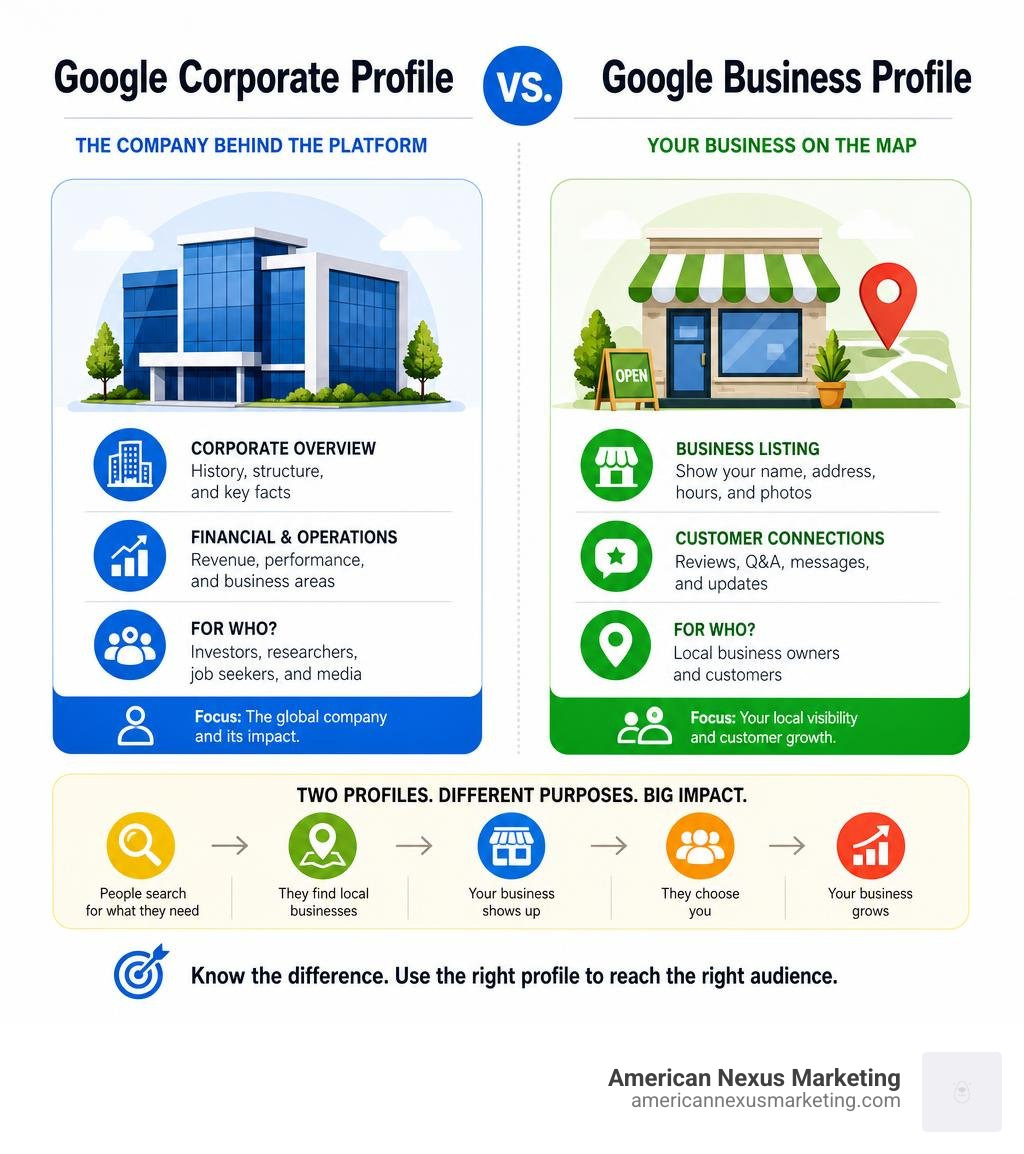
A Google company profile means two different things depending on who you are — and knowing the difference could change how customers find you online.
Here’s the quick answer:
| Term | What It Means | Who It’s For |
|---|---|---|
| Google Corporate Profile | Overview of Google LLC — its history, revenue, and structure as a subsidiary of Alphabet Inc. | Investors, researchers, job seekers |
| Google Business Profile | A free listing that shows your business on Google Search and Google Maps | Local business owners like you |
If you’re a small business owner, the one that matters most to you is the Google Business Profile — the free tool that puts your name, hours, photos, and reviews in front of customers actively searching for what you offer.
Think of it as your business’s second storefront. One that never closes, never takes a day off, and reaches people the moment they’re ready to buy.
Google handles an enormous volume of search activity every single day. And when someone nearby searches for a service you provide, your Google Business Profile is often the very first thing they see — before your website, before your social media, before anything else.
Getting that listing right isn’t optional anymore. It’s the baseline.
This guide covers both sides of the “Google company profile” question — the corporate story behind Google itself, and the practical steps any solo founder can take to claim, verify, and optimize their local listing without spending a dollar.
What is Google? Corporate Mission, History, and Structure
To understand the massive ecosystem that hosts your local business listing, it helps to understand the company behind it. Today, Google is much more than a simple search box on a clean white page. It is a global technology powerhouse.
At its heart, Google’s corporate mission has remained remarkably consistent since its inception: to organize the world’s information and make it universally accessible and useful.
Google was officially founded in September 1998 by Larry Page and Sergey Brin, two Stanford University computer science graduate students. What started as a research project in their dorm rooms has evolved into a multinational conglomerate. Today, Google LLC operates as a wholly owned subsidiary of its parent company, Alphabet Inc., which was created during a massive corporate restructuring in 2015.
To understand how Google fits into this larger corporate family, you can learn more about Google’s history directly from their official archives.
To keep its massive operations organized, Alphabet splits its business activities into three primary operating segments:
Alphabet Inc. Business Segments
| Segment | Primary Focus | Key Products & Services |
|---|---|---|
| Google Services | Consumer-facing products, hardware, and the core digital advertising engine. | Google Search, YouTube, Android, Chrome, Google Maps, Google Photos, Google Play |
| Google Cloud | Enterprise-grade infrastructure, developer tools, and business solutions. | Google Cloud Platform (GCP), Vertex AI, Google Workspace (Gmail, Drive, Docs), Cybersecurity |
| Other Bets | High-risk, high-reward ventures in early-stage stages of development. | Waymo (autonomous driving), Verily (life sciences), Wing (drone delivery) |
The Evolution of the Google Company Profile
The story of the Google company profile begins in 1995 at Stanford University. Larry Page was considering Stanford for graduate school, and Sergey Brin was assigned to show him around. Legend has it they disagreed on almost everything during that first meeting, but they soon found common ground in a shared vision: analyzing the link structure of the World Wide Web.
They built a search engine called “Backrub” because the system analyzed “backlinks” to estimate the importance of a site. Realizing they needed a name that reflected their massive ambition, they chose “Google” — a playful misspelling of the mathematical term “googol” (the number 1 followed by 100 zeros).
In August 1998, Sun Microsystems co-founder Andy Bechtolsheim wrote Page and Brin a check for $100,000 on a front porch in Palo Alto before rushing off to another meeting. That check was made out to “Google Inc.,” a corporate entity that did not yet exist. The founders hurriedly incorporated the company in California so they could deposit the funds.
Their first official office was a rented garage in suburban Menlo Park, California, owned by Susan Wojcicki (who became employee #16 and eventually served as the CEO of YouTube). The team was scrappy; their first server was built out of Lego blocks to allow for cheap, modular expansion. They even created the very first “Google Doodle” in 1998 as a creative “out of office” message to let users know the entire staff was away at the Burning Man festival.
From those humble beginnings, Google grew rapidly, launching its Initial Public Offering (IPO) in 2004, which raised $1.67 billion. To explore how the corporate governance operates today, you can view the Alphabet Inc. corporate structure and see how those early decisions paved the way for a multi-billion dollar empire.
Google’s Global Footprint, Revenue, and Market Position

Google’s physical and financial footprint is nothing short of staggering. Headquartered at the famous “Googleplex” in Mountain View, California, the company has grown into one of the most valuable entities on earth.
As of July 2026, Google boasts:
- Annual Revenue: $307.4 billion
- Market Capitalization: $509.8 billion
- Workforce: 183,103 full-time employees (a slight decrease of 1.9% year-over-year)
- Global Presence: Offices in 51 locations across 17 countries, with employees distributed across 201 countries worldwide.
The vast majority of Google’s revenue still comes from online advertising. Every time someone clicks a sponsored link on a search results page, watches an ad on YouTube, or interacts with a banner ad on a partner website, Google generates revenue.
However, maintaining this market dominance has not been without controversy. Google Search has historically held a massive market share, often exceeding 90% globally. This dominant position led to a landmark legal battle; in August 2024, a U.S. federal court ruled that Google held an illegal monopoly over internet search.
To stay ahead of competitors and diversify its portfolio, Google has invested heavily in artificial intelligence (AI) and enterprise security. The company recently rolled out its advanced Gemini AI models, including Gemini 3.6 Flash (optimized for coding and multimodal performance), Gemini 3.5 Flash-Lite (cost-effective for high-volume workflows), and Gemini 3.5 Flash Cyber (designed to detect software vulnerabilities). Additionally, in March 2025, Google agreed to acquire cybersecurity startup Wiz for $32 billion, representing its largest acquisition to date — far surpassing its historical acquisitions of Motorola Mobility ($12.5 billion in 2012), YouTube ($1.65 billion in 2006), and Waze ($966 million in 2013).
Core Products and Services Under the Google Umbrella
While search is the foundation, Google’s ecosystem is massive. The company has successfully launched or acquired multiple platforms that boast over a billion active users each:
- Google Search: The world’s primary gateway to information.
- YouTube: The premier video-sharing platform, acquired in 2006, which has become the world’s second most-visited website.
- Android: The open-source mobile operating system that powers the vast majority of smartphones globally.
- Google Maps: The mapping and local discovery tool that serves as the foundation for your local Google company profile.
- Google Workspace: A suite of cloud-based productivity tools (Gmail, Drive, Docs, and Sheets) used by millions of businesses worldwide.
- Google DeepMind: Google’s premier AI research division, driving breakthroughs in machine learning and neural networks.
Demystifying the Google Company Profile for Local Businesses
Now that you know the corporate history, let’s pivot to what a Google company profile means for your small business.
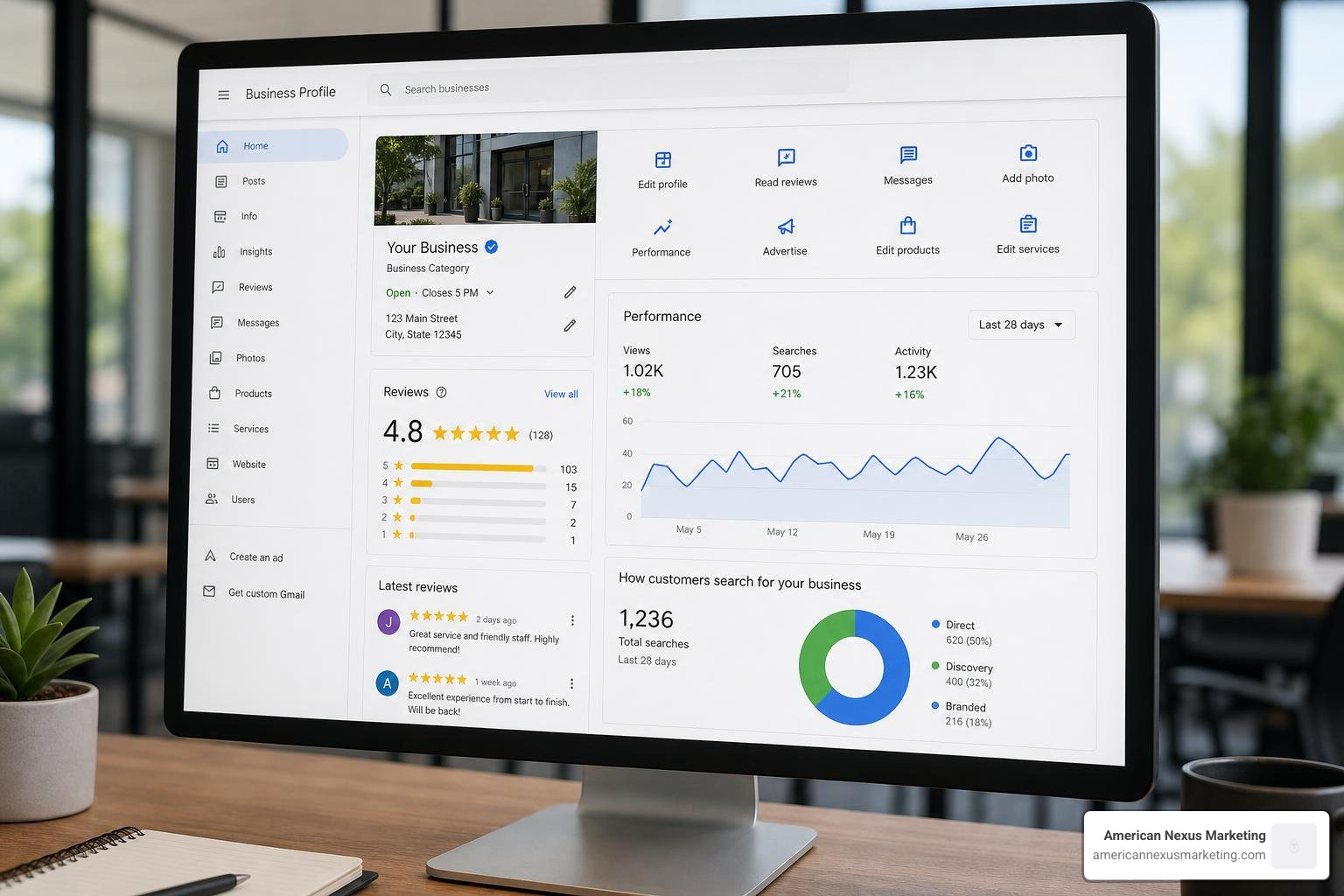
When local customers search for “plumber near me,” “best tacos in town,” or your exact business name, Google compiles local listings into a map-based layout often called the “Local Pack” or “3-Pack.”
Your Google Business Profile is the control panel for this listing. It is a completely free tool that dictates how your business appears on both Google Search and Google Maps. Without it, you are essentially invisible to local searchers.
Why Your Business Needs a Google Company Profile
If you are operating a local service or a brick-and-mortar storefront, a verified profile is your most valuable digital asset. It drives organic traffic, builds customer trust, and makes it incredibly easy for people to buy from you.
Here is why it is so critical:
- Instant Credibility: Reviews are the new word-of-mouth. A profile filled with positive, authentic customer reviews builds immediate trust.
- Google Maps Visibility: If you aren’t on the map, you don’t exist to mobile users looking for immediate solutions.
- Direct Customer Actions: Customers can call you, request real-time quotes, book appointments, or get driving directions with a single tap.
- Zero Cost: Unlike paid ads, organic local search visibility costs absolutely nothing.
To get the most out of your listing, follow these essential optimization steps:
- Keep Hours Accurate: Update your hours of operation regularly, especially for holidays.
- Use High-Quality Photos: Showcase your storefront, products, or completed jobs to build visual trust.
- Respond to Reviews: Answer both positive and negative reviews promptly and professionally.
- Utilize Google Posts: Share temporary updates, promotions, and events directly on your profile.
- Add Your Products and Services: List clear descriptions and pricing so customers know exactly what you offer.
Step-by-Step: How to Claim and Verify Your Listing
Setting up your profile is straightforward, but you must complete the verification process to take full control of your listing.
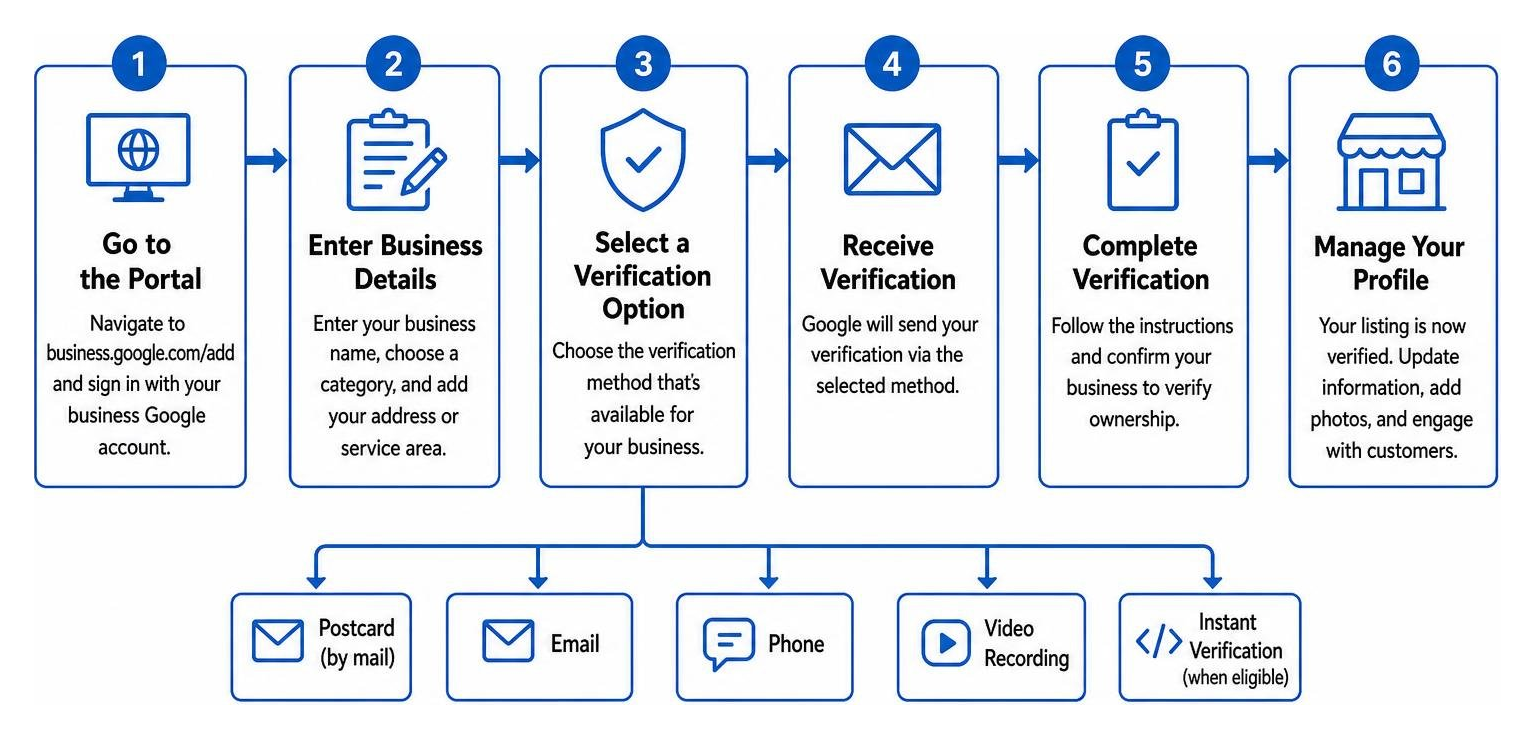
Here is how to get started:
- Go to the Portal: Navigate to
business.google.com/addand sign in with your business’s Google account. - Enter Your Business Details: Type in your business name. If it doesn’t appear, click “Add your business to Google.” Specify your business category and address. (If you are a service-area business without a physical storefront, you can hide your address and define your service radius instead).
- Select a Verification Option: Google needs to verify that you actually own the business at that location. Depending on your business type, you may be offered one of several verification methods:
- Postcard: Google mails a physical postcard with a verification code to your business address (usually arrives within 5–14 days).
- Phone/SMS: You receive a quick automated call or text message with a verification code.
- Video Recording: You record a continuous video showing your business location, street sign, equipment, and proof of management access.
- Claim via Google Maps: Alternatively, you can search for your business name and city directly on the consumer-facing Google Maps app on your phone. If you see an unverified listing, simply click “Claim this business” and then select “Manage now” to begin the verification steps.
Frequently Asked Questions About Google
Is a Business Profile on Google free?
Yes! Creating, claiming, and managing a Business Profile on Google is completely free of charge. Google provides this tool to ensure its search results and maps remain as accurate and helpful as possible. Be cautious of any third-party services that demand payment simply to keep your basic profile active; Google does not charge for this service.
What is the relationship between Google and Alphabet Inc.?
Alphabet Inc. is the parent holding company of Google LLC. This corporate structure was established in 2015 to separate Google’s core internet search and advertising businesses from its more speculative, long-term projects (like Waymo autonomous vehicles or Verily life sciences). Google operates as a wholly owned subsidiary of Alphabet, and Alphabet’s stock trades under the tickers GOOG and GOOGL.
How do I resolve verification issues on my profile?
If you run into issues verifying your profile — such as a postcard failing to arrive or video verification failing — your first step should be to visit the official Google Business Profile Help Community. Often, simple technical glitches can be resolved by updating your web browser to the latest version to ensure full compatibility with Google’s management dashboard. If problems persist, you can submit a support ticket directly through the Google help portal.
Conclusion
Whether you are looking at Google from a macro level as a $307.4 billion corporate giant or from a micro level as a local business owner trying to win your next client, the power of a google company profile cannot be overstated.
For small business owners, solo founders, and local service providers, taking control of your Google Business Profile is the single most effective, zero-cost marketing move you can make. It bridges the gap between someone searching for a solution and finding your business.
Ready to take your local SEO to the next level? We’ve put together a practical, jargon-free checklist to help you maximize your visibility. Read our complete guide on how to Optimize your Google Business Profile in 2026 and start turning online searches into real-world customers today!