
Marketers are constantly searching for smarter ways to connect with audiences, and the tools shaping that pursuit are evolving faster than ever. One development that has quietly gained significant traction is GI technology, a category of solutions that is reshaping how brands gather insights, personalize experiences, and drive measurable results. Yet despite its growing influence, many marketing professionals still have only a surface-level understanding of what it actually involves.
This post cuts through the noise. Whether you are refining your current strategy or evaluating new tools for your organization, understanding GI technology is becoming less of an advantage and more of a necessity. We will break down what this technology actually is, explore the specific ways it is being applied across marketing disciplines, and analyze why it matters for teams looking to stay competitive. By the end, you will have a clear, practical framework for understanding where GI technology fits within the broader marketing landscape and how to think critically about its role in your own work.
What Is GI Technology? A Working Definition for Marketers
GI technology, at its core, refers to the applied use of generative intelligence models within marketing workflows. Unlike narrow AI tools that classify or predict within fixed parameters, GI technology actively creates: it generates original content, anticipates behavioral intent, optimizes for dynamic search environments, and delivers real-time personalization across every customer touchpoint. In practical terms, this means a marketer deploying GI technology is not simply automating a task; they are engaging a system capable of producing novel outputs that adapt as conditions change.
The distinction between GI technology and legacy marketing automation is fundamental to understanding its strategic value. Traditional automation operates on predefined rules and conditional logic. It sends a cart abandonment email because a trigger fired, not because it evaluated context, tone, or timing against live behavioral signals. GI technology operates differently: it synthesizes patterns, anticipates intent through probabilistic reasoning, and generates contextually relevant outputs without requiring explicit reprogramming for each scenario. The shift is from deterministic execution to generative, adaptive strategy.
Across channels, the application footprint of GI technology is now substantial. In SEO, it powers content generation and structured data optimization aligned with both traditional and AI-driven search environments. In paid media, it creates ad variants at scale while refining targeting against predicted behaviors. Email marketing benefits from GI-generated subject lines, sequencing logic, and body content that respond to individual engagement signals. Ecommerce teams use it to produce product descriptions, dynamic recommendations, and predictive pricing insights. Local search applications include location-specific content tailoring and optimization for voice and AI assistant queries. According to IE University’s 2026 digital marketing research, approximately 75% of brands have now incorporated generative AI into their strategies, marking a decisive transition from early adopter advantage to baseline competitive expectation.
The terms “GI technology” and “generative AI” are frequently used interchangeably in marketing contexts, and for good reason: both reference systems that produce new content, insights, or solutions rather than simply sorting existing data. However, precision in terminology carries real business weight. Vague definitions lead to misaligned vendor selections, unrealistic ROI expectations, and compliance blind spots around originality and intellectual property. Teams that define GI technology clearly are better positioned to distinguish between augmentation tools and foundational infrastructure shifts, informing smarter decisions around talent development and strategic AI deployment at scale.
Why GI Technology Is Now Foundational Marketing Infrastructure
What started as a tool for automating repetitive tasks has evolved into something far more significant. As IE University frames it, GI technology has become “a strategic layer that supports content creation, performance optimization, and customer targeting” simultaneously. This is not incremental progress. It mirrors the trajectory SEO followed in the early 2010s, moving from specialist skill to baseline infrastructure woven into every digital function. By 2026, approximately 75% of brands have incorporated generative AI into their core strategies, and the ones that have not are operating at a compounding structural disadvantage.
The Digital Marketing Institute’s 2026 position makes this reality explicit: GI literacy is no longer an optional specialization or a resume differentiator. It is a prerequisite for marketing effectiveness and career advancement. The global digital marketing industry crossed $786 billion in 2026, growing at 13.9% annually. At that scale, practitioners and businesses unable to operate within GI-enabled workflows are not simply missing an edge; they are falling behind the baseline. U.S. total digital ad revenue hit an all-time high in 2025, and according to forecasts from WARC, GroupM, and IAB, GI-powered targeting efficiency is identified as one of the five primary structural drivers sustaining that growth into 2026. The 2026 Global Digital Advertising Trends Forecast projects the global ad market reaching $1.27 trillion this year, with digital accounting for over 73% of that total.
GI technology now supports three core marketing functions at scale. First, behavior analysis: AI processes audience signals at a speed and volume no human team can match, enabling precision targeting and real-time customer journey mapping. Second, content variation generation: GI tools produce creative and copy variations across formats, channels, and audience segments, a capability detailed in Google’s 2026 AI-era marketing guide. Third, real-time campaign refinement: AI continuously adjusts bids, creative, and targeting parameters across active campaigns without waiting for manual review cycles.
For small business owners, the critical insight is this: foundational does not mean complex or costly. Entry-level GI capabilities are already embedded in platforms small businesses use daily, including Google Ads, Meta, and most major email platforms. The adoption gap between businesses leveraging these tools and those ignoring them is widening fast, and it is widening right now.
GI Technology and SEO: The Rise of GEO and AEO
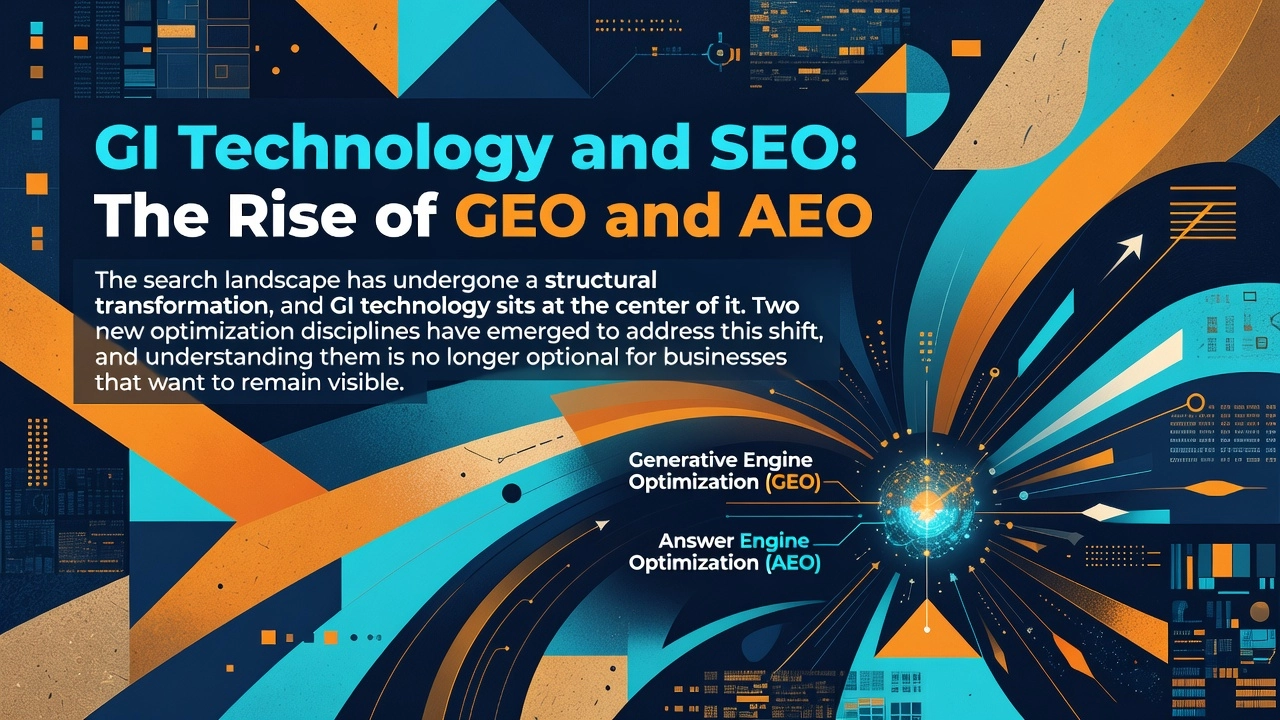
The search landscape has undergone a structural transformation, and GI technology sits at the center of it. Two new optimization disciplines have emerged to address this shift, and understanding them is no longer optional for businesses that want to remain visible.
Generative Engine Optimization (GEO) is the practice of optimizing content so that AI-driven search engines generate, cite, and surface it within their responses. Rather than competing for a ranked link position, GEO practitioners build brand authority and content structure that causes models like ChatGPT, Perplexity, and Google’s AI Overviews to treat their content as a trusted, citable source. As one practitioner framework describes it, the goal is to become the source AI models reference, not simply a result users might click. This distinction matters because the search paradigm has fundamentally shifted from retrieval to synthesis, a transition analysts describe as more significant than the shift to mobile.
Answer Engine Optimization (AEO) operates through a different but complementary mechanism. Where GEO focuses on building the authority that causes AI to cite you, AEO focuses on structuring content so that generative and conversational engines can extract a specific passage and present it directly as the answer to a user’s query. The engine does not synthesize a new response; it finds and fetches your content because it is formatted for extraction. Clear question-and-answer structures, concise paragraphs, and direct declarative statements are the tactical foundation of AEO. These two disciplines are not competing approaches; practitioners who only implement one leave significant AI search visibility unrealized.
Schema Markup as a GI Technology Enabler
Schema markup is the technical infrastructure that makes both GEO and AEO function at scale. Structured data is not simply a legacy SEO tactic; it is a direct GI technology application. FAQPage schema signals to Google that specific question-and-answer pairs are ready for extraction into AI Overviews. HowTo schema breaks processes into discrete, machine-readable steps that generative engines can surface in structured formats. Speakable schema identifies content sections suited for audio playback across voice-activated AI platforms. JSON-LD and entity graphs help generative engines parse content hierarchy, identify named entities, and resolve ambiguity about what a brand represents. According to current GEO and AEO research, 99% of AI Overview answers contain fewer than 328 words, meaning structured, concise content with clean schema signals is precisely what these systems are designed to surface.
Brand Voice and Measurable Performance
Beyond technical structure, brand voice has become an evaluative signal in AI-driven search. Per the Digital Marketing Institute, how consistently and distinctively a brand communicates now influences how generative engines assess and prioritize its content. Generative models reward coherent, authoritative, and topically consistent communication patterns over generic content, a dynamic aligned with Google’s E-E-A-T framework. Consistency across pages, clear sourcing, and first-hand expertise are not soft brand considerations; they are measurable inputs that affect AI citation frequency.
The performance case for these strategies is substantive. SEOProfy has reported a +181% growth in AI citations for clients optimized under a structured AI SEO approach, establishing a concrete benchmark for what deliberate GEO and AEO implementation can deliver. Early movers who built dedicated AEO strategies in 2024 are already seeing 3.4x more answer engine traffic than competitors who delayed, according to available GEO and AEO performance data.
American Nexus Marketing’s AI search optimization and schema optimization services are built around exactly these GI technology applications. The goal is straightforward: ensure that when generative engines synthesize an answer in your market category, your business is the entity they cite.
How GI Technology Is Reshaping Local SEO
The mechanics of local search have changed fundamentally. Generative AI engines no longer scan a list of web pages and select the most authoritative one. Instead, they synthesize information from multiple structured sources simultaneously, pulling from Google Business Profile data, on-site schema markup, third-party citations, and customer reviews to construct a direct local answer. Google’s Gemini-powered AI Overviews operate precisely this way, treating a business’s entire digital footprint as a data ecosystem rather than evaluating any single page in isolation. For local businesses, this distinction carries serious consequences: if the data across these sources is incomplete, inconsistent, or unstructured, the AI engine simply lacks the material it needs to include that business in a generated answer.
The Raised Bar for Local Visibility
GI technology has effectively moved the threshold for appearing in local results. The old model rewarded domain authority and backlink volume. The 2026 model rewards real-world engagement and structured data completeness. A newer business generating strong interaction signals on its Google Business Profile, including photo views, Q&A engagement, direction requests, and review reads, can now outrank an established competitor that neglects its profile. Consider the stakes: 46% of all searches carry local intent, and 78% of local searches lead to an offline action. Businesses that are absent from AI-generated local answers are not simply ranking lower; they are functionally invisible to a growing segment of high-intent searchers.
Specific Actions That Align with GI-Era Local SEO
Three implementation priorities define GI-aligned local SEO in 2026. First, Google Business Profile optimization has expanded beyond basic completeness. GBP now features AI-generated Q&A, where Google auto-constructs answers from review content and business data, making accurate, detailed profile attributes a prerequisite for accurate AI outputs. Second, implementing LocalBusiness schema markup gives AI retrieval systems a structured, parseable representation of core business information, which feeds directly into the entity graphs these systems reference when generating answers. Third, FAQ-structured content on business websites directly matches the conversational query patterns that AI engines process. According to the 2026 Local SEO Playbook, ranking in both Google Maps and AI answer engines now requires content that AI tools can parse, summarize, and confidently cite.
Voice Search as a GI-Adjacent Priority
Voice search sits at the intersection of GI technology and local intent. In 2026, voice queries are processed not only by traditional assistants but also by ChatGPT’s voice mode and Gemini Live, all of which pull from the same structured web content when formulating spoken answers. The linguistic gap between typed and spoken queries is significant. A typed search reads “plumber Chicago emergency,” while the equivalent voice query reads “Who is the best emergency plumber near me in Chicago right now?” According to Circle S Studio’s 2026 voice search optimization guide, voice answers are drawn predominantly from featured snippets, knowledge graphs, and AI Overviews, making structured, conversational content a direct ranking input rather than a secondary consideration. Businesses that continue formatting content around keyword strings rather than natural-language questions are structurally misaligned with how these queries get resolved.
Connecting Strategy to Execution
Understanding the GI-driven shift in local SEO and executing against it are two separate challenges. American Nexus’s local SEO services are designed specifically for businesses that have reached the strategic awareness stage and need structured implementation support. From Google Business Profile optimization and LocalBusiness schema deployment to FAQ content strategy aligned with conversational queries, American Nexus provides the execution layer that translates GI technology insights into measurable local visibility outcomes for both small businesses and large enterprises.
GI Technology and Ecommerce Personalization: Speed Is the New Standard
The 2026 ecommerce personalization standard has shifted from profile depth to processing speed. According to BlueConic’s ecommerce personalization research, the defining principle is direct: “speed determines relevance.” Brands that win in ecommerce this year are not necessarily those with the richest customer data histories; they are the ones acting on behavioral signals within the active session rather than responding to what a customer did yesterday. GI technology is the infrastructure making that possible, powering continuous inference at a pace that legacy batch-processing systems fundamentally cannot match.
The Signal-to-Action Loop Explained
At the operational core of GI-powered personalization is what practitioners call the signal-to-action loop. GI technology ingests behavioral inputs in real time, including browse patterns, cart interactions, session context, scroll behavior, and product comparison activity, and triggers personalized responses within the same session. This replaces the old architecture of static campaign rules built on batched historical data, where a customer’s behavior on Tuesday might influence the email they receive on Thursday. In the GI model, a shopper pausing on a product page, opening a second tab, or returning to a previously viewed item generates an immediate inference about intent, and the system responds accordingly before that intent window closes. The feedback is continuous: every interaction refines the model’s accuracy, making each subsequent session more precisely calibrated than the last.
Four Primary GI-Powered Ecommerce Applications
Current ecommerce personalization trends identify four application areas where GI-driven personalization is generating measurable revenue impact. Product recommendations now surface radically different results for identical search terms based on individual behavioral context, meaning two shoppers using the same search query see catalog results shaped by their own session and purchase history. Dynamic pricing adjusts price presentation based on real-time demand signals, inventory status, and individual shopper behavior rather than fixed promotional calendars. Predictive purchasing prompts leverage hesitation pattern recognition, triggering urgency signals or supporting information precisely when a shopper’s behavior indicates peak intent. Personalized email campaign triggers replace scheduled send cadences with behavioral activations, so a cart abandonment sequence or a restock notification fires based on what a customer actually did, not when a campaign was scheduled to deploy.
What the 75% Statistic Actually Means at GI Speed
Optimizely’s widely cited finding that 75% of consumers are more likely to purchase from brands delivering personalized content establishes the revenue case for personalization as a category. The more precise analytical point is what happens to that conversion lift when personalization operates at GI speed versus legacy cadences. The 75% figure represents the ceiling available when relevance is delivered within the active decision window. Brands still relying on next-day batch logic capture only a fraction of that potential because the intent moment has already passed. This is the conversion gap that GI technology closes.
Accessible at Small Business Scale
Enterprise-level personalization concepts translate directly to small business ecommerce contexts through modular GI applications. Behavioral email sequences triggered by browse and cart signals, on-site recommendation widgets surfacing contextually relevant products, and dynamic product sorting that reorders catalog display based on session behavior are all signal-to-action applications available without custom data infrastructure. The conceptual framework is identical to enterprise deployments; only the infrastructure depth differs.
American Nexus’s ecommerce retention strategies are built specifically to implement these GI-powered personalization frameworks at both scales, translating the documented revenue impact of real-time personalization into operational systems that work for large retailers and growing small businesses alike.
GI Technology and Email Marketing: Beyond the Batch-and-Blast Model
Email remains one of the highest-ROI channels in digital marketing, and that status becomes even more defensible when GI technology enters the equation. The combination of behavioral data density, direct audience ownership, and a high personalization surface area makes email the ideal environment for generative intelligence to operate. Unlike social or paid channels where audience access is mediated by platform algorithms, your email list is a first-party asset. Every open, click, scroll pattern, and conversion event generates a continuous stream of behavioral data that GI systems can process in real time. With 75% of consumers more likely to buy from brands delivering personalized content, the case for applying GI technology to email is not theoretical; it is a direct revenue lever.
From Static Segments to Dynamic Behavioral Cohorts
Legacy email marketing operated on manually defined audience buckets: customers segmented by age, location, purchase history, or subscription date. These buckets aged the moment they were created. GI-driven segmentation replaces this static logic with real-time behavioral signal analysis. Instead of assigning a subscriber to a “lapsed customer” segment based on a 90-day inactivity rule, a generative intelligence system evaluates that subscriber’s current engagement pattern, recent browse behavior, content interaction recency, and purchase intent signals to determine the most relevant cohort at the moment of send. The result is a segmentation model that moves with the subscriber rather than freezing them in a historical snapshot. This is precisely the shift described in forward-looking email marketing strategy for SMBs: segment logic must reflect present intent, not past demographics.
Continuous Optimization Instead of Sequential A/B Testing
One of the most operationally significant applications of GI technology in email is the compression of testing cycles. Traditional A/B testing required sequential experiments: test subject line variant A against variant B, wait for statistical significance, implement the winner, then test the next variable. GI technology inverts this model entirely. Generative intelligence systems can produce and simultaneously test dozens of subject line variants, send-time permutations, and body content configurations across live audience segments. What previously required weeks of isolated experimentation becomes a continuous optimization loop, with the system learning and refining with every send cycle. This matters because open rate and click-through improvements compound over time, and faster iteration means faster revenue impact.
Individualized Retention Sequences at Scale
Where GI technology delivers perhaps its most measurable email value is in retention and re-engagement workflows. Rule-based automation delivers the same win-back email to every lapsed subscriber, regardless of why they lapsed or what they engaged with last. GI tools generate individualized re-engagement sequences that reflect each subscriber’s specific behavioral fingerprint, including what products they viewed, how long since their last purchase, and what content historically drove their clicks. Post-purchase follow-up sequences can be dynamically assembled based on the specific items purchased, the customer’s lifetime value tier, and predicted next-purchase timing. American Nexus’s email marketing software provides the platform infrastructure through which these GI-powered strategies are executed, connecting the intelligence layer to the actual mechanics of list management, send scheduling, and deliverability optimization that make personalized email programs operationally viable at scale.
First-Party Data Strategies and GI Technology
The advertising data infrastructure that powered digital marketing for more than two decades is being systematically dismantled. Privacy regulations including GDPR and CCPA are tightening enforcement while major platforms accelerate the removal of third-party tracking mechanisms. According to Deloitte-Google joint research, 65% of sell-side respondents expect advertising revenues to fall as a direct result of privacy regulation, while 73% believe that first-party data strategies would meaningfully offset that impact. The cookieless future is no longer a planning horizon; it is the present operating environment, and marketers who have not yet rebuilt their data foundation are already working at a disadvantage.
How GI Technology Reconstructs Targeting Intelligence
This is precisely where GI technology enters as a structural solution rather than a tactical workaround. The original value proposition of third-party data was scale: the ability to profile, segment, and target audiences far beyond a brand’s direct customer base. GI-powered predictive analytics can now reconstruct that targeting intelligence using owned, consent-based data sources. Generative intelligence tools extract meaningful behavioral signals, model purchase intent, and automate personalization at a scope that previously required external data enrichment. What once demanded enterprise-grade third-party data partnerships can now be approximated from a well-structured email list, an instrumented website, and a populated CRM.
The Three First-Party Assets GI Technology Amplifies Most
Three owned data assets respond most powerfully to GI technology activation. Email subscriber behavior, including open patterns, click sequences, and content preferences, gives GI tools the signal density needed to predict future intent and trigger personalized follow-up sequences. Website session data reveals purchase readiness and content affinity through behavioral flows that GI models can process into dynamic audience segmentation in real time. CRM purchase history provides the transaction-level record that GI engines analyze for churn risk indicators, upsell timing, and lifecycle stage segmentation. These three assets, when unified and processed through generative intelligence tools, replace much of the targeting precision that third-party data previously provided.
The Small Business Targeting Gap
This structural shift creates a disproportionate challenge for small businesses. Larger organizations have responded to cookie deprecation by investing in proprietary data infrastructure and dedicated data science resources. Small businesses that historically relied on platform-based third-party targeting, such as lookalike audiences and behavioral segments, without simultaneously building owned audience relationships now face a compounding capability gap. GI technology addresses this asymmetry directly: it enables smaller operators to extract significantly more intelligence from the first-party data they already hold, even from a modest email list or a lightweight ecommerce transaction record, without requiring enterprise-scale investment.
American Nexus’s personalization marketing services are built around exactly this operational challenge. The strategic framework involves two sequential capabilities: building first-party data assets through direct audience relationships, then activating those assets through GI technology tools. For businesses at any stage of data maturity, that combination represents the most durable response to a targeting environment that will only become more privacy-constrained over time.
Measuring GI Technology ROI: A Framework for Business Decision-Makers
The returns from GI technology are not hypothetical, and the evidence increasingly demands that marketers stop treating measurement as an afterthought. According to Deloitte Digital data cited by IE University, 48% of marketing personalization leaders exceeded their revenue goals, a figure that reflects what happens when generative intelligence is deployed with intention rather than experimentation. Similarly, SEOProfy reported +181% growth in AI citations among clients optimized under a structured AI search playbook, confirming that visibility gains in generative search environments are trackable, repeatable, and attributable. The question for business decision-makers is no longer whether GI technology produces returns. It is whether your organization has the measurement infrastructure to capture and communicate those returns internally.
A Channel-by-Channel Measurement Framework
Each channel where GI technology operates requires its own set of performance indicators, and conflating them produces measurement noise rather than insight.
For SEO and GEO, the core metrics shift away from traditional keyword rankings toward generative search presence. Track AI citation frequency, meaning how often your brand or content appears within AI-generated answer summaries. Monitor featured snippet capture rate and organic visibility specifically within generative search results, since these reflect how well your structured content is being parsed and surfaced by large language models. For ecommerce, the most direct measurement is conversion rate lift, comparing personalized sessions against non-personalized sessions in controlled segments. This delta isolates the GI personalization contribution from baseline traffic behavior. For email, track open rate improvement over time, click-to-revenue attribution at the campaign level, and retention rate changes across cohorts receiving GI-optimized sequences versus legacy batch sends.
Leading Indicators Versus Lagging Indicators
A critical distinction that most measurement frameworks overlook is the temporal gap between early signals and business outcomes. Leading indicators in GI technology include AI citation frequency, personalization engagement rates, and segmentation accuracy scores. These metrics move first and signal whether the system is functioning correctly before revenue results materialize. Lagging indicators include revenue goal attainment, customer lifetime value growth, and churn reduction. These are the boardroom metrics, but they respond slowly and reflect the cumulative effect of months of optimized leading indicator performance. Building a credible internal ROI case requires reporting both categories with explicit timelines, not waiting for lagging indicators to validate investment decisions that leading indicators have already supported.
The Most Common Measurement Mistake
Organizations frequently make the error of attributing GI technology outcomes to individual tools rather than to the integrated workflow those tools enable. A personalization engine does not produce revenue in isolation; it compounds with GI-optimized email sequences, generative search visibility, and structured data improvements to produce cumulative business outcomes. Measuring at the tool level produces fragmented, often underwhelming numbers that fail to reflect actual performance. Measurement must occur at the business outcome level, where channel contributions are aggregated and compounding effects become visible.
The 90-Day Baseline-and-Benchmark Approach
Before any GI tool deployment, establish documented baselines for each channel metric: current AI citation frequency, pre-personalization conversion rates, email open rates, and retention benchmarks. Implement GI tools systematically rather than simultaneously, which allows cleaner attribution. Then measure the delta at 30, 60, and 90 days. The 30-day checkpoint surfaces early leading indicator movement. The 60-day review identifies whether personalization and content workflows are stabilizing. By day 90, lagging indicators begin responding and a credible internal ROI case, grounded in comparative data rather than projections, becomes available for executive review.
The Next Frontier: AI Agents and the Shift from Automation to Elevation
AI agents represent the most consequential evolution within GI technology to date. Where earlier generative tools assisted marketers by drafting copy or surfacing data patterns, AI agents act autonomously across multi-step sequences, executing campaign adjustments, publishing content, updating audience segments, and reallocating budget without waiting for human approval between each action. Projections indicate that 73% of marketers will be using agentic AI by the end of 2026, and the organizations already deploying these systems are reporting a 40% reduction in campaign management time alongside an average 31% improvement in ROAS compared to manual management. The distinction matters: this is not a faster version of what came before, but a fundamentally different operating model.
The shift from automation to elevation captures exactly what this transition means for marketing teams. Automation, as it has existed since the first email scheduling platforms, replaced repetitive human actions with rule-based triggers. Elevation is something different. GI technology agents handle operational complexity at a scale and speed no human team can match, which frees skilled marketers to concentrate on brand strategy, creative direction, and the relationship-building work that still requires human judgment. As one framework for agentic marketing describes it, the human role is moving from campaign executor to strategic architect. The teams that make this transition deliberately will outperform those that either resist it or deploy agents without proper governance.
For the marketing teams American Nexus serves, the practical 2026 use cases are already well defined. Autonomous email sequence optimization allows agents to test send timing, subject line variants, and behavioral triggers continuously, updating sequence logic based on live engagement signals rather than monthly review cycles. In paid search, real-time bidding adjustments happen at a granularity no human operator can match, removing cognitive bias from moment-to-moment optimization decisions. Dynamic content scheduling uses audience behavior signals to determine what gets published, to whom, and when, maintaining relevance across segments simultaneously.
None of these capabilities deliver their full value, however, without skilled human oversight. AI agents operate within guardrails that must be set deliberately: brand voice constraints, audience targeting boundaries, budget parameters, and ethical standards. Tool access without the strategic literacy to configure those guardrails is not an advantage; it is a liability. This is precisely where structured training becomes the differentiating layer. American Nexus’s marketing courses and programs are designed to build exactly this kind of GI technology fluency, equipping marketing teams to govern agents effectively and extract measurable value from the capabilities already available to them.
GI Technology Is Not a Future Trend — It Is the Current Standard
The data presented throughout this analysis points to one unavoidable conclusion: GI technology is not approaching mainstream adoption, it is already there. With 91% of marketing teams reporting active AI use and 70% of marketers identifying generative AI as the most important consumer trend to watch in 2026, the “wait and see” posture has become a competitive liability rather than a cautious strategy.
Five actions move businesses from observation to execution. Implement schema markup to improve visibility within GI-powered search environments. Audit email segmentation to incorporate behavioral signals rather than static demographic rules. Benchmark ecommerce personalization speed against real-time GI standards, not last year’s batch-processing logic. Build first-party data assets now, before privacy restrictions tighten further and owned audience relationships become even harder to establish. Finally, set baseline metrics before adding GI tools, because measurement discipline separates strategic adoption from reactive spending.
The adoption gap between GI-integrated businesses and those still evaluating compounds with every quarter. Major technology companies are projected to spend $665 billion on AI infrastructure in 2026 alone, a 74% increase over 2025. The capabilities available to competitors who are already operating on GI frameworks are accelerating faster than manual effort can close.
If this analysis has clarified where your business stands on that curve, the logical next step is structured action. American Nexus Marketing offers technical audits, AI search optimization services, and marketing course programs built specifically for where the marketing infrastructure landscape stands today. The businesses closing the gap now are the ones setting the distance others will struggle to overcome.
Pingback: GI Technology Careers Shaping the Digital Marketing Job Market - American Nexus Marketing