
The rules of SEO have never stood still, but what has happened between 2024 and 2026 represents something far more significant than a routine algorithm update. Search engines have fundamentally reimagined how they evaluate, rank, and surface content, and if you are still operating on strategies that worked two years ago, you are likely leaving serious visibility on the table.
This is not a beginner’s guide to keywords and meta tags. This analysis is written for marketers, content strategists, and SEO practitioners who already understand the foundations and are ready to examine what has genuinely shifted at a structural level. From the continued rise of AI-generated search summaries to the evolving weight of user intent signals, the search landscape in 2026 demands a more sophisticated approach than ever before.
In this post, we will break down exactly how modern search engines process and rank content, which SEO fundamentals still hold firm, and which outdated tactics are quietly draining your efforts. By the end, you will have a clear, grounded picture of where SEO stands today and what your next moves should be.
Why SEO Still Delivers the Highest ROI of Any Marketing Channel
In 2026, the data makes an unambiguous case for SEO as the most capital-efficient marketing channel available to businesses. According to 80+ SEO ROI statistics compiled for 2026, the median SEO campaign delivers $22 back for every $1 invested, representing a 748% ROI. At the channel level, SEO, websites, and blogs rank highest for overall marketing ROI at 27%, outperforming paid social at 26% and organic social at 24%. For decision-makers allocating budget across competing channels, that margin is not marginal; it is a structural advantage that compounds with every passing quarter.
Content marketing benchmarks reinforce this picture at the asset level. The 2025-2026 marketing ROI benchmarks from Sender confirm that SEO-fueled content returns approximately $2.77 for every $1 spent, compared to roughly $1.80 for paid advertising. That 67% performance gap makes SEO-driven content one of the most accessible growth levers for businesses of all sizes, not just enterprise organizations with significant budgets. The efficiency advantage is particularly pronounced for companies in competitive markets, where organic visibility functions as a direct signal of brand credibility and authority.
What separates SEO from every paid channel is its compounding return structure. A well-optimized page continues generating traffic and qualified leads for months or years without incremental spend. Content ROI typically breaks even around month seven, reaches 300% by month twelve, and can exceed 1,100% by month thirty-six. Paid advertising, by contrast, stops delivering the moment budgets are paused. Business owners who treat SEO as an optional line item rather than a foundational investment are effectively choosing a model with no residual value over one that builds durable, appreciating organic assets.
Concerns about AI Overviews reducing click-through rates deserve honest acknowledgment, but they do not weaken the ROI case. According to content marketing ROI statistics from OmniBound, 44% of consumers now identify AI-powered search as their primary source of insight. Brands that earn citations within AI-generated answers gain a new form of organic reach that mirrors traditional ranking benefits. Strong SEO authority, built through topical depth and technical optimization, is now the prerequisite for visibility in both traditional search results and AI-generated responses. The channel is evolving; its strategic importance is not diminishing.
The 2026 Search Landscape: What Is Actually Going On
Google still commands 89.82% of global search market share in 2026, but that headline figure obscures a more complex reality unfolding beneath the surface. AI-powered platforms are generating roughly 45 billion sessions per month globally, equaling approximately 56% of worldwide traditional search volume. In the US alone, AI platforms account for 34% of search sessions, growing at 300% year-over-year. This is not a future disruption to prepare for; it is an active redistribution of search behavior happening right now, and marketers who are not tracking it are operating with dangerously incomplete data.
The most immediate structural threat to traditional SEO performance is the rise of zero-click behavior. Google AI Overviews now appear on an estimated 50 to 60% of all US searches as of Q1 2026, concentrated heavily in informational, how-to, and comparison queries. The consequences for organic visibility are severe: approximately 60% of searches now end without a single click, and the click-through rate for the number one organic result drops to just 2.6% when an AI Overview is present. According to AI search statistics for 2026, McKinsey estimates that 20 to 50% of traditional organic traffic is now at risk due to AI-related changes. This is not a rounding error; it represents a fundamental restructuring of how search demand converts into website visits.
In response to this shift, Generative Engine Optimization (GEO) is emerging as a formalized discipline. Rather than optimizing purely for blue-link rankings, GEO focuses on structuring content so AI platforms cite or surface it within generated responses. The competitive dynamics here are stark: research into AI search behavior in 2026 shows that only approximately five brands capture around 80% of AI-generated responses in any given category, making early positioning critical.
Underlying all of these changes is a broader philosophical shift in how search engines evaluate content. The 2026 paradigm rewards situational relevance and intent over keyword frequency or raw backlink volume. Satisfying content now accounts for 23% of Google’s ranking algorithm, signaling that context and genuine user value outweigh technical manipulation. Marketers still optimizing around 2022-era keyword density and link-building volume alone are not just stagnating; according to comprehensive AI SEO analysis from Semrush, they are actively losing ground to competitors who have restructured their strategies around intent, authority, and AI-readiness signals.
Context Over Keywords: The Shift That Is Rewriting Rankings
The transformation underway in search rankings is not incremental. It represents a fundamental rewrite of what it means to compete for visibility online. Where SEO once rewarded pages that strategically placed target keywords in titles, headers, and body copy, Google’s current algorithm weighs satisfying content as a primary ranking signal, reflecting a shift from surface-level matching to genuine query resolution. Pages that fully answer what a user needs, in the right context and at the right depth, now outperform pages that simply repeat keywords at optimal density. This is not a minor algorithmic adjustment; it is a redefinition of the ranking contract between publishers and search engines.
Understanding this shift operationally requires separating two distinct questions: what a user is searching for, and why they are searching for it. A query like “best inventory software for retail” carries different intent depending on whether the searcher is in early research mode, comparing specific options, or ready to make a procurement decision. Intent-driven content creation in 2026 requires mapping the full arc of that journey and building content that satisfies each stage, not just optimising a single page for the highest-volume variant of the query. Search engines, particularly AI-driven systems, are increasingly capable of distinguishing between content that addresses a question and content that genuinely resolves it.
Topical authority has emerged as the structural mechanism through which this contextual depth is communicated to both traditional search engines and AI retrieval tools. When a website covers a subject comprehensively through a network of interlinked, high-quality content, it signals credibility that isolated pages cannot replicate. Notably, 52% of sources cited in AI Overviews also rank in the top ten organic results, confirming that earning strong traditional rankings simultaneously earns citations in AI-generated answers. Platforms like Perplexity and Bing Copilot use retrieval-augmented generation to select sources; they prioritise brands with consistent, authoritative coverage of a subject across multiple trusted references, not brands with a single optimised landing page.
This context-first reality redefines the practical role of keyword research. Volume chasing, the practice of targeting the highest-traffic terms regardless of strategic fit, is increasingly a misallocation of resources. The more productive approach is to treat keyword research as an intent-mapping exercise: grouping related queries into thematic clusters that reveal the complete context surrounding a topic. This cluster-based model ensures content strategy addresses the full scope of how users discover information across fragmented platforms, from Google to AI assistants to community platforms, rather than optimising narrowly for a single search engine behaviour.
The competitive divide this creates is already measurable. Businesses investing in consistent, in-depth content that reflects genuine subject matter expertise are outperforming those relying on keyword-stuffed or thinly generated pages. Google’s January 2026 Authenticity Update directly targets generic AI-generated content and rewards demonstrated first-hand knowledge. For smaller businesses with limited content teams, this is actually an opportunity: a focused content strategy covering one subject area with real depth will outperform a high-volume competitor producing shallow content at scale. Expertise, consistently demonstrated across a coherent content architecture, is the durable competitive advantage that rankings now reflect.
AI Search Optimization: How to Stay Visible When Answers Skip Your Website
The shift from traditional search to AI-generated answers is not a distant forecast; it is the operational reality of search in 2026. AEO and GEO statistics confirm that AI Overviews now reach approximately 2.5 billion people per month, appearing on anywhere from 25% to 60% of all searches. When an AI Overview appears, the top organic result loses roughly 58% of its clicks, and the zero-click rate climbs to approximately 83%. For businesses that have built their visibility strategies entirely around blue-link rankings, this represents a structural problem that keyword optimization alone cannot solve.
Why Structure Is the New Ranking Signal for AI
AI systems do not crawl pages the way traditional search bots do. They use retrieval-augmented generation, pulling specific passages from content to construct synthesized answers. This means your content must be architected for extraction, not just for reading. Pages built with static HTML and schema markup achieve a 94% AI parse success rate, compared to 68% for plain HTML and just 23% for JavaScript-rendered content, according to 2026 GEO trend data. Practically, this means using clear headings that frame the question being answered, writing concise paragraph-level responses to specific sub-questions, labeling statistics with their sources inline, and structuring processes as numbered steps. FAQ schema alone adds approximately a 28% citation lift within three weeks. Every structural choice either increases or decreases the probability that an AI system will pull your content as a source.
Zero-Click Does Not Mean Zero Value
Brand mentions within AI Overviews and chatbot responses function as a modern-day featured snippet. Even when no click occurs, the mention creates awareness and signals authority, particularly for users who encounter your brand name repeatedly across AI-generated answers. Critically, generative engine optimization research shows that only 17% to 38% of AI-cited pages also rank in the organic top 10, confirming that AI visibility operates on separate criteria from traditional SEO. Additionally, 84% of AI citations originate from earned media, meaning third-party editorial coverage and authoritative external mentions are now direct inputs to AI visibility, not just brand reputation.
Accessibility for Small Businesses and Scale for Enterprise
For small businesses, GEO does not require large technical teams or enterprise budgets. The most effective entry point is answering specific, localized questions with clear, accurate language. A regional HVAC company answering “how long does a furnace last in a cold climate” with a precise, well-structured response competes on terms where national brands rarely produce direct answers. Fewer than 10% of sources cited by major AI platforms rank in Google’s top 10, meaning this is genuinely an open field.
Larger organizations need a formal GEO audit. Standard SEO audits miss AI citation gaps entirely; 28.3% of the pages most frequently cited by ChatGPT carry zero organic visibility in Google. A proper audit maps brand citation rates across platforms like ChatGPT, Perplexity, Gemini, and Claude, identifies topic clusters where competitors are being cited and the business is not, and flags crawler accessibility issues where robots.txt settings may be inadvertently blocking AI indexing.
American Nexus Marketing’s AI search optimization service provides a structured entry point for both scales of business, covering content structuring, citation-building strategy, and a full AI-readiness assessment so organizations can compete in the answer layer, not just the ranking layer.
Schema Optimization and Technical SEO as AI Readiness Signals
Structured data and schema markup have crossed a critical threshold in 2026. They are no longer technical refinements applied after the fact; they function as eligibility signals that determine whether your content surfaces in AI Overviews, rich results, and LLM-cited answers. Research into how AI Overviews are changing SEO in 2026 confirms that AI systems prioritize well-structured, machine-readable content when selecting citation sources, and schema markup is among the most direct mechanisms for communicating that structure. Critically, only 38% of pages cited in AI Overviews also rank in the top ten organic positions, which means positional authority alone no longer guarantees AI inclusion. Structural signals are now doing work that rankings used to handle automatically.
The Schema Types That Matter Most Right Now
Four schema types carry the highest practical impact across both traditional SERPs and AI answer layers in 2026. FAQ schema feeds directly into the conversational answer formats that AI Overviews prefer, and pages using structured FAQ markup increase their probability of being featured in AI-generated summaries. HowTo schema is particularly valuable given that informational and how-to queries now trigger AI Overviews on more than 70% of results pages, making step-by-step structured content a high-priority target for implementation. Product schema is non-negotiable for e-commerce visibility as AI-layered SERPs absorb an increasing share of transactional queries. LocalBusiness schema addresses the growing intersection of location-based queries and AI Overview prominence, ensuring that businesses competing in local search are legible to both traditional and AI-driven discovery surfaces. Each of these schema types translates page content into a format that AI systems can parse, evaluate, and cite with confidence.
Technical Foundations Still Carry the Weight
Schema optimization loses its impact when deployed on a technically unhealthy site. Core Web Vitals, mobile responsiveness, crawlability, and page speed remain non-negotiable prerequisites because a site cannot earn AI citations if it cannot be efficiently crawled and rendered in the first place. A page with precise FAQ schema but a three-second load time and broken internal links will still underperform against a technically sound competitor. This means that AI readiness is not purely a content or markup challenge; it requires a stable technical foundation operating correctly underneath everything else.
That foundation also requires continuous attention. Technical SEO audits should be treated as an ongoing operational practice rather than a one-time project. Algorithm updates and the expanding role of AI in interpreting site structure mean that issues emerge between scheduled reviews. A 90-day audit and adaptation cycle, covering crawlability, schema validation, Core Web Vitals benchmarks, and mobile performance, provides a reasonable rhythm for keeping pace with the current rate of change.
The Competitive Gap That Remains Open
For small and mid-sized businesses, schema markup represents one of the most actionable and underutilized SEO levers available. Many businesses whose traffic reports appear stable are experiencing a quiet erosion in lead quality and click volume, a pattern directly tied to AI Overviews absorbing demand that once converted through organic listings. Implementing structured data is among the most direct steps available for closing that gap. Businesses that have not yet adopted schema are leaving a measurable opening for competitors who have, particularly as AI Overview coverage continues expanding across query categories at pace.
Local SEO in the Age of AI: What Small Businesses Need to Know
Local SEO has entered a new operational phase in 2026, and the rules governing who gets found, recommended, and called have shifted in ways that demand a recalibrated strategy from small businesses.
Google Business Profile Is Now an AI Input
Google Business Profile (GBP) optimization has moved well beyond its traditional function as a map pack signal. AI Overviews are now actively synthesizing GBP data, alongside website content and review signals, to generate direct local recommendations before a user clicks a single result. When someone queries “Which HVAC company in Tampa can replace a capacitor today and has good reviews?”, the AI-generated answer draws on real-time GBP information to surface a specific recommendation, not a list of options. This makes GBP a dual-use asset: it feeds both the traditional local pack and AI-generated answers simultaneously. Businesses that treat GBP as a living, continuously updated profile, with accurate categories, current hours, fresh photos, completed Q&A, and regular posts, gain a compounding structural advantage in AI-surfaced results. One documented case study showed a local service business achieving a 450% increase in AI visibility after implementing a focused local AI search optimization strategy.
Mobile-First Behavior and the AI-Mediated Purchase Path
Mobile-first buying behavior continues to accelerate the shift away from traditional organic listings as the primary discovery channel. Consumers increasingly begin their local research through AI tools, receiving a single synthesized recommendation rather than browsing a ranked list of results. Voice queries on mobile, such as “Who handles emergency plumbing calls on weekends in Jacksonville?”, have become the new standard for local service searches, not an emerging trend. The practical consequence for small businesses is significant: AI-generated recommendations now mediate the path from search to purchase more often than organic listing position does.
NAP Consistency, Review Management, and Schema as the AI-Readiness Stack
AI systems cross-reference multiple data sources to verify business information before including it in a generated answer. Inconsistent Name, Address, and Phone data across directories, citations, and structured data creates conflicting signals that cause AI systems to deprioritize or omit a business entirely. Alongside NAP consistency, review recency and response patterns are now explicit inputs into AI answer quality, not just ranking algorithms. A business that actively responds to reviews, both positive and negative, signals trustworthiness to AI systems in a way that static profiles do not. For multi-location businesses and franchises, combining LocalBusiness schema markup with dedicated, location-specific landing pages creates a machine-readable foundation that allows AI systems to generate accurate, geographically relevant answers across multiple markets simultaneously. These three elements, consistent citations, active review management, and structured data layered onto location pages, form the core AI-readiness stack for local SEO in 2026.
The High-ROI Case for Refreshing Existing Content Instead of Always Creating New
The performance gap between refreshed content and neglected content is no longer a marginal difference worth debating. Refreshed content generates up to 70% more organic traffic and delivers 32% higher engagement time compared to pages left to decay, according to 2026 content marketing benchmarks. In an environment where content marketing already returns $2.77 for every $1 spent, amplifying that return through systematic auditing rather than compulsive new content creation represents one of the clearest ROI opportunities available to SEO teams this year.
What a Real Content Refresh Actually Requires
The distinction between a genuine refresh and a cosmetic update matters significantly for outcomes. Simply changing a publish date accomplishes nothing. A legitimate refresh involves updating outdated statistics with current figures, expanding thin sections that no longer satisfy user intent, re-optimizing heading structures to reflect how search queries have evolved, improving internal linking to pass authority more strategically across your site, and adding structured data where it was previously absent. That last element carries particular weight in 2026, as schema markup now functions as an eligibility signal for AI Overviews, meaning properly marked-up refreshed content gains access to discovery surfaces that unstructured content cannot reach.
Identifying Pages Worth Prioritizing
Not every underperforming page deserves equal attention. The strongest refresh candidates are pages that once held page-one positions but have slipped due to algorithm updates or increased competitor content density. These pages carry established domain authority signals and inbound link equity; they simply need content-level improvements to reassert relevance. A page that earned backlinks when it ranked well does not lose those links when rankings slip, making the recovery investment substantially lower than building authority on a brand-new URL from scratch.
Building a Sustainable Audit Cadence
Businesses managing content libraries of 50 or more published pages should treat quarterly content audits as standard operating procedure rather than an occasional task. Each audit cycle should identify three distinct categories: decay (pages losing traffic), cannibalization (pages competing against each other for the same queries), and gap opportunities (topics your existing authority could credibly expand into). For resource-constrained teams, the prioritization logic is straightforward: a refresh calendar targeting your top 20% of traffic-generating pages will consistently outperform publishing net-new content on lower-authority sections of the domain. Protecting and compounding existing asset performance is the more efficient path when budget and bandwidth are limited.
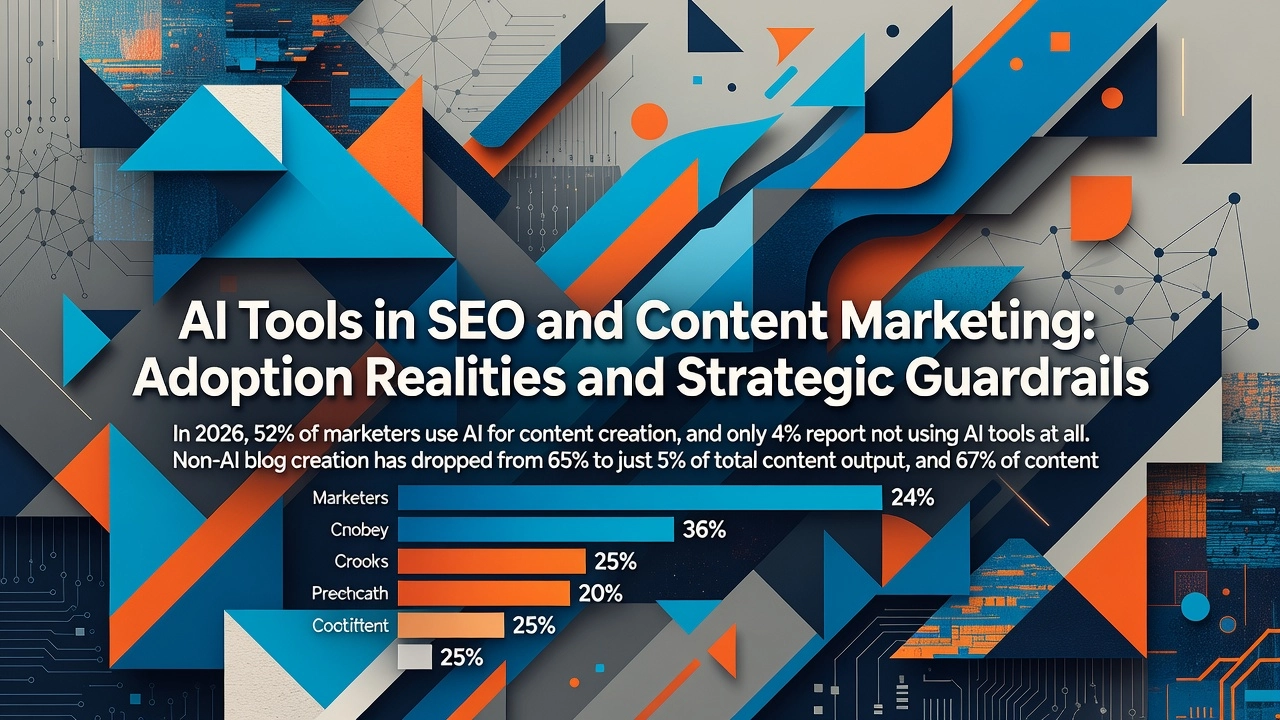
AI Tools in SEO and Content Marketing: Adoption Realities and Strategic Guardrails
AI adoption in content marketing has crossed the threshold from strategic advantage to industry baseline. In 2026, 52% of marketers use AI for content creation, and only 4% report not using AI tools at all. Non-AI blog creation has dropped from 65% to just 5% of total content output, and 67% of content marketing teams now deploy AI tools on a daily basis. The practical implication is significant: simply using AI no longer differentiates your business from competitors. The first-mover advantage that early adopters enjoyed has been fully absorbed by the market, and the question is no longer whether to use AI but how to use it in ways that produce content your competitors cannot easily replicate.
Where the Real Competitive Edge Now Lives
The value of AI-generated content has commoditized at a speed few anticipated. Basic informational content can now be produced at near-zero cost, which has collapsed its perceived value in search and among readers. The organizations gaining measurable ground are those combining AI efficiency with genuine human expertise, proprietary data, original research, and brand-specific perspective that no language model can generate independently. Teams that close the gap between AI usage and strategic measurement are seeing 2.4x better content ROI than those running AI tools without structured governance. That gap separates tactical users from strategic operators.
The Penalty for Unreviewed AI Output
Google’s quality signals have grown increasingly precise at identifying content that resolves queries without genuine depth or credibility. AI-generated content that bypasses expert review, omits real-world examples, or relies on unsourced claims fails to meet what Google evaluates under its “satisfying content” signal, which now accounts for 23% of its ranking algorithm. Real-world testing across large content archives has documented initial ranking gains from purely AI-generated pages followed by significant declines after Google’s core updates in late 2024. The pattern is consistent: copy-pasted AI output without editorial input ranks briefly, then deteriorates.
High-Value AI Use Cases That Do Not Compromise Quality
The SEO tasks where AI delivers legitimate workflow acceleration include keyword clustering, content brief generation, meta description drafting, schema markup generation, and internal linking audits. These applications compress timelines without displacing editorial judgment. They handle the structural and repeatable dimensions of SEO work, freeing subject matter experts to focus on analysis, sourced insights, and the kind of experience-driven commentary that satisfies E-E-A-T requirements.
Businesses should formalize this distinction in a documented AI content policy that classifies which tasks are AI-assisted versus human-led, sets review requirements before publication, and establishes E-E-A-T compliance checkpoints at the editorial stage. Organizations with documented content strategies already generate 3x more leads per dollar spent than those without frameworks, and that advantage compounds when AI governance is built into the production process rather than managed informally.
Practical SEO Priorities Tiered by Business Size
The right SEO priorities depend heavily on where a business sits in terms of size, technical capacity, and geographic complexity. A single-location service business and a multi-regional enterprise face fundamentally different challenges, and applying enterprise-level tactics to a small business wastes resources just as surely as applying small-business thinking to a large one.
Small Businesses: High-Impact Fundamentals First
Small businesses should concentrate resources on four interconnected priorities. Google Business Profile optimization remains the highest-leverage local ranking signal available, with profile completeness, review consistency, and category accuracy directly influencing how both traditional search and AI systems surface local results. Paired with LocalBusiness schema markup, this creates a verified, machine-readable identity that AI platforms can reference with confidence. Beyond local signals, building a content strategy around 5 to 10 core topic clusters establishes topical authority without overextending limited resources; long-tail, intent-specific content within those clusters consistently outperforms broad keyword targeting at this scale. Finally, a quarterly content refresh cycle applied to highest-traffic pages captures the documented performance gains that refreshed content delivers, maintaining relevance as AI systems weigh content freshness more heavily.
Mid-Sized Businesses: Closing the Structural Gaps
As organizations grow, informal SEO practices accumulate gaps that compound over time. Mid-sized businesses should add a full technical SEO audit to identify crawl issues, indexing inconsistencies, and page speed deficiencies before they erode rankings across an expanding site. Structured data implementation should move beyond basic schema to cover product pages, service descriptions, FAQs, and review markup. A formal AI search visibility assessment is now essential; AI systems cannot independently verify a business’s authority without structured, consistent signals, making this review a functional requirement rather than an optional upgrade. Businesses operating across multiple cities or regions also need dedicated local SEO strategies per service area, supported by distinct landing page architecture for each location.
Large Enterprises: Systematic, AI-Era Architecture
Enterprise SEO in 2026 requires a systems-level approach. GEO audits across AI platforms identify where enterprise content appears, or fails to appear, inside AI-generated answers. Schema implementation at scale ensures that thousands of pages maintain consistent, AI-readable structure. International or multi-location SEO architecture keeps indexing and entity recognition coherent across markets. An AI-assisted content operations workflow allows enterprises to produce and refresh content at volume while preserving editorial standards.
Across all three tiers, the foundation is identical: fast, mobile-optimized pages, clear intent-driven content, properly structured data, and a consistent publishing cadence. American Nexus Marketing works with businesses at every scale, offering local SEO, technical audits, schema optimization, and AI search optimization calibrated to each organization’s specific goals and resources.
Actionable Takeaways for Navigating SEO in 2026
The most effective starting point is not a new tactic. It is an honest assessment of where you currently stand. Before layering on additional strategies, audit your technical health, content quality, structured data coverage, and AI search visibility as a baseline. Understanding your gaps before investing in new initiatives prevents wasted budget and surfaces the highest-leverage opportunities first.
With that foundation in place, prioritize content refreshes on your highest-value existing pages before committing resources to net-new creation. The evidence is direct: refreshed content generates up to 70% more organic traffic and 32% higher engagement time, making it one of the most capital-efficient moves available in 2026.
Schema markup deserves immediate attention, particularly for local businesses and ecommerce pages. Structured data directly improves AI Overview eligibility and rich result performance, two visibility surfaces that increasingly determine whether your content gets surfaced at all.
Build every piece of content around complete query satisfaction and genuine topical authority, not keyword density. Google’s algorithm now weights “satisfying content” at 23% of its ranking signals, which means intent fulfillment is a primary ranking factor, not a secondary consideration.
Finally, as GEO, local SEO, and AI-driven search continue evolving, keeping your team educated is a competitive necessity. Programs offered by American Nexus Marketing provide structured, expert-led training covering these disciplines for businesses preparing for 2026 and beyond.
Conclusion
The search landscape of 2026 is not simply a refined version of what came before; it is a fundamentally different environment that rewards depth, intent alignment, and genuine expertise. Here are the core takeaways to carry forward: AI-generated summaries have reshaped how visibility is earned, user intent signals now carry more weight than technical optimization alone, and outdated tactics are actively working against you rather than simply fading into irrelevance.
The practitioners who will win in this environment are those willing to audit their assumptions, not just their keyword rankings.
Start by revisiting your content strategy through the lens of what search engines are actually rewarding today. Identify where your approach still reflects 2024 thinking. Then rebuild from there.
Search has changed. Your strategy should too. The opportunity for those who adapt quickly has never been greater.
Pingback: Email Marketing in 2026: What the Data Actually Tells You – American Nexus Marketing
Pingback: How to Choose an SEO Agency in the UK That Will Still Work in 2027 – American Nexus Marketing
Pingback: Google Digital Marketing & E-Commerce Certificate: Honest 2026 Review + What It Doesn’t Teach You – American Nexus Marketing
Pingback: SEO Services That Actually Move the Needle in 2026 – American Nexus Marketing
Pingback: What Is Search Engine Positioning in SEO? The 2026 Definition Has Changed – American Nexus Marketing
Pingback: Claude AI for Marketing: What It Is and How to Use It – American Nexus Marketing
Pingback: Janitor AI: What 130 Million Monthly Users Tell Marketers – American Nexus Marketing
Pingback: Micron Tech Stock Price in 2026: Analysis and What the AI Memory Boom Means - American Nexus Marketing
Pingback: AI Search Visibility for Brand Managers: Measure, Track, Act