
When a single AI platform quietly amasses 130 million monthly active users, marketers should stop and pay attention. Janitor AI has done exactly that, growing from a niche roleplay chatbot into one of the most visited AI destinations on the internet, and most marketing teams have barely noticed.
That oversight is becoming increasingly costly. The platform’s explosive growth reveals something deeper than a fleeting trend; it signals a fundamental shift in how audiences engage with conversational AI, personalized content, and digital interaction at scale. For marketers willing to look past the surface, the data embedded in Janitor AI’s rise offers a remarkably clear window into user behavior, content consumption patterns, and emerging audience segments.
In this analysis, we break down what 130 million monthly users actually tell us. You will learn which demographics are driving this growth, what keeps users engaged at such remarkable rates, and how forward-thinking brands can translate these behavioral insights into sharper marketing strategies. Whether you are refining your content approach or scouting the next major digital channel, the story behind Janitor AI’s numbers is one worth understanding in full.
What Is Janitor AI
Janitor AI (janitorai.com) is a browser-based AI roleplay chat platform launched in June 2023, purpose-built for character-driven storytelling and immersive conversational fiction. Unlike general-purpose productivity tools, it occupies a distinct and deliberate niche: character-based entertainment AI. The platform hosts over 100,000 preset characters spanning anime, fantasy, sci-fi, romance, and mature-themed categories, giving users an immediately accessible library of interactive personas without requiring any technical setup. According to the 2026 guide to Janitor AI chatbot features, the platform draws approximately 130 million monthly visits globally and sustains around 2 million daily active users, figures that underscore just how sizeable this niche has become.
The platform’s defining competitive feature is a toggleable NSFW mode that permits mature and explicit content, a capability that mainstream character chat platforms deliberately restrict. This single toggle is the primary engine behind Janitor AI’s user acquisition at scale; users actively migrate toward the platform seeking fewer content filters. The results speak directly to that demand: Janitor AI reached 1 million registered users within its first week of launch, a growth rate that rivals early adoption curves of far better-funded platforms.
Beyond content permissiveness, the platform delivers meaningful functional depth. Users can build fully custom characters with defined personalities, backstories, and conversational styles. Conversations operate in multi-turn, context-aware threads where the system tracks narrative continuity across a session. Technically, Janitor AI functions as a frontend interface rather than a standalone large language model; it connects users to backend models through a Bring-Your-Own-API architecture, supporting GPT-4o, KoboldAI, and other compatible endpoints.
Critically, the free tier is genuinely functional, not a stripped-down preview. New users can engage the platform’s native model without supplying an API key, which eliminates friction and broadens the addressable audience considerably. A Pro plan is available at $9.99 per month for users who want enhanced capabilities. For marketers and analysts tracking AI consumer behavior, Janitor AI represents a case study in how a tightly scoped value proposition, combined with accessible pricing and a feature incumbents will not replicate, can build a durable and measurable audience at scale.
The Scale Is Not Niche: Traffic and Reach in 2026
Janitor AI’s traffic footprint defies the “niche” label that market share reports quietly assign to it. The platform records approximately 130 million monthly visits worldwide as of 2026 and ranks within the top 350 websites globally, according to Semrush traffic analytics for janitor.ai. For context, that threshold places it above a significant portion of enterprise software brands, legacy media properties, and household-name SaaS platforms that carry far greater marketing budgets and institutional recognition. Reaching top-350 globally is not a participation trophy; it is a meaningful signal of sustained consumer demand.
The daily active user figure sharpens that picture further. The platform sustains approximately 2 million daily active users, which means the audience is not simply arriving and bouncing. Users are returning with enough regularity to generate a daily engagement pattern that most content platforms would consider exceptional. When you hold that figure against the 130 million monthly visits, it suggests a behaviorally committed core audience driving consistent session volume.
The platform’s position within the broader AI traffic hierarchy is equally notable. According to the Top 100 AI Tools by Traffic ranking, the March 2026 AI tools traffic landscape was dominated by general-purpose assistants: ChatGPT at roughly 6.20 billion visits, Google Gemini at approximately 1.10 billion, and Claude at around 722 million. Janitor AI appeared in that same ranking as the only character-chat or entertainment-oriented platform on a list otherwise composed entirely of productivity and utility AI tools. That structural anomaly is worth sitting with analytically.
Yet despite this verified traffic scale, Janitor AI holds zero recorded share in formal AI chatbot market rankings from Statcounter and First Page Sage as of June 2026. Those trackers show ChatGPT at 76.87%, Gemini at 7.94%, Perplexity at 7.91%, Claude at 3.74%, and Copilot at 3.49%. Janitor AI does not appear because standard market share methodology scopes its coverage to utility-oriented AI assistants, systematically excluding entertainment and roleplay platforms by category definition rather than by traffic volume.
This measurement gap is itself a substantive data point for marketers and analysts. The headline AI market share figures, while accurate within their defined scope, structurally undercount the total footprint of human-AI engagement. Character-based platforms represent a distinct and sizable behavioral category that sits entirely outside the productivity AI taxonomy. Any business intelligence exercise that relies solely on Statcounter-style rankings to understand AI adoption is working from an incomplete map.
Who Actually Uses Janitor AI (And Why It Matters)
Janitor AI’s demographic profile is one of the most analytically interesting facts in the AI tools space, and it remains almost entirely absent from mainstream coverage. At launch, approximately 70% of the platform’s user base consisted of women, a figure reported by early platform reviews and corroborated by community discussions where self-identified female users described creative writing, story development, and personal narrative exploration as their primary reasons for engaging with the platform. It is worth noting that Similarweb data from February 2026 suggests the ratio has since shifted toward a more balanced, male-leaning split, consistent with Reddit community observations that the demographic composition has meaningfully changed as the platform scaled. The more defensible analytical framing is this: Janitor AI launched with a predominantly female user base, a distinction that is statistically rare for any technology product and almost entirely invisible in mainstream AI coverage.
That early demographic skew directly challenges a persistent assumption in technology marketing: that AI power users are predominantly male and technically oriented. Janitor AI’s initial audience demonstrates that narrative-driven, emotionally engaging AI experiences attract a fundamentally different user profile than productivity-focused tools do. The motivations are creative and relational rather than utilitarian, and the research supporting this from its first week is striking: the platform reached 1 million users within its first seven days of launch. That growth rate is consistent with word-of-mouth and community-driven discovery patterns common in fandom and creative writing communities, not paid search acquisition or app store optimization.
For audience segmentation purposes, this cohort represents a high-engagement group of creative-media-consuming users who are persistently underserved by most AI platform advertising strategies. Broader engagement data reinforces the strategic importance of this observation. Average session durations across leading AI chat platforms are rising, with conversational tools that sustain narrative or relational interaction commanding disproportionate user attention over time. Platforms that can hold a user inside a story, a relationship, or an emotionally resonant scenario are building a fundamentally different kind of engagement asset than those optimized for quick, task-completion interactions. Marketers building audience strategies around AI platform behavior in 2026 who ignore this segment are overlooking one of the most organically active user communities in the space.
How Janitor AI Works: The BYOA Architecture and Pricing
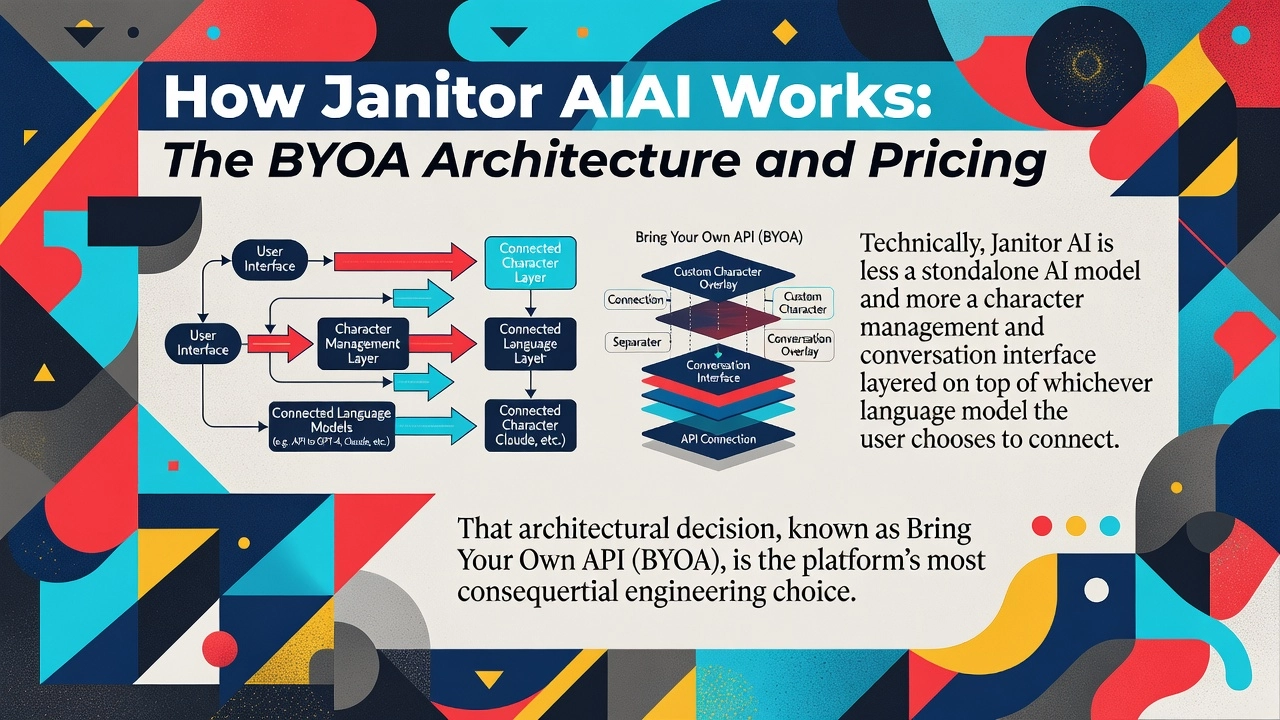
Technically, Janitor AI is less a standalone AI model and more a character management and conversation interface layered on top of whichever language model the user chooses to connect. That architectural decision, known as Bring Your Own API (BYOA), is the platform’s most consequential engineering choice and the primary reason it attracts a technically sophisticated secondary audience alongside its large general user base.
The BYOA Model Explained
Under the BYOA framework, users can connect three distinct backend options: Janitor AI’s own hosted JanitorLLM model, OpenAI’s API (including GPT-4o), or KoboldAI, an open-source alternative that can be self-hosted locally or run via cloud environments such as Google Colab. The platform also accepts any OpenAI-compatible endpoint, which broadens compatibility to open-weight models like Mistral and Mixtral. This means the platform’s character library, persona logic, and conversation UI remain constant, while the underlying inference engine is entirely swappable. Technical users gain direct control over response quality, operational cost, and content policy enforcement, three variables that are fixed on most consumer AI chat products.
KoboldAI and the Zero-Cost Pathway
KoboldAI integration is particularly significant from a cost architecture standpoint. Because KoboldAI is open-source and self-hostable, users running their own instance pay zero incremental API cost per conversation. For high-volume users or developers building applications on top of the platform, this is a meaningful financial lever. Community tutorials combining KoboldAI with Janitor AI have accumulated tens of thousands of views, confirming strong, sustained demand for this cost-free access path rather than treating it as an edge case.
Pricing Tiers and Privacy Considerations
As of 2026, Janitor AI offers three pricing tiers: a free tier using JanitorLLM Beta, a Pro plan at $9.99 per month, and a pay-as-you-go structure for users supplying their own API keys. This mirrors the freemium-to-power-user funnel common across the AI chatbot category, lowering the barrier to entry while monetizing users who demand higher performance or higher volume.
The BYOA model introduces one underappreciated complexity: data privacy. When a third-party API key is connected, conversation data routes through both Janitor AI’s infrastructure and the external provider’s systems simultaneously. As OpenAI’s enterprise documentation clarifies, data protections like no-training guarantees apply to direct enterprise customers, not necessarily to traffic arriving through third-party integrations. Any organization conducting a compliance assessment of Janitor AI should treat this dual-routing architecture as a primary variable, not a footnote.
Where Janitor AI Sits in the Competitive AI Chatbot Landscape
The competitive map for Janitor AI looks nothing like the market share charts that dominate AI industry coverage, and that distinction matters analytically.
Character.AI represents Janitor AI’s most direct mainstream rival. Both platforms offer large, user-generated character libraries, free-tier access, and browser-based interfaces. The operative difference is content policy. Character.AI enforces stricter moderation filters, and that restriction has become a documented driver of user migration. According to a 2026 roundup of tested Character.AI alternatives, “why people are leaving Character AI in 2026” is an explicit editorial framing across the space, confirming that the content restriction gap is a recognized market dynamic. Janitor AI’s toggleable mature-content mode is the single clearest product differentiator between the two platforms.
Replika competes on a separate axis entirely, targeting the emotional companion use case rather than open-ended roleplay. With over 42 million global users and a near-complete platform rebuild completed in 2026 focused on emotional understanding and persistent memory, Replika is a serious platform; it also applies content filters comparable to Character.AI. SpicyChat AI and CrushOn AI occupy the less-restricted end of the niche more directly. SpicyChat has grown to over 100 million users and 300,000 user-created characters as of mid-2026, now adding in-chat image generation and voice replies. These platforms together form a competitive sub-market that operates on different terms than the general-purpose AI assistant space.
WeavAI and Candy AI signal where the niche is heading next. A 2026 review of Janitor AI alternatives positions Candy AI as a leading option noted for realistic conversation and image generation polish. WeavAI differentiates through localization, targeting Taiwanese and Hong Kong audiences specifically. The character-chat niche is fragmenting into feature-specialized sub-platforms competing on voice, imagery, and customization rather than content permissiveness alone.
Against this backdrop, the macro market concentration figures require careful interpretation. ChatGPT holds 76.87% of global AI chatbot market share as of June 2026, with the top five platforms accounting for nearly all tracked share. However, that measurement framework covers productivity and general-purpose assistant usage exclusively. Platforms like Janitor AI, SpicyChat, and Replika do not appear in Statcounter’s tracked rankings at all. The practical implication is significant: the character-chat niche faces substantially less competitive pressure from dominant AI labs than the headline numbers suggest.
Janitor AI’s BYOA architecture reinforces this competitive insulation at the product level. Users who have invested time selecting a preferred API endpoint, configuring model parameters, and building out a personal character library face real friction when evaluating any alternative platform that relies solely on a proprietary model. No competitor in the character-chat category currently offers comparable API flexibility, making this a structural moat that platform-level features alone cannot easily replicate.
Privacy, Compliance, and Brand Safety Considerations
Janitor AI’s explicit adult-content orientation is a structural fact, not an edge case. The platform’s own safety documentation describes it as built for adults, with a content policy that permits mature material and a “Limitless” character tag actively used in everyday browsing. For any advertiser running programmatic campaigns or brand partnership programs, adjacency to that environment carries both reputational and regulatory risk. The critical error most marketing teams make is treating this risk as theoretical until it becomes visible. Brand safety evaluations must address content environment explicitly, before a campaign launches, not after an earned media screenshot surfaces in the wrong context.
The privacy picture is more layered than most platform audits assume. Janitor AI’s privacy policy states that the platform does not sell personal data or share private conversations with third parties for advertising purposes, and it processes over one million automated content reviews per week according to its safety documentation. However, those are first-party commitments without published third-party audits. The BYOA model compounds this: when a user connects an external API key, two separate data-handling frameworks govern that session simultaneously. Janitor AI’s policy covers what the platform collects; the API provider’s terms cover what happens to prompts and completions on their infrastructure. Anyone routing sensitive or business-related data through this architecture should treat each provider’s data retention and training-use policies as independent compliance obligations, reviewed separately.
Regulatory exposure is no longer abstract. Brazil’s Digital ECA took effect March 17, 2026, mandating platform-level age verification for Brazilian users through facial estimation or ID scan. Australia’s Online Safety Act creates parallel obligations. Critically, both are jurisdiction-specific responses to regulatory compulsion, not globally deployed safeguards. In markets without equivalent legislation, no mandatory age gate applies. For businesses in financial services, healthcare, or education, whose audience-protection obligations do not adjust based on the platform’s compliance posture in any given country, this gap is directly relevant.
Algorithmic bias adds a further consideration specific to character-based platforms. When AI personas are shaped by user-generated content at scale, the resulting behavior can reflect and amplify social biases in ways that are less transparent than in general-purpose assistants. These patterns matter for brand associations, particularly when broad audience targeting extends campaign reach into communities where those biases carry real consequences.
For media buyers, the practical response is straightforward: excluding mature AI chat platforms from programmatic campaigns is a baseline hygiene step, applying the same logic as any other brand-unsafe content category exclusion in display advertising.
What the Janitor AI Phenomenon Actually Tells Marketers
The aggregate picture that emerges from studying Janitor AI is more instructive than any single data point about the platform itself. Pulling these threads together reveals six concrete implications that should reshape how marketers approach AI strategy in 2026 and beyond.
The AI ecosystem is not monolithic, and your optimization strategy should reflect that. Janitor AI’s 130 million monthly visits exist entirely outside the standard AI chatbot market share rankings tracked by Statcounter and similar intelligence sources. ChatGPT commands 76.87% of tracked market share, but “tracked” is doing significant work in that sentence. A platform generating 2 million daily active users simply does not appear in those reports. Marketers building AI search optimization strategies around the dominant platforms alone are mapping a partial territory. The full ecosystem includes entertainment-oriented, character-based, and niche platforms capturing substantial audience time and attention that aggregate reports cannot see.
Demographic assumptions about AI users are costing brands audience intelligence. The 70% female user base at Janitor AI is not an anomaly to be explained away; it is a signal that AI adoption patterns vary dramatically by platform type and use case. Brands targeting female-skewing consumer segments who limit their AI platform mapping to general-purpose productivity tools are almost certainly missing where significant portions of their audience are actually spending time. Systematic audience mapping across the full AI platform landscape, including niche and entertainment categories, is rapidly becoming a baseline competitive requirement.
Character-based AI interaction is a functioning model for what personalization marketing aspires to achieve. Users return to Janitor AI daily because the platform delivers consistency, emotional relevance, and individualized narrative continuity. This is precisely what high-performing personalization strategies attempt to engineer in ecommerce and email contexts: reducing generic friction and increasing perceived relevance to the individual. The AI roleplay market driving this engagement was estimated at $0.85 billion in 2024 and is projected to reach $1.20 billion by 2026, reflecting genuine and growing consumer appetite for this interaction model.
The BYOA architecture signals where mainstream consumer expectations are heading. Today, Bring-Your-Own-API behavior is concentrated among developers and technically sophisticated users. Within a short horizon, the expectation that users can bring their preferred models, data configurations, and personal preferences to any AI-assisted experience will migrate into mainstream consumer behavior. Product teams and marketers building AI-assisted tools now should design for this expectation rather than engineer against it.
From an Answer Engine Optimization standpoint, niche AI platforms represent an underaddressed visibility surface. AI-driven traffic to retail sites grew 693% year-over-year during the 2025 holiday season, with AI referrals converting 31% better than non-AI sources and delivering 254% higher revenue per visit. That traffic originates from a wider citation ecosystem than most brand AEO strategies currently target. Reviewing 2026 marketing statistics and trends reinforces that AI-influenced discovery is accelerating across every category, making full-ecosystem content visibility a priority rather than an advanced tactic.
The freemium-to-Pro funnel structure is a retention architecture worth dissecting directly. Janitor AI removes acquisition friction entirely with a free tier, then gates meaningful value such as enhanced memory, higher token limits, and premium model access behind a $9.99 monthly threshold. The conversion mechanism is not feature promotion; it is continuity of a personalized experience the user has already emotionally invested in. Ecommerce and SaaS marketers running their own freemium or trial-to-paid funnels will recognize this structure immediately. The lesson is that users who have invested in a personalized experience convert and retain at higher rates than users who have only evaluated features, a principle that applies directly to email personalization sequences and ecommerce loyalty program design.
Janitor AI, AEO, and the Expanding AI Search Ecosystem
Answer Engine Optimization has historically been framed around a narrow set of platforms. ChatGPT, Gemini, and Perplexity receive the overwhelming majority of AEO industry attention, and for understandable reasons. ChatGPT holds 76.87% of global AI chatbot market share as of June 2026, and the top five tracked platforms collectively dominate the measurable landscape. But the Janitor AI traffic data exposes a structural blind spot in how marketers conceptualize AI search visibility: the ecosystem extends far beyond those flagship platforms, and the gap is not marginal.
Janitor AI records approximately 130 million monthly visits worldwide in 2026, and 2025 data places that figure closer to 200 million. Put those numbers alongside Character.AI at 220 million monthly visits and DeepSeek at 267 million, and the picture becomes analytically significant. These platforms collectively represent hundreds of millions of AI-mediated sessions per month where conversations unfold, content is generated, and brand or product references occur entirely outside standard AEO tracking frameworks. No schema report captures these touchpoints. No rank tracker monitors what Janitor AI’s characters say about a product category. That absence is not a minor oversight; it is a systematic gap in how brands measure AI-era visibility.
The 23% of AI chatbot market share not held by ChatGPT does not translate to 23% of total attention being inconsequential. In absolute session terms, that remaining share represents an audience of extraordinary scale, distributed across niche platforms with deeply engaged user bases. Grok users average over 11 minutes per session. Janitor AI sustains approximately 2 million daily active users. These are not passive impressions; they are immersive interactions where AI-generated content shapes perception.
For businesses investing in AI search optimization, the practical implication is precise: a credible AEO strategy requires niche platform signal mapping, not just optimization for the top-line chatbot rankings. Understanding which AI environments your specific target audiences actually inhabit matters more than allocating all resources toward the most visible platforms.
American Nexus Marketing’s AI search optimization services are built around this full-ecosystem perspective. Through schema optimization, structured content architecture, and AEO frameworks designed to extend brand presence beyond mainstream chatbot rankings, the approach addresses the entire AI-driven discovery landscape rather than the fraction of it that appears in standard market share reports.
Personalization Lessons from Character-Based AI Engagement
Janitor AI’s retention mechanics are not accidental. The platform sustains approximately 2 million daily active users because it is built around the same psychological drivers that make personalization marketing effective in ecommerce: consistency, character, and the persistent sense that the experience was constructed for the individual rather than the general public. When every session picks up where the last one ended, when a character remembers established details, and when the interface reflects months of user-defined configuration, the experience stops feeling like a product and starts feeling like a relationship. That distinction is what separates platforms with genuine retention from platforms with high bounce rates.
The behavioral parallel to ecommerce is direct and analytically significant. Users who build character libraries and configure persistent personas on Janitor AI, particularly after the platform removed its persona limit entirely in June 2026 and introduced persona cloning, exhibit the same engagement pattern as highly invested ecommerce customers who build wishlists, configure saved searches, and maintain preference profiles. The investment itself becomes the retention mechanism. Switching costs are not just technical; they are psychological. The more a user has shaped an environment, the less likely they are to abandon it, regardless of what alternatives exist.
For ecommerce marketers, the operational lesson is that personalization depth is the variable that actually moves retention metrics. First-name tokens in subject lines and browsed-category retargeting are table stakes, not strategy. Platforms that allow users to genuinely shape their own experience generate the kind of compulsive daily return behavior that Janitor AI’s 2 million DAU figure represents. McKinsey research consistently shows that personalization at scale can lift revenues by 10 to 15 percent; the ceiling rises substantially when personalization extends beyond surface-level triggers into genuine experience architecture.
Character-consistent AI interaction also confirms something with direct implications for email personalization, product recommendation engines, and chatbot-assisted customer service: audiences engage deeply with AI-generated content when the experience feels coherent and purposeful. Coherence is the operative word. A recommendation engine that contradicts itself, a chatbot that forgets prior exchanges, or an email sequence with no through line all signal to the customer that the experience was not built for them specifically.
American Nexus Marketing’s personalization marketing and ecommerce retention services are structured around precisely these principles. The focus is on building individualized customer journeys that increase session depth, repeat purchase rates, and brand loyalty by treating personalization as infrastructure rather than a campaign tactic, applying the same engagement logic that drives sustained growth in platforms like Janitor AI.
Key Takeaways for Marketers Watching the AI Platform Landscape
Five analytical conclusions stand out after a thorough examination of Janitor AI’s traffic profile, user demographics, technical architecture, and engagement mechanics.
Janitor AI is a consumer product, not a business tool, but it is a legitimate intelligence asset. Its 130 million monthly visits, 70% female user base, and BYOA architecture are data points that belong in any serious AI platform analysis. Dismissing the platform because it does not appear in formal market share rankings is a strategic error, not a responsible filter.
The niche AI ecosystem is structurally larger than headline reports reflect. A credible AEO strategy accounts for the full traffic landscape, including platforms that Statcounter does not formally rank. Audience attention is distributed across that full landscape whether your strategy acknowledges it or not.
Character-based engagement, freemium conversion funnels, and user-configurable experiences are proven retention frameworks. Each translates directly into ecommerce and email marketing applications, particularly for brands targeting personalization and lifecycle depth.
Brand safety and programmatic exclusion lists must explicitly address mature-content AI platforms. The category is growing, and passive exclusion policies leave meaningful exposure gaps.
If your current strategy optimizes only for the platforms appearing in headline AI market share reports, you are already behind. The gap between formal rankings and actual audience attention continues to widen, and the marketers closing it fastest are the ones treating platforms like Janitor AI as intelligence, not noise.
Pingback: Online Advertising Platforms: What Enterprise Buyers Get Wrong – Zinnmann Foundry