
The AI landscape is shifting faster than most businesses can adapt, and one platform is quietly reshaping how organizations operate at scale. Google Gemini, often searched as google gamini, has moved well beyond its initial release hype to become a genuinely transformative force across enterprise workflows, customer engagement, and data analysis. If you are still treating it as just another chatbot, you are already falling behind.
This analysis cuts through the noise to give you what actually matters for business decision-makers in 2026. You will learn how Gemini’s multimodal capabilities are being deployed in real competitive environments, which industries are seeing the strongest return on investment, and where the genuine limitations still exist. We will also examine how Google’s continued model updates have changed the competitive calculus against rivals like OpenAI and Anthropic.
Whether you are evaluating Gemini for the first time or looking to deepen an existing implementation, this breakdown gives you the strategic clarity to make informed decisions. The businesses winning with AI right now are not the ones moving fastest; they are the ones moving smartest.
What Is Google Gemini?
If you searched “google gamini,” you are in exactly the right place. That is one of the most common misspellings of Google Gemini, Google’s flagship AI model, and it frequently appears in voice searches and queries from non-native English speakers. Whether you arrived here via “google gamini” or “Google Gemini,” the stakes for your business are the same, and understanding this technology is no longer optional for anyone with an online presence.
Google Gemini as a Multimodal AI System
Google Gemini is far more than a chatbot or a simple text generator. It is a natively multimodal AI model developed by Google DeepMind, built from the ground up to reason across text, images, video, audio, and code within a single unified system. That multimodal capability is the critical distinction. While earlier AI tools processed one type of input and returned one type of output, Gemini can receive a photograph and generate a written recipe, analyze a video and produce a code snippet, or synthesize audio content into a structured report. As Google Cloud describes it, multimodality gives AI “the ability to process and understand different sensory modes,” meaning the model is not constrained to a single communication channel.
As of 2026, the Gemini family includes several variants, from Gemini 3 Pro for advanced reasoning to Gemini Nano for on-device mobile applications. The model powers not just the standalone Gemini app but also Google Search, Google Workspace, Android, and, as of early 2026, Apple’s iOS and Siri integration. The scope of its deployment is enormous.
From 2023 Debut to Search Transformation
Google Gemini’s history traces back to its December 2023 launch, followed by the February 2024 rebranding of Google’s Bard chatbot under the Gemini name. By 2026, following major announcements at Google I/O and Google Marketing Live, Gemini had been fully integrated into Search via AI Overviews, a feature that replaces traditional ranked blue-link results with AI-generated conversational summaries. This is a structural shift in how information reaches users, and it compresses the organic traffic opportunities that businesses have relied on for over a decade.
The business implications are measurable. According to data tracked by SEO analysts, brands that proactively optimized their content for Gemini’s AI citation framework saw +181% growth in AI citations, a metric that is rapidly replacing page-one rankings as the primary visibility indicator. For any business relying on search-driven discovery, that number signals where the competitive frontier now sits.
How Is Gemini Changing Search Results in 2026?
The way Google surfaces information has undergone a fundamental structural transformation. Rather than presenting a ranked list of blue hyperlinks, Google now generates a synthesized, conversational answer block at the very top of the SERP before any traditional organic result appears. This AI Overview, powered by Gemini, aggregates claims and insights from multiple sources into a single response with inline citations. Critically, Gemini selects which sources to reference based on content structure, claim clarity, and entity authority, not solely on a page’s organic rank position. The classic “rank, then click” value exchange that defined search marketing for two decades has been fundamentally disrupted.
The Click Compression Problem
The scale of this disruption is measurable and significant. According to Google AI Overviews surge data from Digital Applied, AI Overviews now appear on 48% of all search queries as of March 2026, up from 34.5% in December 2025, representing a 58% surge in just three months. On informational and how-to queries specifically, that figure climbs above 70%. Eye-tracking behavioral research confirms that 71% of searchers read the AI Overview box and leave without scrolling further, meaning traditional page-one listings are effectively pushed below the visible viewport for the majority of users. A peer-reviewed study covering 46.5 million observations found that AI Overview exposure reduced daily traffic to source pages by approximately 15%, translating to an estimated 4.21 billion fewer visits per year flowing to publisher sites. CTR drops range from 15% to 89% depending on query type, and position one below an AI Overview now delivers 30 to 65% fewer clicks than that same ranking delivered in 2023.
Ranking Versus Citation: The New Visibility Metric
This reality introduces a critical distinction that every marketer needs to internalize: ranking and citation are no longer the same thing. Appearing on page one means your URL is technically visible in the traditional results, but being cited inside Gemini’s AI-generated answer is now the more strategically valuable position. As detailed in Stackmatix’s analysis of AI Overviews and SEO, AI-referred visitors convert 42% better, spend 48% longer on site, and generate 37% higher revenue per visit compared to standard organic visitors. Citation within an AI Overview builds brand authority signals that translate into direct search and type-in traffic, metrics that standard rank-tracking tools entirely miss. One SEO case study reported a 181% growth in AI citations after restructuring content for Gemini eligibility, underscoring the compounding value of pursuing citation as a primary KPI.
Gemini’s Expanded Footprint in 2026
Google I/O and Google Marketing Live 2026 accelerated Gemini’s integration well beyond core search. Gemini now powers AI-assisted features across Google Maps (surfacing business summaries and local recommendations conversationally), Google Shopping (synthesizing product comparisons and intent-matched suggestions), and Google Workspace (supporting automated drafting, summarization, and research within enterprise tools). This expansion means that visibility strategy can no longer be confined to one channel. A business appearing in Gemini-powered Shopping results or Maps summaries gains touchpoints that operate independently of traditional organic rankings entirely.
Why Legacy Tactics Fall Short
Against this backdrop, tactics like keyword stuffing and isolated link-building campaigns simply cannot carry the weight they once did. Search Engine Journal’s publisher adaptation guide confirms that Gemini prioritizes well-structured, intent-driven content with clear entity signals over raw keyword density or link volume alone. Content that buries its core answer inside long narrative blocks is far less likely to be cited; pages must lead with a concise, direct response early in each relevant section. Structured data markup using Article, FAQ, HowTo, and Organization schema improves machine readability and citation eligibility substantially. The discipline emerging to address these requirements, often called Generative Engine Optimization (GEO) or Answer Engine Optimization (AEO), represents the next required evolution for any serious search strategy in 2026.
Google Gemini in Numbers: Key Statistics for 2026
The numbers behind Google Gemini tell a story that every marketing and SEO professional needs to understand in concrete terms. According to detailed Gemini usage research from Thunderbit, the Gemini app crossed 750 million monthly active users by February 2026, representing approximately 170% year-over-year growth from 350 million in April 2025. Beyond the standalone app, Google’s AI Overviews now reach 2 billion monthly users, with AI Mode in Search generating 75 million daily active sessions. These are not speculative projections; they are current operational figures reflecting the scale of a platform that has fundamentally repositioned itself as the primary interface between searchers and information.
The industry has responded to this growth with equally serious measurement. SEOProfy has tracked 58 documented data points covering Gemini usage and growth trends, a level of analytical granularity that signals just how seriously competitive intelligence teams are treating AI visibility. One documented case study of content optimized specifically for Gemini and AI search environments reported +181% growth in AI citations, a result that illustrates the performance delta between businesses that have adapted and those still relying on traditional organic strategies alone.
The global context amplifies the urgency. India ranks among the top three sources of Gemini traffic globally, drawing from an internet user base now exceeding 950 million people. When AI-powered search reaches populations at that scale, regional optimization gaps translate directly into missed commercial opportunities.
This data shift has already changed how performance is measured. According to Google Gemini statistics and growth trends for 2026, marketing and SEO teams are now treating Gemini citation rates and AI visibility scores as core benchmarks alongside traditional KPIs like keyword rankings and click-through rates. The business case is straightforward: with 2 billion users encountering AI Overviews monthly, brands absent from Gemini-generated responses are invisible to a fast-growing share of the market. Companies that delay optimization are not standing still; they are actively ceding measurable ground to competitors who are already building citation authority within AI-generated search results.
How Gemini Affects Small Businesses Differently Than Enterprise
Enterprise brands enter the Gemini era with a structural advantage that is difficult to overstate. Years of accumulated domain authority, extensive content libraries, and deep backlink profiles give large organizations a natural head start in earning citations within AI-generated answers. Google’s AI systems evaluate trustworthiness through signals built over time, and those signals disproportionately favor businesses that have invested consistently in their digital presence. Small and local businesses operating with thinner content archives and lower domain credibility must work harder to achieve equivalent AI visibility, a reality that has reshaped how local SEO strategy needs to be approached in 2026.
The Visibility Risk for Small Businesses
The most immediate threat facing small businesses is query displacement. Queries that previously surfaced local results, including map pack listings and nearby business directories, are increasingly returning AI-generated summaries that cite nationally recognized brands instead. According to Google AI Mode and Local SEO research from Verlua, Google’s AI Mode surfaces 32% fewer local businesses than the traditional map pack, and the local map pack does not appear in AI Mode at all. For small businesses that historically depended on that map pack for discovery, this is a direct erosion of a core visibility channel. SOCi’s 2026 Local Visibility Index summarizes the stakes plainly: AI does not return a page of results. It selects one or two businesses, and everyone else disappears from view entirely.
Where Small Businesses Can Compete
The competitive opportunity for smaller operators lies in specificity. Enterprise content is inherently broad, written to serve wide audiences across many markets. It cannot and does not target every hyperlocal niche, community-specific question, or neighborhood-level query. According to AI SEO for Local Businesses guidance from Seoprofy, businesses that combine targeted Generative Engine Optimization strategies with locally specific, question-answering content have a clear pathway to earn AI citations even against larger competitors. One documented case study recorded a remarkable 181% growth in AI citations following structured optimization work. A small plumbing company in a specific metro area that consistently publishes detailed, locally grounded content will outperform a national brand for that precise niche query every time.
Google Business Profile as a Strategic Priority
Google Business Profile optimization has crossed into higher-stakes territory in 2026. GBP signals now intersect directly with how Gemini generates local answers, meaning a neglected or incomplete profile is no longer just a missed opportunity. It is an active liability. A complete, regularly updated GBP, with accurate business information, consistent review management, and active engagement, is now one of the four foundational requirements for small business AI visibility, alongside schema markup, consistent directory citations, and authoritative local content. As noted in analysis of how AI Overviews impact SEO in 2026, agencies are now treating GBP management as a distinct, elevated service category within broader AI search strategy, which reflects just how central it has become.
American Nexus Marketing’s local SEO services are built to serve both sides of this landscape. For enterprise clients, the focus centers on scaling topical authority and earning broad AI citation coverage. For small businesses, the strategy is more surgical, using locally specific content architecture, schema optimization, and GBP management to capture the niche AI citations that large brands are simply not competing for.
How Does Gemini Affect Local SEO and Google Business Profile?
Local search has historically depended on the Google local pack, that familiar cluster of three business listings anchored by a map. Gemini is now disrupting that model directly. Approximately 47% of U.S. queries now trigger an AI Overview, and a growing share of those are local in nature. When a user searches “best HVAC company in Dallas” or “emergency plumber near me,” Gemini increasingly generates a conversational recommendation that appears above the traditional local pack, absorbing user attention before the map results even load. For local businesses that have relied on local pack placement as their primary digital storefront, this represents a structural shift, not a temporary trend.
Google Business Profile as a Core Gemini Signal
Google Business Profile (GBP) has always mattered for local visibility, but in the Gemini era it functions as a direct data feed into AI-generated local answers. Former Google Director Brad Wetherall has stated clearly that GBP is Google’s core verified business data asset for local AI. Gemini pulls from GBP when constructing responses to local intent queries, which means profile incompleteness is no longer just a missed opportunity; it is an active barrier to AI visibility. The signals that carry the most weight include correct primary category selection, keyword-rich and localized service descriptions, review volume with recent recency, and complete profile coverage across all available fields. A business with an outdated category selection or sparse reviews sends weak signals to Gemini, reducing the likelihood of appearing in its conversational local answers regardless of how well its website ranks organically.
Schema Markup as the On-Site Bridge
Structured data serves as the technical connection between a business’s website and Gemini’s ability to understand and cite it. Gemini 3 uses a query fan-out technique that decomposes searches into sub-queries and pulls evidence from multiple sources. Content with clear structural formatting, including LocalBusiness schema, ServiceArea markup, Review schema, and GeoCoordinates, has a measurably higher probability of being selected by the model. Businesses implementing Google AI Overviews SEO strategies that align on-site schema with GBP data create a consistent entity signal across both surfaces, which Gemini evaluates when determining local recommendation credibility. Without that schema layer, even a well-optimized GBP profile loses the on-site corroboration that Gemini’s ranking logic requires.
Practical Adaptation for Local Businesses
Service-area queries and “best [service] in [city]” searches are the highest-stakes battlegrounds right now, precisely because they carry strong purchase intent. These are the query types where AI Overviews and local packs are actively competing for the same user attention. Businesses that adapt their local SEO strategy to account for Gemini’s signals will protect and extend their visibility; those that do not will find their local pack placements generating fewer clicks even when rankings hold steady. American Nexus Marketing’s local SEO services are built specifically for this environment, combining GBP optimization, schema implementation, citation building, and review strategy into a cohesive approach designed to earn visibility within Gemini’s local answer generation, not just traditional organic rankings.
Gemini, Ecommerce, and AI-Powered Personalization
Google’s integration of Gemini directly into Shopping represents one of the most consequential structural shifts in ecommerce since the introduction of product listing ads. As of Google Marketing Live 2026, Gemini-powered formats including Conversational Discovery ads, Highlighted Answers, and AI-powered Shopping ads now appear prominently before organic product listings. These formats deliver real-time, personalized product guidance synthesized from structured merchant data, meaning a shopper searching for a specific item may receive a complete comparison, pricing summary, and purchase recommendation without ever scrolling to a single retailer’s product page. Google has made its commercial intent explicit, with executives stating they are “reinventing what an ad is” as the platform integrates shopping features directly into both AI Search mode and the Gemini chatbot itself.
The Retention Risk Hidden Inside AI Convenience
The compressed discovery journey creates a measurable retention problem for ecommerce brands. When Gemini resolves a shopper’s purchase decision within a conversational AI interface, the retailer loses every touchpoint that traditionally built customer relationships: the browse session that triggers retargeting, the email capture at checkout, the upsell opportunity on a product detail page, and the loyalty program enrollment. Gemini’s agentic checkout capability, announced in late 2025, extends this compression further by enabling purchase completion without a store visit at all. For businesses that depend on multi-session browsing journeys to build familiarity and trust, the shift is significant. Every owned touchpoint, including post-purchase email sequences, on-site personalization, and loyalty incentives, becomes exponentially more valuable precisely because there are fewer of them.
Personalization as the Strategic Counterweight
The same AI infrastructure creating funnel compression also unlocks personalization capabilities that were previously reserved for enterprise budgets. Research from BCG and Google found that companies classified as “AI leaders” reported revenue growth approximately 60% higher than companies at the “AI essentials” stage over a twelve-month period. Gemini-powered tools enable marketers to predict purchase intent, deliver contextually relevant product recommendations, and engage consumers across streaming, scrolling, searching, and shopping behaviors simultaneously.
For ecommerce brands, the practical response involves two parallel tracks. First, product schema, review schema, and FAQ schema must be implemented correctly so that Gemini can extract and cite product content within AI-generated shopping answers. Brands whose data is machine-readable and well-structured are substantially more likely to be surfaced; those without it risk near-total exclusion from AI-generated results. Second, the retention strategy must be rebuilt around owned channels that AI surfaces cannot replicate.
This is precisely where American Nexus Marketing’s ecommerce retention strategies and personalization marketing services address the gap directly. Their approach equips businesses of all sizes to compete in AI-compressed funnels by strengthening the touchpoints that remain within brand control, transforming every post-purchase interaction into a retention and revenue opportunity.
What Are GEO, AEO, and Schema Optimization — And Why Do They Matter Now?
Three distinct but interconnected disciplines now determine whether Gemini surfaces your content or a competitor’s. Understanding each one, and how they reinforce each other, is the analytical foundation every serious digital marketer needs heading into the second half of 2026.
Generative Engine Optimization (GEO)
Generative Engine Optimization is the practice of structuring and positioning content so that AI engines like Gemini choose to cite it within a generated answer. The distinction from traditional SEO is precise and important: traditional SEO optimizes for ranking position in a list of links, while GEO optimizes for citation inside a synthesized response. A website can rank on page one and still never appear inside an AI Overview if the content has not been structured for generative readability. The term itself was formally coined in a November 2023 research paper from researchers at Princeton, Georgia Tech, the Allen Institute for AI, and IIT Delhi. That study found that targeted GEO implementation can increase visibility in generative AI responses by up to 40%, and it identified the most effective techniques as adding citations, statistics, quotations, and authoritative language. Keyword stuffing, notably, showed no measurable improvement. In 2026, the primary KPI for GEO-focused content is reference rate, meaning how frequently an AI engine cites a given source, rather than click-through rate.
Answer Engine Optimization (AEO)
Answer Engine Optimization operates alongside GEO with a complementary but distinct focus. Where GEO addresses whether AI trusts and selects your content as a source, AEO addresses whether AI can efficiently extract a clean, direct answer from that content. The practical standard is demanding: if a user has to work to find the answer on a page, Gemini will pull from a source that makes the answer immediately accessible. AEO implementation relies on clear heading hierarchies, direct one-to-two sentence definitions placed near the top of each section, and FAQ-style formatting that presents questions and answers in a predictable, machine-readable pattern. Pages optimized for AEO also perform better in Featured Snippets and People Also Ask boxes, meaning the benefits extend beyond AI Overviews into traditional SERP features as well.
Schema Markup: The Technical Foundation
Schema markup is the machine-readable layer that connects both GEO and AEO to a reliable technical foundation. It tells Gemini not just that a page exists, but precisely what that page is, who published it, what questions it answers, and whether the source carries enough trust to cite. Research confirms that large language models rely on structured data even more heavily than traditional search crawlers, making schema implementation the single highest-impact technical action a business can take right now for AI visibility.
For businesses prioritizing Gemini exposure, five schema types deliver the greatest return. Organization schema establishes business identity and authority. LocalBusiness schema is critical for any service-area or brick-and-mortar operation seeking visibility in local AI responses. FAQ schema directly feeds AEO by marking up question-and-answer pairs that Gemini can extract and surface verbatim. Product schema enables ecommerce and product pages to be cited with specificity, including pricing and availability signals. Review schema adds trust indicators that raise Gemini’s confidence in treating a source as citable.
The gap between businesses that have implemented these schema types correctly and those that have not is widening rapidly. American Nexus Marketing’s schema optimization and technical audit services are built specifically to close that gap. Their audit process identifies structural and markup deficiencies that silently prevent Gemini from surfacing a business’s content in AI Overviews, then delivers a prioritized remediation roadmap so clients capture the AI citation visibility their content has already earned but is not yet receiving.
Why Email Marketing Becomes More Valuable as Gemini Dominates Search
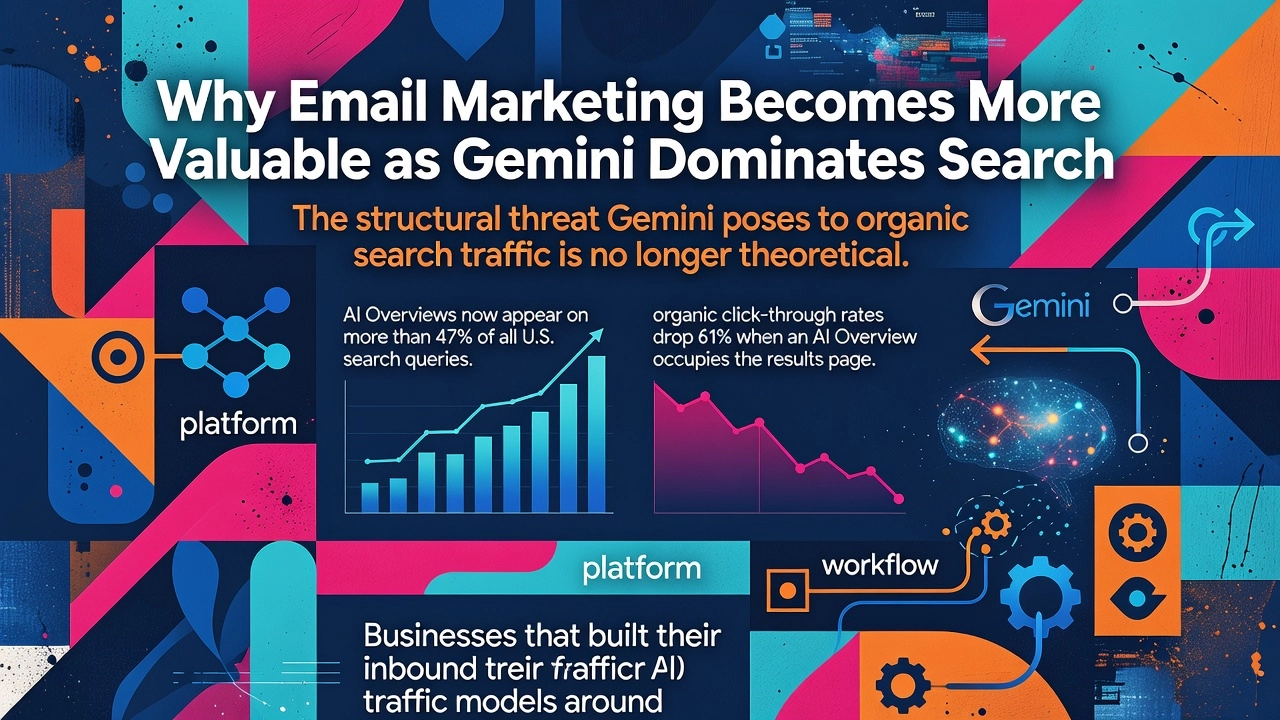
The structural threat Gemini poses to organic search traffic is no longer theoretical. AI Overviews now appear on more than 47% of all U.S. search queries, and organic click-through rates drop 61% when an AI Overview occupies the results page. Businesses that built their inbound traffic models around page-one rankings are discovering that ranking position no longer guarantees clicks. A position-one result sitting below an AI Overview now delivers 30 to 65% fewer clicks than the same ranking delivered in 2023. This is not a temporary algorithmic fluctuation; it is a structural compression that deepens as Gemini’s search integration matures.
Email marketing exists entirely outside this compression dynamic. A subscriber list is an owned asset. No Google update, no Gemini citation decision, and no AI Overview expansion can reduce the reach of a message sent directly to a confirmed subscriber. Where a page-one ranking can be displaced by AI-generated summaries overnight, an email list is permanent capital that the business controls completely. This distinction becomes strategically critical as zero-click behavior reaches 77% on mobile and 60% of all searches end without a single outbound click.
The personalization dimension reinforces this advantage further. Users arriving from AI-powered search have already been pre-qualified by Gemini’s conversational summaries. They expect context-aware, relevant communication, not generic messaging. AI-powered email platforms now enable businesses to replicate this relevance through behavioral triggers, predictive send-time optimization, and dynamic content blocks that adapt to individual subscriber activity. Matching the personalization standard that Gemini has established inside search requires the same data-driven precision inside the inbox.
Brands that began building email audiences before AI Overview penetration deepened now hold a meaningful competitive advantage. Their subscriber bases represent a traffic and revenue channel that requires no Gemini citation and no algorithm favor to function.
American Nexus Marketing’s email marketing software is built specifically to help businesses construct and protect this owned channel asset, combining list segmentation, automation, and behavioral personalization into a single platform designed for the realities of AI-dominated search in 2026.
Gemini Readiness Checklist: 8 Actions for Businesses in 2026
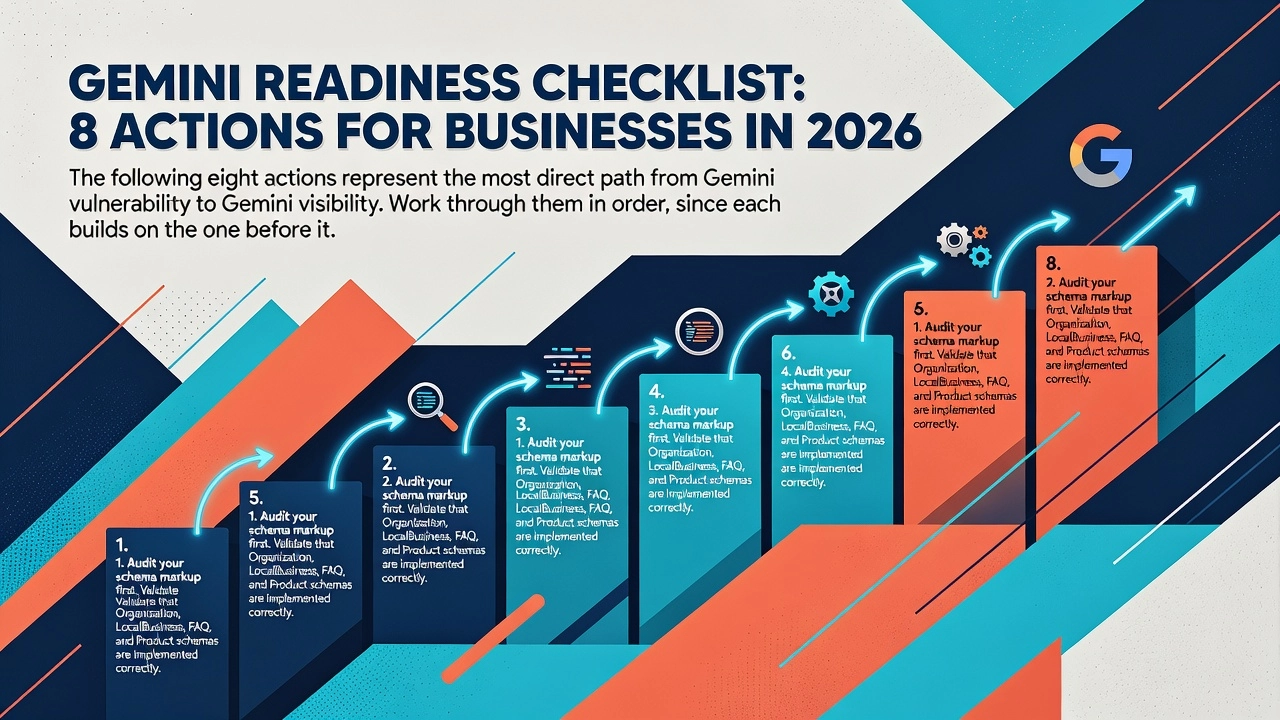
The following eight actions represent the most direct path from Gemini vulnerability to Gemini visibility. Work through them in order, since each builds on the one before it.
1. Audit your schema markup first. Validate that Organization, LocalBusiness, FAQ, and Product schemas are implemented correctly across your site using Google’s Rich Results Test. Schema is the single highest-leverage technical action available because it gives Gemini machine-readable signals about exactly what your business is, what it offers, and where it operates. Without validated structured data, Gemini cannot cleanly extract or surface your content in AI-generated answers regardless of how well-written that content is.
2. Restructure pages for direct-answer formatting. Rewrite key service and product pages to open with concise definitions, use question-formatted subheadings, and close with FAQ sections. Gemini is designed to understand the underlying intent of a query, not just match keywords, so content that directly and thoroughly addresses complex questions earns citation priority.
3. Optimize your Google Business Profile completely. Categories, services, attributes, Q&A responses, and photos all feed into Gemini’s local answer generation signals. A profile with gaps in any of these areas reduces the confidence signals Gemini draws on when constructing local recommendations.
4. Run a technical SEO audit for crawlability and indexation. If Gemini cannot access your content, it cannot cite it. Identify and resolve crawl blocks, indexation errors, and page speed issues before investing in content or schema work.
5. Build a question-based content calendar. Shift from single-keyword targeting to conversational, intent-driven queries that reflect how users speak to AI assistants. Queries like “what is the best email marketing strategy for a local service business in 2026” represent the format Gemini is optimized to answer.
6. Expand your email list as a traffic hedge. A Q1 2026 study found that 90% of brands have zero AI search mentions across eight AI platforms. Owned email lists insulated by segmentation and personalization provide engagement continuity regardless of how AI Overviews compress organic click-through rates.
7. Monitor AI citation rates, not just rankings. Traditional rank tracking does not capture whether Gemini is referencing your brand. Dedicated tools that surface AI mention rates across Gemini, Google AI Overview, and similar platforms are now essential measurement infrastructure. Google Analytics added AI traffic source grouping in June 2026, making this tracking more accessible than ever.
8. Commission a formal GEO and AEO audit. Given the complexity of optimizing across schema, content structure, GBP, technical SEO, and citation tracking simultaneously, a structured audit from a specialist like American Nexus Marketing provides a benchmarked baseline and a prioritized action plan rather than a scattered list of fixes.
What Gemini Means for Your Business and Where to Start
The evidence across this entire analysis points to one unavoidable conclusion: Google Gemini has permanently shifted the primary visibility metric from page-one ranking to AI citation frequency. Businesses that act now inherit a compounding advantage, because citation authority, schema depth, and content structure become harder for competitors to replicate the longer they are established. Waiting is not a neutral position; it is a decision to let early movers build that lead.
Gemini readiness is not a single tactic you can delegate to one team member. It is a coordinated strategy spanning schema optimization, local SEO signals, structured content, ecommerce product data, and owned channels like email that maintain audience access regardless of how search traffic shifts. Every layer reinforces the others.
The most actionable first step is a technical audit and schema review. Before investing in broader GEO or AEO strategy, you need a clear baseline of your current Gemini exposure: which pages are crawlable, where structured data is missing, and which content is already citation-eligible.
American Nexus Marketing offers exactly that starting point, along with AI search optimization, local SEO, schema optimization, and technical audit services designed for businesses ready to compete in the Gemini era. Contact the team today to begin.