
Why Smart Businesses Seek HubSpot Open Source Alternatives
The intro is already written, include it as is and ensure the rest of the article is consistent with the intro.
#
The best HubSpot open source alternatives in 2026 are:
- erxes — Self-hosted experience operating system with a plugin-based architecture; free core features
- EspoCRM — Lightweight, highly customizable sales CRM; completely free to self-host
- Mautic — Open-source marketing automation focused on email campaigns and lead nurturing
- nowCRM — Developer-first, multi-channel outreach platform built on Strapi 5 and Next.js
- CiviCRM — Best for non-profits; integrates directly with WordPress and Drupal
- YetiForce — Enterprise-grade customization with 80+ ready-to-use modules
- SuiteCRM — Community-supported fork of SugarCRM with broad sales pipeline features
If you’ve ever used HubSpot’s free plan, you know the feeling. It’s great — until it isn’t.
The free tier hooks you in with solid tools. Then your contact list grows, or you need one more feature, and suddenly you’re staring at a $890/month Professional plan. That’s not a typo.
HubSpot owns nearly a third of the marketing automation market, so it’s easy to assume it’s the only serious option. It’s not.
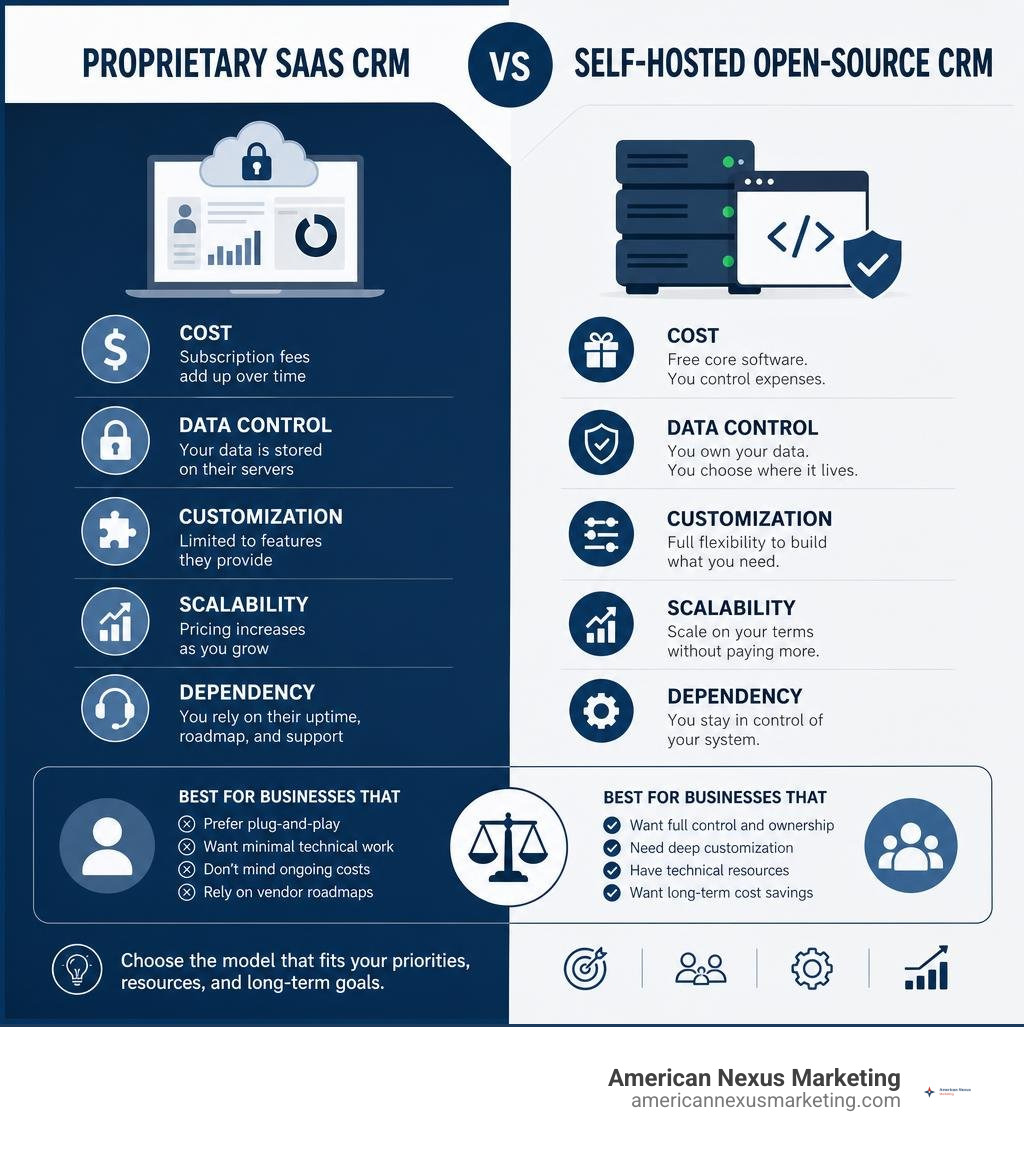
Open-source CRMs let you self-host the software on your own server. You own the data. You control the features. And in many cases, the core software costs you nothing.
The trade-off is real — you’ll need to handle hosting, setup, and maintenance yourself. But for a solo founder or small team watching their budget, that trade-off is often well worth it.
This guide compares the top open-source alternatives so you can find the right fit without paying for features you’ll never use.
Hubspot open source alternatives helpful reading:
For many growing startups and solo founders, the journey with proprietary CRM systems starts with optimism and ends with severe “sticker shock.” HubSpot’s free tier is an incredibly effective gateway. It allows unlimited users and up to 1,000 contacts, which makes it perfect for early-stage startups. However, as soon as you step off the free tier, the financial slope becomes incredibly steep.
While their Starter plans are relatively affordable, upgrading to Professional tiers for advanced marketing automation features triggers a massive jump to $890/month. On top of that, these premium tiers often come with mandatory 12-month contracts and expensive, forced onboarding fees that can add thousands of dollars to your initial setup. If you need custom reporting, expect to pay an extra $200/month just for the privilege.
This aggressive pricing model is why many smart businesses are looking to break free. By switching to a self-hosted, open-source alternative, you can bypass these artificial paywalls entirely. Instead of paying per stored contact or per user seat, you only pay for the raw infrastructure required to run the software. To understand how these subscription costs pile up over time, check out our guide on The Real Crm Software Cost For Small Business And How To Avoid Overpaying.
Beyond the sheer financial burden, there is the critical issue of data ownership and privacy compliance. When you host your customer data on a proprietary cloud like HubSpot, you do not have complete data sovereignty. For European businesses or companies handling international clients, GDPR compliance is a major operational hurdle. Even if you choose HubSpot’s EU-based hosting, the company remains subject to the US CLOUD Act, which allows US federal authorities to access data under certain conditions.
With an open-source CRM, you can host your database on your own local, secure EU servers, giving you absolute control over your compliance audits. Furthermore, proprietary platforms make leaving incredibly difficult. Exporting your data often leaves behind your automated workflows and historical interaction logs, creating a highly restrictive vendor lock-in. Open-source solutions give you direct database access, meaning your data is always yours to move, modify, or back up. For a broader look at how these platforms stack up against other market options, read The Ultimate Guide To Companies Like Hubspot For Growing Businesses.
Top Open-Source CRM Platforms to Replace HubSpot
Choosing the right open-source tool requires matching your team’s technical capabilities with your business goals. Below, we have outlined a quick comparison of three leading open-source options:
| Feature | erxes | nowCRM | EspoCRM |
|---|---|---|---|
| Primary Focus | Omnichannel Experience (XOS) | High-Scale Multi-Channel | Customizable Sales & B2B |
| Backend Tech | Node.js, MongoDB, GraphQL | Strapi 5, Next.js, PostgreSQL | PHP, MySQL |
| Best For | All-in-one operations | Mass campaigns & developers | Sales pipelines & B2B teams |
| Self-Hosting Cost | Free (Core) | Free (AGPL-3.0) | Free (Core) |

These self-hosted platforms offer incredible flexibility, but they do require a basic understanding of server administration. Let’s look at how each of these platforms can help you scale your operations without breaking the bank.
erxes: The Experience Operating System (XOS)
We like to think of erxes as more than just a CRM; they call themselves an “Experience Operating System” (XOS). The name itself is pronounced “erk-sis” and is the Mongolian word for “galaxy,” symbolizing a unified system where all your business operations revolve around a single core.
The platform is designed as an Nx-powered monorepo utilizing GraphQL Federation and Module Federation. In plain English, this means it is built on a highly modular, decoupled microservices architecture. The core platform and essential plugins—like a shared team inbox, basic contact management, and simple marketing automation—are source-available and entirely free to use.
If your business has specialized needs, erxes offers a marketplace with advanced plugins for industries like tourism, finance, and advanced accounting. While some of these advanced plugins require an Enterprise Edition license, the free core is more than enough for most small businesses to replace HubSpot’s basic marketing and service hubs. You can explore the codebase and get started by visiting the erxes/erxes GitHub repository.
nowCRM: Multi-Channel Outreach at Scale
If your business relies heavily on outbound marketing across multiple messaging channels, nowCRM is an incredibly powerful, developer-first option. It is built on a modern tech stack consisting of Strapi 5 as a headless CMS backend, Next.js 15 for the frontend, and a KrakenD API Gateway to orchestrate its microservices.
What makes nowCRM stand out is its ability to handle heavy, asynchronous bulk operations without crashing your server. It achieves this by using BullMQ and Redis to manage queues. When you import a list of 100,000 leads and trigger a campaign, the platform uses a “masssendQueue” to throttle outbound messages, alongside a “sendQueue” that handles individual dispatches with exponential backoff if a message fails.
Out of the box, nowCRM supports a massive array of communication channels:
- Email (via AWS SES or standard SMTP)
- WhatsApp Business API
- SMS (via AWS SNS)
- Telegram Bot API
- Twitter (X) API
- LinkedIn OAuth and Unipile integration
The platform is licensed under the GNU AGPL-3.0, which closes the “SaaS loophole” by requiring you to open-source any modifications you make if you run the software as a network service. You can download the code from nowtec/nowCRM or check out active community forks like gariwat/nowCRM_af.
EspoCRM: Highly Customizable Sales Tracking
For businesses that are sales-first rather than marketing-first, EspoCRM is an exceptional choice. While HubSpot started as an inbound marketing platform and bolted its CRM features on later, EspoCRM was built from the ground up to track sales pipelines, manage accounts, and streamline B2B sales cycles.
The beauty of EspoCRM lies in its customization. Without writing a single line of code, you can use its administrative portal to create custom entities, design relationship schemas, and build custom dashboards. If you do have developer resources, you can easily extend the platform using PHP and JavaScript.
EspoCRM is completely free to use if you self-host it on your own server. It includes robust features for sales automation, calendar synchronization, and lead tracking. For B2B sales teams that want to avoid the cluttered, marketing-heavy interface of HubSpot, EspoCRM offers a clean, lightning-fast alternative. To learn more about selecting the right sales-focused CRM for your business, read our guide on Sprocket Science Finding Software Similar To Hubspot For Your Small Business.
Advanced AI-Driven Platforms for Modern Sales
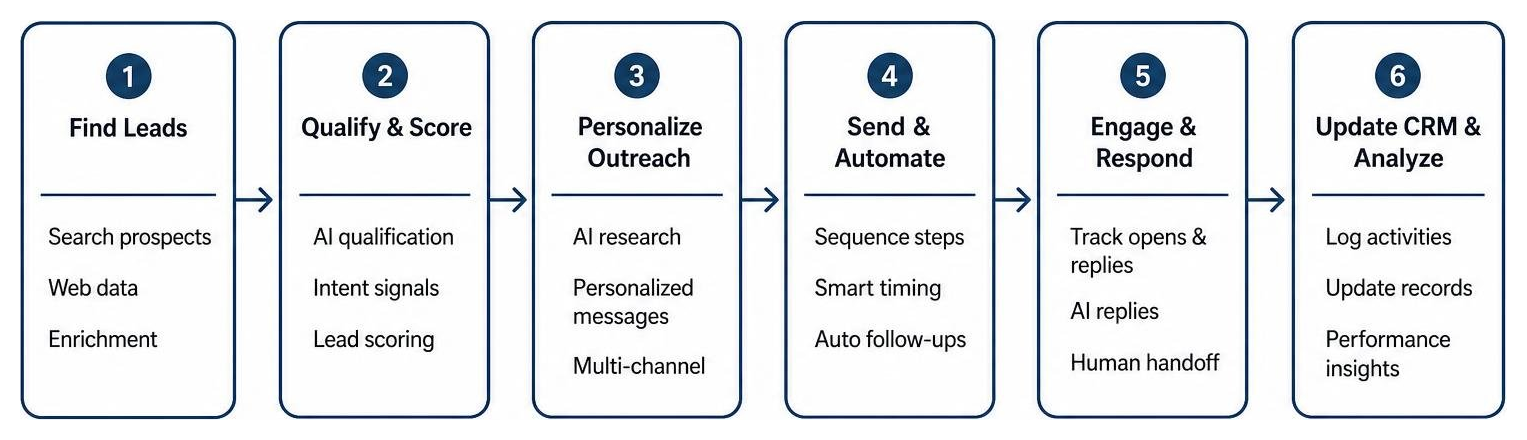
As we move through 2026, the CRM landscape is shifting rapidly toward automation and artificial intelligence. Many businesses are realizing that they don’t just need a database to store contacts; they need an active engine that helps them source leads, score deals, and draft personalized outreach.
Evaluating AI-Powered HubSpot Open Source Alternatives
Proprietary AI sales assistants and “AI SDRs” have become incredibly popular, but they often operate as expensive closed-source “black boxes” that charge upwards of $2,000 to $5,000 per month. Under the hood, many of these tools are simply expensive wrappers around public APIs. Open-source AI tools allow you to run these exact same workflows using your own API keys for a fraction of the cost—typically between $50 and $200 per month depending on your volume.
Here are three leading open-source AI engines that can replace HubSpot’s native prospecting tools:
- revenue-os: This is an open-source AI prospecting agent designed to replace high-cost proprietary SaaS tools. It allows you to connect your own email accounts, sync contacts, and define your ideal customer profile (ICP). By running durably on serverless workflow engines like Trigger.dev, it can automate multi-day, multi-channel outreach sequences. If an email address burns out, the system automatically rotates in a new sender profile without interrupting the sequence. You can access the repository at personizeai/revenue-os.
- gtm-engine: If you want to replace an entire $100,000/year marketing and sales SaaS stack, this platform uses five autonomous AI agents running on your own infrastructure. It features an ICP Agent for lead scoring, an Outbound Agent for drafting personalized emails, a Deal Intelligence Agent for calculating risk, a Retention Agent for churn prediction, and a Content Agent for SEO blog generation. Crucially, it includes a “human-in-the-loop” approval queue so that no AI-generated email is sent without your manual sign-off. Check out the project at sohan-a11y/gtm-engine.
- Signal: Signal is a chat-first, AI-driven sales intelligence workspace built with Claude. It monitors the web for buying signals (such as hiring changes or product launches), enriches contact data using browser automation, and drafts outreach sequences. Because you bring your own Supabase and Anthropic API keys, you maintain 100% data ownership. You can find the code at jay-sahnan/signal.
Integrating HubSpot Open Source Alternatives with Existing Tools
A common worry when moving to an open-source CRM is losing the seamless integrations that proprietary platforms offer. Fortunately, modern open-source CRMs are highly compatible with the daily business tools you already use.
Most open-source options offer native integrations or easy API connections for:
- Email & Calendars: Bidirectional syncing with Gmail and Outlook ensures that your emails, meetings, and tasks are automatically logged without manual data entry.
- Marketing & Newsletters: You can easily connect your self-hosted database to platforms like Mailchimp or open-source alternatives like Mautic to keep your subscriber lists synchronized.
- Video Conferencing: Integrations with Zoom allow you to generate meeting links directly from your CRM calendar.
By using tools like Zapier, Make, or open-source workflow automation platforms like Activepieces, you can build custom integrations that connect your self-hosted CRM to virtually any tool in your business stack. For a step-by-step approach to setting up these integrations on a budget, take a look at our Small Team Crm Guide Free And Cheap Tools That Actually Work.
Frequently Asked Questions about Open Source CRMs
Is it necessary to pay for a CRM, or can a free open-source solution suffice?
For many small businesses, solo founders, and startups, a free open-source solution is more than sufficient. If your primary needs are tracking a sales pipeline, managing customer contact information, and sending basic email campaigns, paying hundreds of dollars a month for a proprietary CRM is simply unnecessary.
Open-source platforms give you the exact same core capabilities as paid systems. The deciding factor is your technical resource level. If you have the time or a team member who can handle a basic server setup, you can run a world-class CRM for nothing more than the cost of hosting.
What are the hidden costs of running a self-hosted open-source CRM?
While the software itself is free, running an open-source CRM is “free like a puppy, not free like beer.” You won’t pay software licensing fees, but you will encounter operational costs:
- Hosting: You will need a cloud server (such as DigitalOcean, AWS, or Linode) to host the software, which typically costs between $10 and $100/month depending on your database size.
- Maintenance: You must dedicate time (or hire a developer) to handle software updates, database backups, and server security.
- Third-Party APIs: If you use your CRM for mass emailing, SMS, or AI enrichment, you will pay direct usage fees to providers like AWS SES, Twilio, or Anthropic.
Even with these infrastructure costs, the total cost of ownership is usually a fraction of a HubSpot subscription. For a deeper breakdown of affordable CRM options, read our analysis of The Best Low Cost Crm Software For Small Business In 2026.
How do open-source CRMs handle data privacy and security compared to HubSpot?
Open-source CRMs actually offer superior data privacy because they grant you complete data sovereignty. When you host your own CRM, your customer data is stored on your own private servers. It is not pooled in a shared cloud database, and it is not subject to the tracking or data-sharing policies of a third-party corporation.
This makes it much easier to comply with strict regulations like GDPR, as you can choose exactly where your physical servers are located and control exactly who has access to the database.
Conclusion
Transitioning to one of the top hubspot open source alternatives is one of the smartest moves a growing, budget-conscious business can make. It allows you to escape the predictable “sticker shock” of proprietary upgrades, reclaim complete ownership of your customer data, and customize your workflows without paying for bloated feature sets you don’t actually need.
At American Nexus Marketing, we specialize in providing practical, jargon-free digital marketing guidance tailored specifically for low-budget, solo-founder teams. We believe that you shouldn’t have to overpay for enterprise-grade tools to build a successful business.
If you are ready to evaluate your marketing stack and find the perfect balance between cost, control, and performance, explore our comprehensive guide on the best all-in-one marketing platforms compared in 2026 to make your next strategic move with confidence.