
The Ultimate Guide to Companies Like HubSpot for Growing Businesses
Companies Like HubSpot: The Best Alternatives for Growing Businesses in 2026
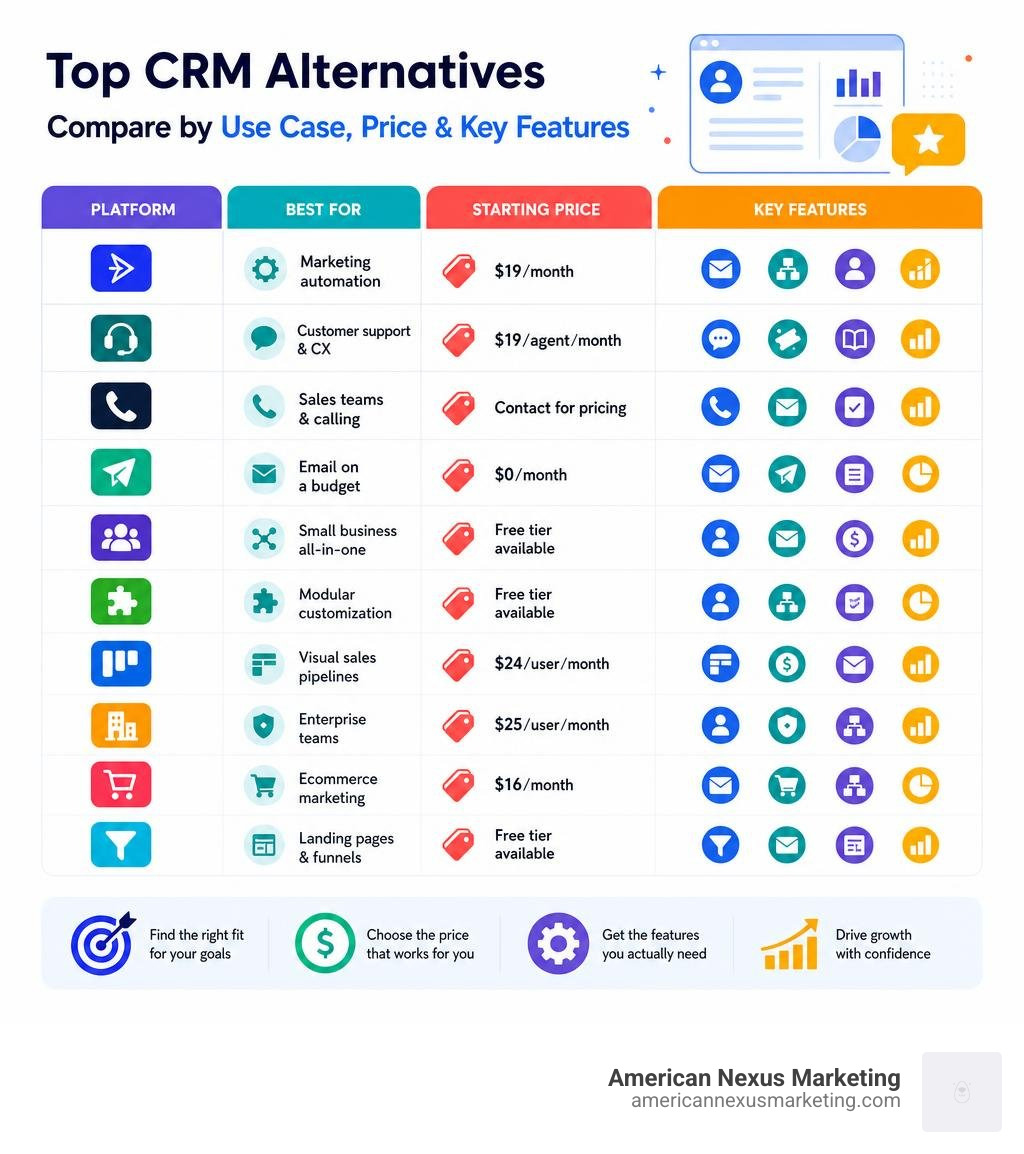
If you’re evaluating companies like HubSpot, here are the top alternatives worth knowing about:
| Platform | Best For | Starting Price | Free Trial |
|---|---|---|---|
| ActiveCampaign | Marketing automation | $19/month | Yes |
| Zendesk | Customer support & CX | $19/agent/month | 14 days |
| Close | Sales teams & calling | Contact for pricing | Yes |
| Brevo | Email on a budget | $0/month | Yes |
| EngageBay | Small business all-in-one | Free tier available | Yes |
| Zoho CRM | Modular customization | Free tier available | Yes |
| Pipedrive | Visual sales pipelines | $24/user/month | Yes |
| Salesforce | Enterprise teams | $25/user/month | 30 days |
| Omnisend | Ecommerce marketing | $16/month | Yes |
| GetResponse | Landing pages & funnels | Free tier available | Yes |
HubSpot is genuinely impressive software. It owns nearly a third of the marketing automation market, and its free CRM is trusted by over 299,000 customers across 135+ countries. Those are not small numbers.
But here’s the problem most small business owners run into: the free plan is great until it isn’t.
The moment you need real marketing automation, advanced reporting, or proper customer support tools, the price jumps fast. We’re talking from around $20–$50 per month on Starter plans to $890 per month for Professional marketing features. That’s a cliff, not a step.
And it’s not just the price. HubSpot’s customer service tools are relatively new. Its knowledge base has frustrating limitations. It lacks native SMS. And plugging those gaps means paying for third-party add-ons that quietly inflate your total cost of ownership.
So it makes sense that thousands of growing businesses are looking for alternatives — tools that do one thing really well without charging enterprise prices for features you barely use.
This guide breaks down the best options by category, so you can find the right fit for your actual needs and budget.
Why Growing Businesses Seek Companies Like HubSpot
While HubSpot has built an incredible ecosystem, we frequently speak with business owners who feel backed into a corner by their software. The decision to hunt for companies like HubSpot rarely stems from a single missing button; instead, it is usually driven by a combination of compounding costs and structural limitations.

The Financial Cliff of HubSpot Pricing
The most common driver for leaving HubSpot is what we call the “financial cliff.” HubSpot’s pricing model is incredibly friendly to early-stage startups. You can use their free tier indefinitely, and their Starter plans (often priced around $15 to $50 per month) feel highly accessible.
However, as your business grows, your contact list expands, and you require more sophisticated workflows, you hit a massive price jump. Upgrading from the Starter CRM Suite to Professional marketing features costs roughly $890 per month. If you need advanced reporting, HubSpot charges an additional $200 per month add-on. This steep escalation makes it incredibly difficult for a self-funded startup or small team to scale sustainably. You find yourself paying for a massive suite of enterprise tools when you may only use a fraction of them.
Limitations in Customer Experience and Customization
Another major pain point is HubSpot’s Service Hub. While HubSpot is a marketing powerhouse, its customer service and support features are relatively new and lack the depth of dedicated help desk platforms.
For instance, businesses trying to build out a robust help center often find that they cannot easily duplicate articles, leading to tedious manual rework. Furthermore, HubSpot lacks deep, native SMS and popular messaging channels out of the box. To reach customers on their preferred platforms, you are forced to purchase third-party integrations, which increases both your technical complexity and your total cost of ownership.
Top Companies Like HubSpot Categorized by Business Need
To help you navigate the landscape of companies like HubSpot, we have broken down the top competitors into specialized categories. Depending on whether your primary bottleneck is sales follow-ups, customer support, or budget-friendly email marketing, the right platform will vary.
Best Companies Like HubSpot for Sales and Marketing Automation
If your primary goal is to generate leads, nurture them through automated email sequences, and close deals with a visual sales pipeline, these platforms are your best bet.
- ActiveCampaign: Regarded as a powerhouse for marketing automation, ActiveCampaign offers a visual, flowchart-style automation builder that is far more intuitive and flexible than HubSpot’s lower-tier offerings. Starting at just $19 per month, it provides advanced lead scoring, site tracking, and deep CRM integration without the enterprise price tag.
- close.com: If your team is heavily focused on outbound sales, Close is a fantastic alternative. It is a highly action-oriented sales CRM built specifically for calling, emailing, and texting. Rather than forcing you to jump between different tools, Close features built-in calling, SMS marketing, and automated pipeline tracking. It eliminates the administrative bloat of traditional CRMs so your reps can focus entirely on selling.
- Pipedrive: For teams that want a simple, highly visual sales pipeline, Pipedrive is a favorite. Starting at $24 per user/month, it uses a visual card system to help you track deals, sync calendar tasks, and automate follow-ups without any unnecessary complexity.
Best Companies Like HubSpot for Customer Experience and Support
If your business relies heavily on post-purchase support, customer retention, and managing inquiries across multiple channels, you need a dedicated customer experience (CX) platform.
- Zendesk: With over 160,000 businesses trusting its platform, Zendesk is the gold standard for customer support. Unlike HubSpot’s newer Service Hub, Zendesk offers a unified agent workspace, advanced ticket management, and native omnichannel support (including live chat, voice, SMS, and messaging apps). Pricing starts at a reasonable $19 per agent/month, making it highly competitive.
- Ortto: Your customer data, marketing automation & analytics, together: Ortto is a modern platform that brings customer data, marketing automation, and support together. By combining a Customer Data Platform (CDP) with multi-channel messaging (Email, SMS, Push, and In-app notifications), Ortto allows you to build highly personalized customer journeys. It features no-code integrations, custom reporting dashboards, and built-in AI response tools to streamline customer support, making it an incredibly powerful option for fast-growing SaaS and B2B brands.
Best Value-for-Money Alternatives for Small Businesses
For solo founders, startups, and small businesses operating on tight budgets, these alternatives deliver incredible features without breaking the bank.
- EngageBay: Designed specifically as a direct, affordable alternative to HubSpot’s all-in-one suite, EngageBay offers marketing, sales, and support tools in a single platform. Its Pro plan is priced at just $49.99/month, providing a massive discount compared to HubSpot’s Professional tiers.
- Brevo (formerly Sendinblue): Trusted by over 600,000 users, Brevo takes a unique approach to pricing by charging based on the volume of emails sent rather than the number of contacts in your database. This is a game-changer for businesses with large contact lists but low sending frequencies. Paid plans start at $39/month for 20,000 emails and unlimited contacts.
- Omnisend: If you run an online store, Omnisend is a highly specialized ecommerce marketing tool. Starting at $16/month, it offers pre-built workflows for cart abandonment, transactional SMS, and seamless integrations with Shopify and WooCommerce.
- GetResponse: Operating in 183 countries, GetResponse features over 180 responsive landing page templates, conversion funnels, and email marketing tools starting at affordable rates.
AI-Native CRMs vs. Traditional Platforms
As we move through 2026, the CRM landscape is undergoing a massive shift. Traditional platforms like HubSpot and Salesforce were built as passive databases—systems of record where human employees must manually input data, log calls, and drag cards across a pipeline.
Modern, AI-native platforms are turning CRMs into active systems of action, where human employees and autonomous AI agents work side-by-side.

The Rise of Agentic CRM Workflows
An “agentic” CRM uses autonomous AI agents to build, coordinate, and optimize workflows with minimal manual intervention. Instead of your team spending hours setting up complex triggers, AI handles the heavy lifting.
- Creatio: As a leader in low-code and AI-native CRM architecture, Creatio offers a approach to business automation. Through their core platform, AI CRM and Workflow Platform | Creatio, businesses can orchestrate workflows where humans and AI agents collaborate seamlessly.
- Creatio Marketing: For marketing operations, Agentic Marketing CRM Platform with AI and No-Code | Creatio Marketing employs specialized AI agents for content generation, lead scoring, and campaign orchestration. It uses visual, no-code designers to accelerate the lead-to-revenue cycle with no limits on scale.
- Creatio CRM: By utilizing Creatio AI CRM Software Product Overview | Get a demo | Creatio, organizations report up to a 37% lower total cost of ownership and 70% faster implementation times. It offers a true no-code, conversational interface that adapts dynamically to your business rules.
- Conversion | AI-Native B2B Marketing Automation Platform: Built specifically for marketing operations teams looking to replace legacy systems like HubSpot or Marketo, Conversion unifies your CRM and data warehouse (such as Snowflake or BigQuery) into a single, flexible data model. Unlike HubSpot’s basic flat-field contact mapping, Conversion’s deep data warehouse sync allows AI agents to handle quality assurance, run real-time workflows, and build complex multi-channel campaigns in hours instead of weeks.
Comparing Traditional Databases to AI Teammates
To illustrate the difference between traditional CRMs and AI-native systems, let’s look at how they handle daily sales activities:
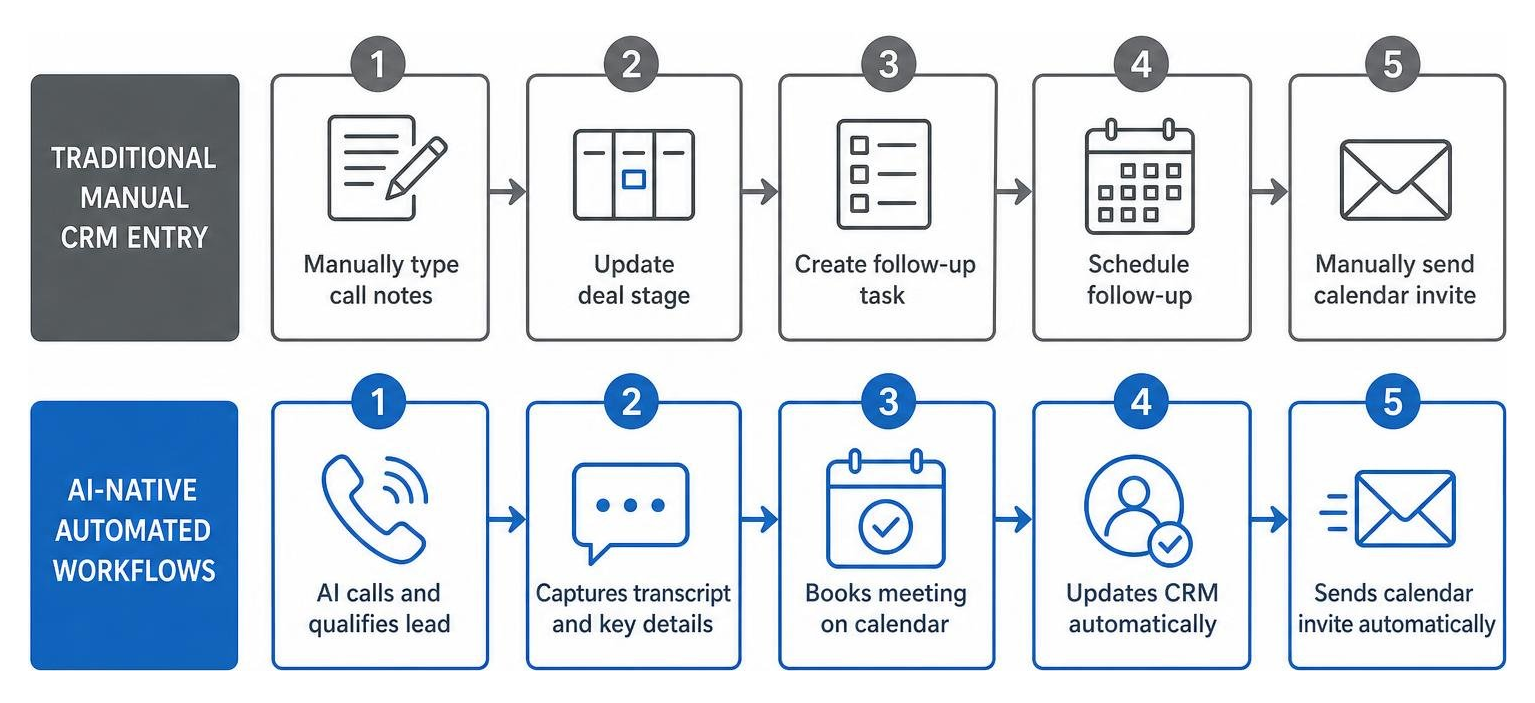
In a traditional CRM, a sales rep must manually type call notes, update the deal stage, schedule a follow-up task, and manually send a calendar invite.
With an AI-native CRM like Close, its built-in AI teammate (Chloe) can automatically call leads, qualify prospects through natural phone conversations, log call transcripts, book meetings directly onto the rep’s calendar, and update the CRM records instantly. This reduces manual data entry by up to 17% and allows your team to focus entirely on building human relationships and closing deals.
All-in-One Platforms vs. Modular Tech Stacks
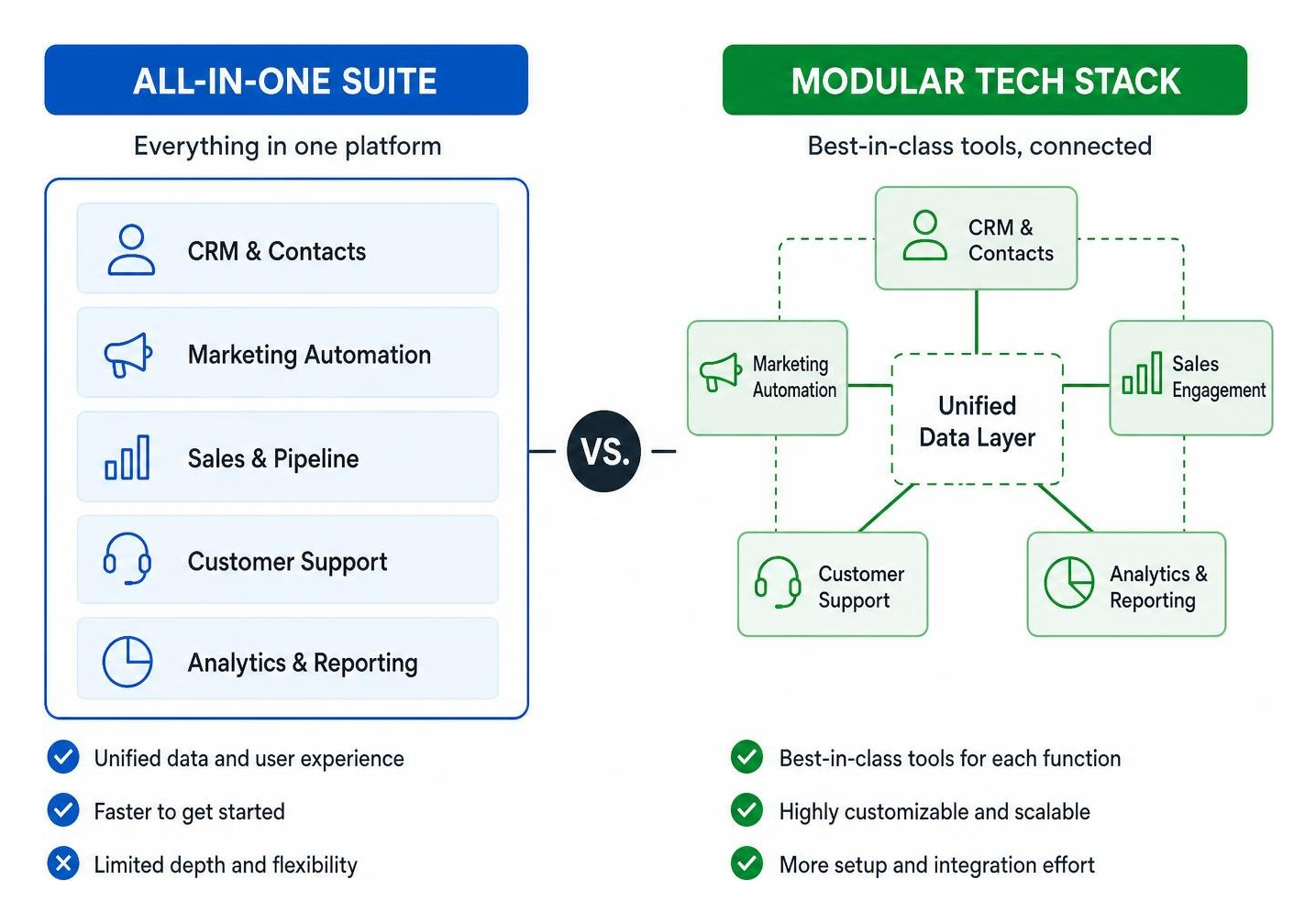
When choosing a software suite, businesses face a fundamental architectural question: Do you buy an all-in-one platform, or do you build a modular tech stack using specialized tools?
The Case for Unbundling Your CRM
HubSpot’s pitch is simple: “Keep all your data and tools in one place.” While this sounds convenient, the reality is that all-in-one platforms are often “jacks of all trades, masters of none.” HubSpot’s marketing hub is fantastic, but its customer support and sales calling features can feel limited compared to specialized tools.
Unbundling your CRM means choosing “best-of-breed” software for each department. For example, you might use:
- ActiveCampaign for advanced marketing automation.
- Close for outbound sales and calling.
- Zendesk for world-class customer support.
This modular approach prevents software bloat, protects you from paying for dormant features, and ensures that each team has the absolute best tool for their specific job.
Key Considerations for Choosing Your Stack
If you decide to build a modular stack, keep these three best practices in mind:
- Two-Way Data Sync: Ensure your tools support real-time, bidirectional data synchronization. This prevents duplicate records and keeps your sales and marketing teams aligned.
- Define the Master CRM Record: Decide which platform serves as your single source of truth (the Master Record) to avoid data conflicts.
- Process Alignment: Before automating any workflow, test it manually. Software cannot fix a broken process; it will only accelerate the confusion.
Risks and Challenges of Migrating from HubSpot
If you decide to transition to a HubSpot alternative, it is vital to prepare for the migration process. While 72% of companies use marketing automation, roughly 52% find it highly challenging to migrate workflows from legacy CRMs.
Data Migration and Workflow Disruption
The biggest risk during migration is data loss and pipeline disruption. HubSpot relies on flat-field mapping for many of its contact records, whereas other advanced platforms use complex custom objects and relational databases. Exporting your data, cleaning up duplicate contacts, and mapping historical deal records to a new system requires careful planning. If done incorrectly, you risk losing valuable lead history, breaking active email sequences, and disrupting active sales conversations.
Retraining and Team Adoption Costs
The financial cost of a new software contract is only one part of the equation. You must also account for the time and productivity lost during the transition. Your go-to-market team will need to learn a new interface, build new habits, and rebuild their automated workflows from scratch. To minimize this friction, we recommend utilizing free trials (typically ranging from 14 to 30 days) to test platform usability with a small group of users before committing to a full migration.
Frequently Asked Questions About HubSpot Competitors
Why is HubSpot so expensive compared to its competitors?
HubSpot uses a contact-based pricing model combined with steep feature gating. While their starter tiers are cheap, upgrading to get access to essential features like advanced automation, custom reporting, or smart content triggers requires moving to their Professional or Enterprise tiers, which cost hundreds of dollars more per month. Additionally, they charge based on the number of marketing contacts in your database, meaning your bill automatically increases as your business grows.
What is the best free alternative to HubSpot CRM?
For small businesses looking for a free CRM, EngageBay and Zoho CRM offer highly capable free tiers that include contact management, basic email marketing, and simple pipeline tracking. While HubSpot’s free CRM is also excellent, these alternatives offer cheaper upgrade paths when you eventually outgrow the free limits.
Is it difficult to migrate data from HubSpot to another CRM?
Yes, it can be challenging. Because HubSpot utilizes proprietary data structures and workflows, moving your data requires exporting CSV files, cleaning the data, and manually rebuilding your automated marketing campaigns and email templates in the new system. For larger databases, hiring a migration specialist is often recommended to avoid data loss.
Conclusion
Finding the right software is about aligning your tools with your actual business processes. HubSpot is a fantastic platform, but it is not the only option on the market in 2026. Whether you choose an all-in-one alternative like EngageBay, a specialized powerhouse like Zendesk, or an AI-native platform like Creatio, the key is to avoid paying for empty software seats and bloated features.
At American Nexus Marketing, we specialize in providing jargon-free, checklist-driven digital marketing guidance for small businesses and solo founders. We want to help you make informed decisions without breaking your budget.
If you are ready to explore your options further, check out our comprehensive breakdown of the Best All-in-One Marketing Platforms Compared 2026 to find the perfect fit for your growth journey.
Pingback: CRM Software with Email Integration: Ultimate Growth
Pingback: Best Content Creation Services for Nonprofits
Pingback: HubSpot Open Source Alternatives: Smart 2026 Guide