
Clean Up Your Act: Why You Need a Professional Citation Cleanup Service
The Hidden Problem Costing Your Business Local Search Rankings
A citation cleanup service fixes the messy, inconsistent business information scattered across online directories — and it can make or break your visibility in local search results.
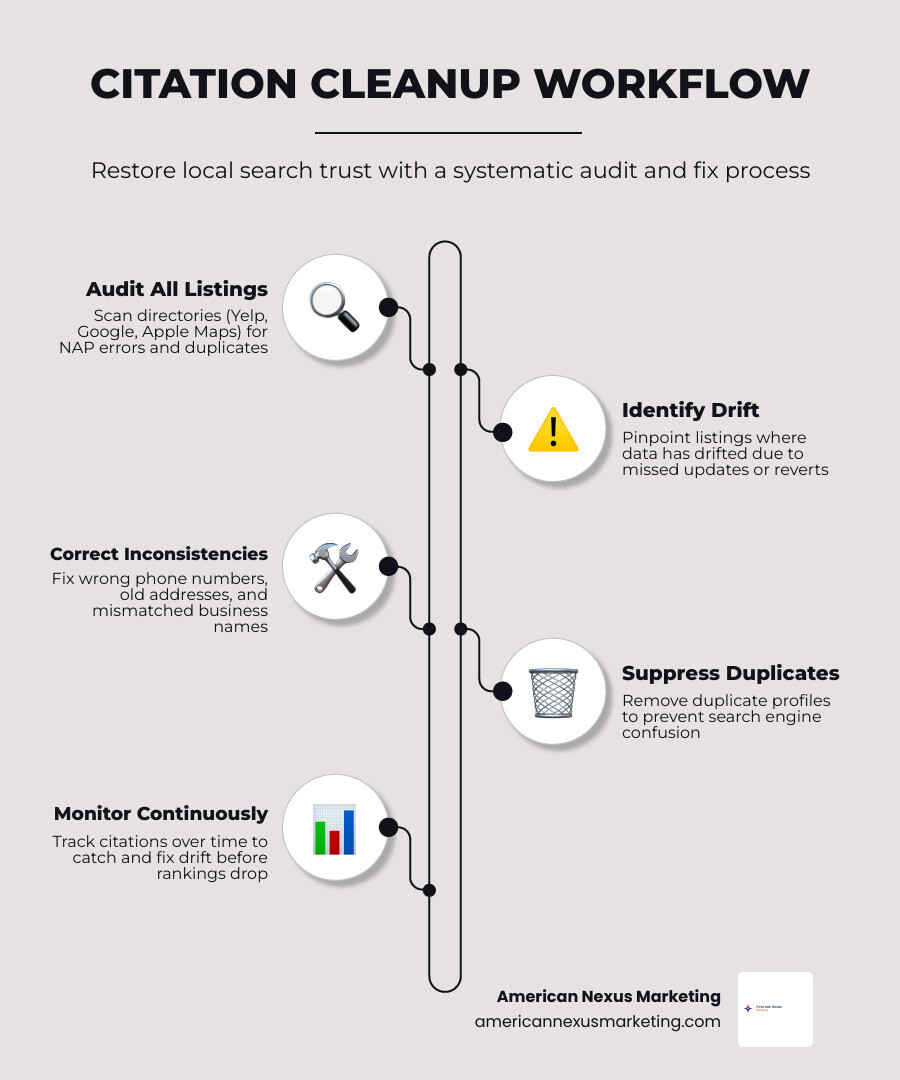
Here’s what a citation cleanup service does:
- Finds and corrects wrong or outdated Name, Address, and Phone (NAP) data across directories like Yelp, Google, and Apple Maps
- Removes duplicate business listings that confuse search engines
- Standardizes how your business name, address, and categories appear everywhere online
- Monitors for “citation drift” — when corrected listings quietly revert back to errors over time
There are actually two very different types of citation cleanup services:
| Type | Who It’s For | What It Fixes |
|---|---|---|
| Local SEO citation cleanup | Small businesses, local brands | Inconsistent NAP data, duplicate directory listings, wrong categories |
| Academic citation cleanup | Researchers, students, journal editors | Formatting errors, hallucinated references, bibliography mismatches |
If you run a local business, here’s why this matters right now.
One wrong phone number on a directory listing. An old address that never got updated. A duplicate profile from when someone else claimed your business years ago. None of these feel urgent — until your competitor shows up in the Google Map Pack and you don’t.
Search engines like Google use your citation data as a trust signal. When your business information conflicts across directories, Google gets confused about who you are and where you are. That confusion pushes you down in local results.
The good news? It’s a fixable problem — when you use the right service.
What is a Citation Cleanup Service and Why Does It Matter?
At its core, a citation cleanup service is a systematic process designed to identify and correct inaccuracies across your digital footprint. In the local SEO world, this centers entirely around your “NAP” data (Name, Address, Phone number).
When you first launch a business, you might list your company on Yelp, the YellowPages, and Facebook. Over time, you might move offices, change your primary phone number, or slightly tweak your legal business name. If you do not manually update every single directory, you create a trail of digital breadcrumbs that lead to dead ends.
This causes two major issues:
- Search Engine Identity Confusion: Search engines crawl these directories to verify that your business is legitimate and active. If Google sees three different addresses or two different phone numbers, its algorithm loses trust in your data. To protect its users, Google will push your business down in the local search results.
- Customer Frustration: Imagine a potential customer trying to call your shop, only to reach a disconnected line found on an outdated directory. They will not search for your correct number — they will simply click on your competitor.
To make matters worse, listings suffer from “citation drift.” This is a phenomenon where previously corrected directory listings revert to old, incorrect data or spawn new errors. This happens because directories constantly share, buy, and scrape data from third-party aggregators. To keep your search rankings healthy, you must audit your digital presence regularly. For a step-by-step approach to diagnosing your business’s current state, see our guide on how to Keep It Consistent How To Audit Your Business Nap For Better Rankings.
Local SEO vs. Academic Citation Cleanup: Key Differences
While the word “citation” is shared by both local marketers and academic researchers, the actual services perform entirely different functions.
In the local SEO space, a citation is any online mention of a business’s name, address, phone number, or website. The objective is to build trust with search engines and place your business on the map. Tools like a Google Business Profile act as the anchor for these citations. If you are new to managing this asset, check out our guide on Google Company Profile 101 Put Your Business On The Digital Map to understand how it integrates with your broader directory presence.
In the academic world, a citation is a reference to a published source (like a journal article or book). Academic citation cleanup focuses on ensuring that bibliographies are free of formatting errors, that in-text citations match the reference list, and that “hallucinated” or fabricated references generated by AI writing tools are caught and removed.
Here is how the two types of services compare across core workflows:
| Feature | Local SEO Citation Cleanup | Academic Citation Cleanup |
|---|---|---|
| Primary Goal | Standardize NAP data across business directories | Format bibliographies and verify academic sources |
| Core Identifiers | Business Name, Address, Phone, Website | Author, Publication Year, Title, DOI, Page Ranges |
| Primary Databases | Yelp, Google Maps, Apple Maps, Foursquare | CrossRef, OpenAlex, Google Scholar, PubMed |
| Common Tools | Directory scanners, API aggregators | Zotero, Mendeley, CiteOrbit, CitationFixer Pro |
| Key Threat | Duplicate profiles and citation drift | Hallucinated AI references and orphaned citations |
Choosing a Local SEO Citation Cleanup Service
If you are looking to boost your local visibility, you need a service that specializes in directory audits, duplicate suppression, and address normalization. Because directory update speeds depend heavily on third-party platform responsiveness and edit permissions, choosing a provider with a proven methodology is critical.
When evaluating local SEO citation cleanup options, look for providers that offer:
- Comprehensive Directory Audits: The service should scan major search engines, mapping apps, and niche directories to find every instance of your business information.
- Thorough Duplicate Suppression: Having multiple listings for the same location confuses search engines. A good service will identify and permanently remove or merge these duplicates.
- Address and Category Normalization: Your business address must be formatted consistently (e.g., “Suite 100” vs. “Ste 100”), and your business categories must align across all platforms.
- Ongoing Monitoring: Because of citation drift, corrected listings can revert over time. Continuous tracking ensures your data remains clean.
To understand why having clean data is so critical for showing up where customers are looking, read our detailed article on Why Your Business Needs The Best Local Seo Expert To Dominate Google Maps. If you prefer to handle the initial setup yourself before hiring help, you can follow The No Nonsense Guide To Create Company Profile On Google.
Choosing an Academic Citation Cleanup Service
If you are a graduate student, researcher, or journal editor, your “citations” are the scholarly references at the end of your manuscript. Academic bibliographies fail in highly predictable ways, including:
- Orphaned references: In-text citations that have no matching entry in the bibliography.
- Ghost citations: Bibliographic entries that are never cited in the body of the paper.
- AI hallucinations: Completely fabricated sources generated by large language models that look convincing but do not actually exist.
To solve these issues, researchers turn to academic citation cleanup tools and services:
- CiteOrbit – Citations that stay consistent : Built specifically for journal editors and researchers, CiteOrbit uses deterministic, non-LLM algorithms to check manuscripts without uploading them to AI training sets. It supports 20+ citation styles (including APA, MLA, Chicago, Harvard, IEEE, and Vancouver). Editors report that automating this step cuts manual bibliography cross-checking time by up to 98%.
- CitationFixer Pro — Fix Citation Formatting Errors in Word Documents : This tool specializes in mechanical formatting. It supports 17 styles (including Bluebook, OSCOLA, and APA 7) and offers a free demo that previews the first 5 citations. Paid plans are highly affordable, starting at just $4.99 for a 1-week pass covering up to 200 citations.
- Citation Enhancement Service – Contentxprtz : A professional, human-in-the-loop service that starts at ₹2,999 per project. It reviews citation gaps, verifies source quality, and ensures strict style compliance.
- Citation & Reference Management – liftmypaper.in : This service provides manual, line-by-line verification of academic references. It is ideal for researchers who need to migrate their entire library across styles (e.g., from Harvard to Vancouver) or clean up their Zotero or Mendeley databases.
Key Features to Look For in a Citation Cleanup Tool
Whether you are cleaning up business directories or academic papers, you should not settle for a tool that simply spits out a basic audit report. You need a solution that actively fixes the issues and verifies the results.
When evaluating a citation cleanup service, look for these essential features:
- Database Verification: The tool must cross-reference your data against authoritative databases. For local SEO, this means checking listings against major data aggregators and mapping platforms. For academics, it means verifying DOIs and metadata against open-access databases like CrossRef and OpenAlex.
- Manual Verification Pass: Automated tools are great for finding errors, but they can make incorrect assumptions. The best services combine software scanning with manual human reviews to ensure that duplicates are actually removed and address formatting is normalized.
- Automated Tracking and Reporting: You need to see a clear “before and after” comparison. A quality service will show you exactly which listings or references were broken, what corrections were made, and confirm when those changes are live.

Common Mistakes to Avoid When Cleaning Up Your Citations
Cleaning up citations is a highly technical task. If you try to rush the process, you can easily make mistakes that hurt your search visibility or academic credibility. Here are the most common pitfalls to avoid:
- Treating it as a one-time fix: For local businesses, citation drift is a constant threat. New directories scrape old data, and directories constantly merge. You must treat citation cleanup as an ongoing maintenance task rather than a single project.
- Ignoring category and address normalization: In local SEO, simply matching your business name and phone number is not enough. If one directory lists your category as “Pizza Restaurant” and another lists it as “Italian Restaurant,” search engines may struggle to understand your primary offering. Standardizing your business categories is just as important as fixing your address.
- Relying on pure automation: Automated overwrites can accidentally merge two distinct locations or overwrite correct data with outdated information. Always choose a service that allows you to review and approve changes before they are pushed live.
If you are looking for more ways to keep your digital presence optimized, explore our guide on Six Simple Ways To Improve Your Sites Seo Ranking Today.
Frequently Asked Questions About Citation Cleanup
How do citation cleanup services detect hallucinated or fabricated references?
Academic citation cleanup services like CiteOrbit and CitationFixer Pro do not rely on generative AI to check your bibliography. Instead, they use deterministic, heuristic algorithms to extract the metadata from your references (such as titles, author names, and years). They then query massive, verified scholarly databases like CrossRef and OpenAlex. If a reference does not return a matching DOI or verified record, the system flags it as a potential hallucination or error for your review.
How do citation cleanup tools differ from citation management tools like Zotero or Mendeley?
Citation management tools like Zotero or Mendeley are designed to store, organize, and generate citations while you write. However, they do not automatically audit your final manuscript for errors. A citation cleanup service takes your completed document, cross-checks your in-text citations against your reference list to find mismatches, repairs broken metadata, and verifies that every source is legitimate. Essentially, management tools help you build your bibliography, while cleanup tools audit and repair it.
How long does the citation cleanup process typically take?
For academic papers, automated tools can analyze and format your document in a matter of minutes, while manual academic services usually take 2 to 5 days.
For local SEO, the timeline is longer. While an audit can be completed in a few hours, pushing corrections to live directories depends heavily on third-party platforms. Some directories accept updates instantly, while others can take several weeks to verify and publish changes. A thorough local SEO citation cleanup campaign typically takes between 30 to 45 days to fully reflect across the web.
Conclusion
Whether you are trying to rank your local business on Google Maps or preparing a research paper for journal submission, clean citations are non-negotiable. Inconsistent data damages your credibility — both with search engine algorithms and academic review boards.
At American Nexus Marketing, we believe in keeping digital marketing simple, practical, and highly effective for small business owners. Managing your local SEO strategy does not have to be overwhelming or expensive. By cleaning up your directory footprint, you remove the roadblocks that are keeping your business from dominating local search.
Ready to take control of your local search presence? Get your business on track with our Local SEO Checklist for Small Businesses and start building a digital foundation that search engines trust.
Pingback: Master Google Local Listing Optimization Now