

Why Local Search Visibility Can Make or Break Your Small Business
To improve local SEO is to put your business in front of the people who are ready to buy — right now, right near you.
Here’s a quick snapshot of what that actually means in practice:
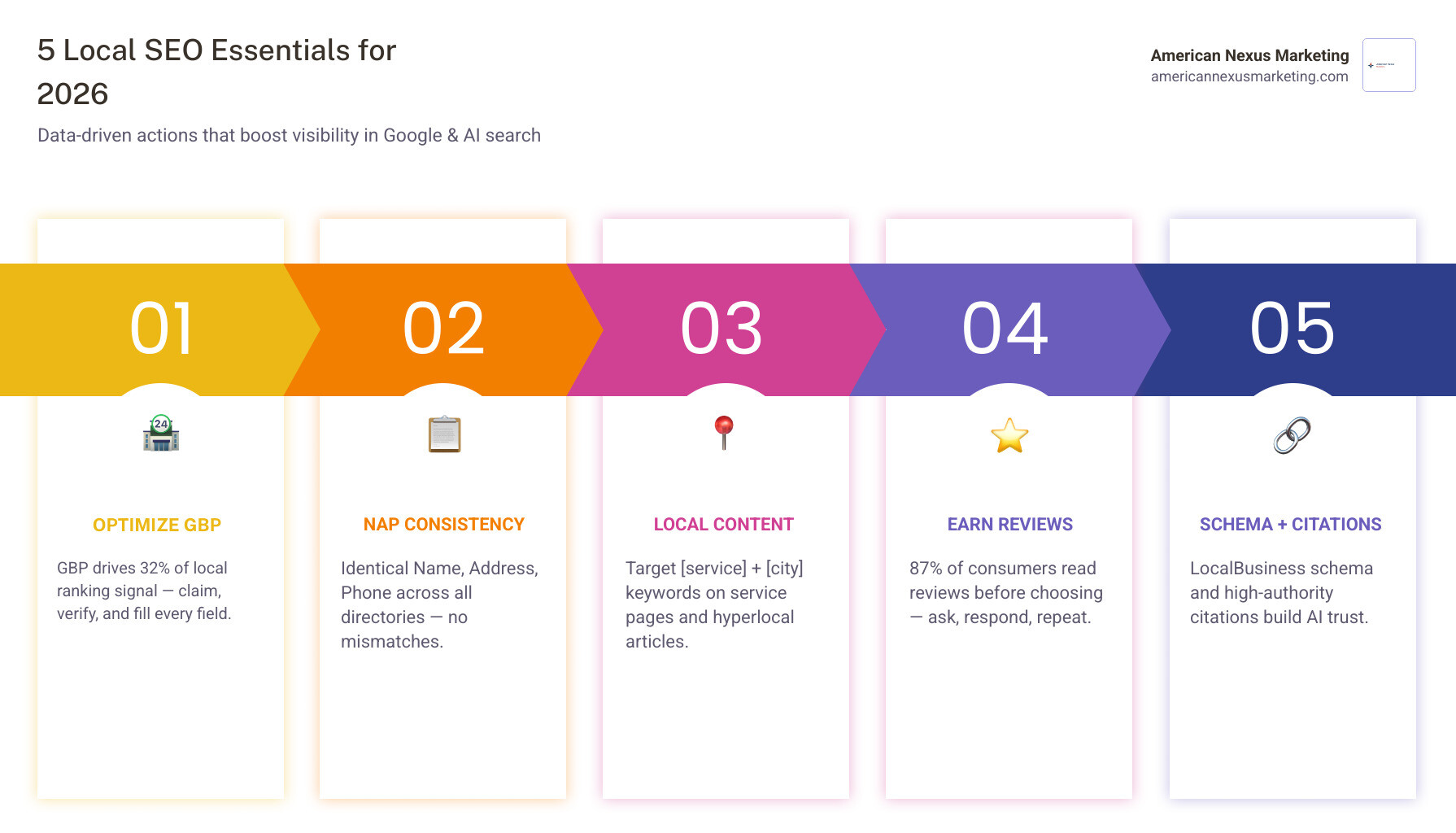
- Claim and optimize your Google Business Profile — it drives 32% of your local ranking signal
- Keep your Name, Address, and Phone number (NAP) identical across every directory listing
- Add location and service pages to your website targeting service and city keywords (such as “plumber in Chicago”)
- Collect reviews consistently — 87% of consumers read reviews before choosing a local business
- Build local backlinks from community events, local press, and partner businesses
- Use schema markup so search engines clearly understand where you operate
- Optimize for AI search (ChatGPT, Perplexity, Gemini) — 30–40% of searches now happen there, not on Google
Think about the last time you searched for a restaurant, a plumber, or a gym on your phone. You probably clicked one of the first three results on the map. You almost certainly never scrolled past them.
That map is where your customers are making decisions — and 46% of all Google searches have local intent.
The stakes are real. Up to 98% of consumers use the internet to find information about local businesses. And 60% of smartphone users have contacted a business directly from a local search result.
But here’s what’s changed in 2026: local search is no longer just Google Maps and organic results. AI-powered engines like ChatGPT, Perplexity, and Gemini now handle 30–40% of searches — and they recommend businesses the same way a trusted friend would. If your local presence isn’t built to be found by both Google and AI, you’re already invisible to a massive slice of your potential customers.
The good news? You don’t need a big budget or a technical background to fix this. You just need the right steps, done in the right order.
This guide walks you through exactly that.
Improve local seo helpful reading:
Why You Must Improve Local SEO to Survive the AI Era
Many business owners ask us: “What’s the actual difference between local SEO and traditional SEO?”
Traditional SEO focuses on national or global search visibility. If you write an informational blog post about “how to fix a leaky faucet,” you are competing with massive home improvement sites worldwide.
Local SEO, on the other hand, focuses on immediate geographic visibility. It is designed to capture high-intent users in your exact neighborhood. When someone searches for “plumber near me” or “emergency faucet repair in Portland,” Google triggers a completely different algorithm. This algorithm relies on three core pillars:
- Relevance: How well your business profile and website match what the user is looking for.
- Distance: How physically close your business is to the searcher’s location.
- Prominence: How well-known, trusted, and authoritative your business is across the web (driven by reviews, links, and citations).
But in July 2026, the local search landscape has shifted. Traditional organic listings are feeling the squeeze. With Google’s AI Overviews synthesizing direct answers at the very top of search pages, traditional organic listings have seen 20-35% lower click-through rates. Additionally, “zero-click searches” mean that over 30% of users find the answer they need (like your phone number or business hours) directly on the search results page without ever visiting your website.
Furthermore, searchers are increasingly bypassing Google entirely. With 30-40% of searches happening in conversational AI engines like ChatGPT, Perplexity, and Gemini, your business must be discoverable by large language models. Fortunately, AI engines rely heavily on the same prominence and relevance signals that power local SEO. If you optimize your digital footprint correctly, AI engines will cite your business as a trusted local recommendation.
Here is a quick breakdown comparing the two search landscapes:
| Feature | Traditional SEO | Local SEO (2026 AI Era) |
|---|---|---|
| Primary Target | National/Global Audiences | Hyperlocal Neighborhoods & Suburbs |
| Core Ranking Signals | Backlinks, Content Depth, Technical SEO | Relevance, Distance, Prominence, GBP Accuracy |
| Primary Search Interfaces | Standard Organic Blue Links | Google Local Map Pack, Apple Maps, AI Chatbots |
| AI Disruption Risk | High (AI Overviews answer informational queries) | Low (AI cannot physically cut your hair or fix your roof) |
| User Intent | Researching & Informational | Immediate Buying Intent (Ready to call/visit) |
To explore this landscape further, you can check out the comprehensive Local SEO 2026 | 7-Strategy Blueprint | FlashCrafter for an in-depth look at how search has evolved.
Master Your Google Business Profile (GBP)
If you only have one hour a week to spend on digital marketing, spend it here. Your Google Business Profile (GBP) is the single most influential asset for local search success—accounting for 32% of your local ranking signal.
According to Google data, businesses with complete, actively managed profiles receive 2.7x more search visibility and 70% more direction requests than incomplete profiles. If you are not actively managing your profile, you are leaving money on the table.
First, you must claim and verify your profile. Google allows verification through several methods, including email, text, phone call, or a short video upload of your physical location and tools.
When setting up your profile, pay close attention to your business categories. Your primary category carries the most weight in Google’s ranking algorithm. Choose the absolute most specific primary category that describes your business (e.g., “Italian Restaurant” instead of just “Restaurant”). While Google allows you to select secondary categories, we recommend using as few as possible to keep your profile’s relevance highly focused.
Be extremely careful with your business name. Only use your official, legal business name. Do not stuff keywords into your GBP name (e.g., writing “Portland Plumbers – Quick Pipe Repair” instead of “Quick Pipe Repair”). Keyword stuffing looks unprofessional to prospective customers and is a fast track to getting your profile suspended by Google.
For a complete step-by-step walkthrough on setting up your digital footprint, read our guides on google company profile 101 put your business on the digital map and the no nonsense guide to create company profile on google.
Step-by-Step Optimization to Improve Local SEO Rankings
Once your profile is verified, it is time to optimize it for maximum conversions.
Follow this checklist to fully optimize your profile:
- Write a Compelling Description: You have 750 characters. Focus on what makes your business unique, your core services, and the local neighborhoods you serve. Naturally include local keywords, but write for humans first.
- Keep Hours 100% Accurate: Update your hours promptly for holidays or seasonal changes. There is no faster way to earn a 1-star review than having a customer drive to your shop only to find it closed.
- List Custom Services: Do not rely solely on Google’s predefined service categories. Add custom services with detailed descriptions (up to 300 characters each) and transparent pricing if applicable. This feeds rich, topical data directly into Google’s local search index.
- Publish Regular GBP Posts: Think of GBP Posts as mini social media updates. Share weekly offers, events, and company announcements. This signals to Google that your business is highly active.
- Upload High-Quality Photos Weekly: Upload storefront photos, interior shots, team photos, and images of your completed work. Profiles with recent photos see a massive lift in driving direction requests.
Build NAP Consistency and Local Citations
Before search engines can trust your business enough to recommend it, they need to verify that you actually exist where you say you do. This is where NAP consistency comes in. NAP stands for Name, Address, and Phone number.
A citation is any online mention of your business’s NAP across the web. This includes directories like Yelp, Yellow Pages, Apple Maps, Bing Places, Foursquare, and local Chamber of Commerce directories.
In the early days of SEO, building thousands of low-quality directory links was a dominant strategy. In 2026, mass-directory spam is a waste of time. However, having consistent NAP data on the core, high-authority directories is still critical for building foundational trust with search engines.
If your business name is listed as “John’s Plumbing LLC” on Yelp, “John’s Plumbing” on Google, and “John Daniel Plumbing” on Facebook, search engines get confused. They may treat these listings as separate entities, which dilutes your local authority.
To audit your digital footprint, search for your business name and phone number across the web. Document every incorrect listing you find. You can fix these manually or use citation management tools to streamline the cleanup. If you find your business listings are a cluttered mess, read our guide on keep it consistent how to audit your business nap for better rankings or explore why you might need a professional citation cleanup service.
Optimize Your Website for Local Search Intent
Your website is the anchor of your local SEO strategy. While your Google Business Profile captures local map searches, your website captures long-tail, high-intent organic search queries.
To optimize your site to improve local SEO, start with your core page architecture. Avoid the temptation to build a single-page website. Instead, create dedicated pages for each individual service you offer and each physical location you serve.
For instance, if you run an HVAC company, do not put all your services on one page. Create separate pages for “AC Repair,” “Furnace Installation,” and “Duct Cleaning.” Each page should feature 800 to 1,000 words of unique, helpful content targeting specific service-city keywords (e.g., “AC repair in Portland”).
On-page optimization essentials:
- Optimize Your H1 Header: Your homepage H1 should immediately tell search engines and users what you do and where you do it (e.g., “Residential Plumbing Services in North Denver”).
- Use Indexable Text for Contact Info: Never put your address or phone number inside an image. Search engines cannot reliably read text in images. Put your NAP in the footer of your website in clean, indexable HTML text.
- Implement Schema Markup: Structured data (specifically LocalBusiness schema) is code you add to your website to help search engines understand your address, phone number, operating hours, and payment methods. While it requires a bit of technical setup, it is incredibly powerful. Only about 30% of local businesses use schema properly, making it an easy way to outpace your competition.
For more foundational tips on boosting your site’s organic presence, check out our guide on six simple ways to improve your sites seo ranking today.
Create Hyperlocal Content to Improve Local SEO Authority
National competitors can easily target broad keywords like “best lawn care tips.” What they cannot do is replicate hyper-local, first-hand knowledge of your specific community.
To build deep local authority, create content that addresses the unique constraints, rules, and characteristics of your service area.
Excellent hyperlocal content ideas:
- Local FAQ Pages: Answer questions specific to your city’s weather, regulations, or local building codes.
- Local Case Studies: Write about real projects you completed in specific neighborhoods, including local challenges you solved and photos of the job site.
- City-Specific Guides: Create helpful local resources (e.g., “A Homeowner’s Guide to Preparing Your Pipes for Chicago Winters”).
By publishing content that national brands cannot easily replicate, you prove to both Google and AI engines that you are a genuine local expert. To dive deeper into on-page ranking factors, review the Local SEO Ranking Factors Checklist 2026 | YOOtraffic.
Drive Reviews and Build Local Backlinks
Online reviews are a massive ranking signal. They do more than just build trust with potential buyers—they feed valuable semantic data to search engines. When customers write detailed reviews mentioning specific services (e.g., “They did a fantastic job with our tankless water heater installation in Seattle“), Google reads those reviews as contextual citations that reinforce your topical relevance.
To get more reviews, you must build a systematic collection process:
- Ask Immediately: The best time to ask for a review is right after a successful service delivery when customer satisfaction is highest.
- Make it Simple: Create a shortened, direct Google review link (using tools like bit.ly) and send it via a polite text message or email.
- Use QR Codes: If you run a physical retail shop or restaurant, display a QR code at your checkout counter or on printed materials.
Always respond to every review—both positive and negative—promptly and professionally. When responding to negative reviews, keep your cool, offer to take the conversation offline to resolve the issue, and avoid using your target keywords (you don’t want the negative review ranking for your core services!).
Beyond reviews, building local backlinks is key to expanding your online prominence. A link from a local newspaper, a neighborhood blog, or a local youth sports league website is incredibly valuable. Search engines heavily weigh these links because they prove you are an active, recognized member of the physical community.
You can earn these links by sponsoring local events, joining your local Chamber of Commerce, or writing guest posts for complementary, non-competing businesses in your area. For more details on the importance of local authority, read why your business needs the best local seo expert to dominate google maps.
Frequently Asked Questions about Local SEO
To help you get the most out of your optimization efforts, we have answered some of the most common questions small business owners and organizations ask about local search.
How long does it take to see results from local SEO?
Local SEO is an ongoing process, not a one-time project. However, the timeline for seeing results is generally faster than national SEO:
- Google Business Profile Visibility: You will often see a noticeable increase in profile impressions, calls, and direction requests within 60 to 90 days of fully optimizing your profile and starting a review acquisition routine.
- Organic Website Rankings: Meaningful organic search movement for localized keywords usually takes 4 to 6 months for lower-competition terms, and 6 to 12 months for highly competitive local niches in major metropolitan areas.
What specific local SEO strategies should nonprofits use?
Nonprofits have unique local SEO needs because they must appeal to multiple audiences simultaneously: donors, volunteers, and the local clients they serve.
- Target Distinct Audiences: Create separate, highly optimized service pages for each program you offer. For example, a local food pantry should have distinct pages for “How to Receive Food Assistance” (for clients) and “How to Donate Food or Volunteer” (for donors).
- Leverage High-Authority Trust Directories: Claim and optimize your profiles on trusted nonprofit databases like GuideStar (Candid) and Charity Navigator. These profiles act as incredibly strong local citations and trust signals.
- Build Partner Backlinks: Reach out to local government agencies, school districts, and community foundations that support your work and ask them to link to your website from their resource directories.
For a deeper look at tailoring these strategies for non-commercial organizations, see Local SEO for Small Businesses: A Complete 2026 Guide.
Do I need a physical address to rank in local search?
No, you do not need a public physical address to rank. If you run a Service Area Business (SAB)—such as a mobile car detailer, plumber, or locksmith who travels to customers—you can set up your Google Business Profile as a Service Area Business.
During setup, you can hide your physical home address from the public and instead define your service area by specific cities, counties, or a radius around your location. Google’s algorithm is fully equipped to rank service area businesses in the local map pack within their designated service zones.
Conclusion
Improving your local SEO is the single highest-return marketing activity available to small businesses and local organizations. In an era where AI search engines and zero-click results are changing how users find information, building a strong, localized digital footprint ensures you remain highly visible.
By claiming your Google Business Profile, maintaining strict NAP consistency, optimizing your website with hyperlocal content, and systematically gathering customer reviews, you build an online presence that search engines—and real customers—can easily find and trust.
Ready to dominate your local market? Download our comprehensive, step-by-step Local SEO Checklist for Small Businesses 2026 to start optimizing your business today!