
Why Local SEO Google Search Is the Most Valuable Real Estate for Small Businesses
Local SEO Google search is the practice of optimizing your business so it appears when nearby customers search for what you offer on Google — in the map results, the Local Pack, and local organic listings.
Here’s a quick breakdown of what it means and why it matters:
- What it is: A set of strategies that help your business show up in location-based Google searches
- Who it’s for: Any business that serves customers in a specific geographic area — whether you have a storefront or work from home
- How it works: Google ranks local results using three core factors — relevance, distance, and prominence
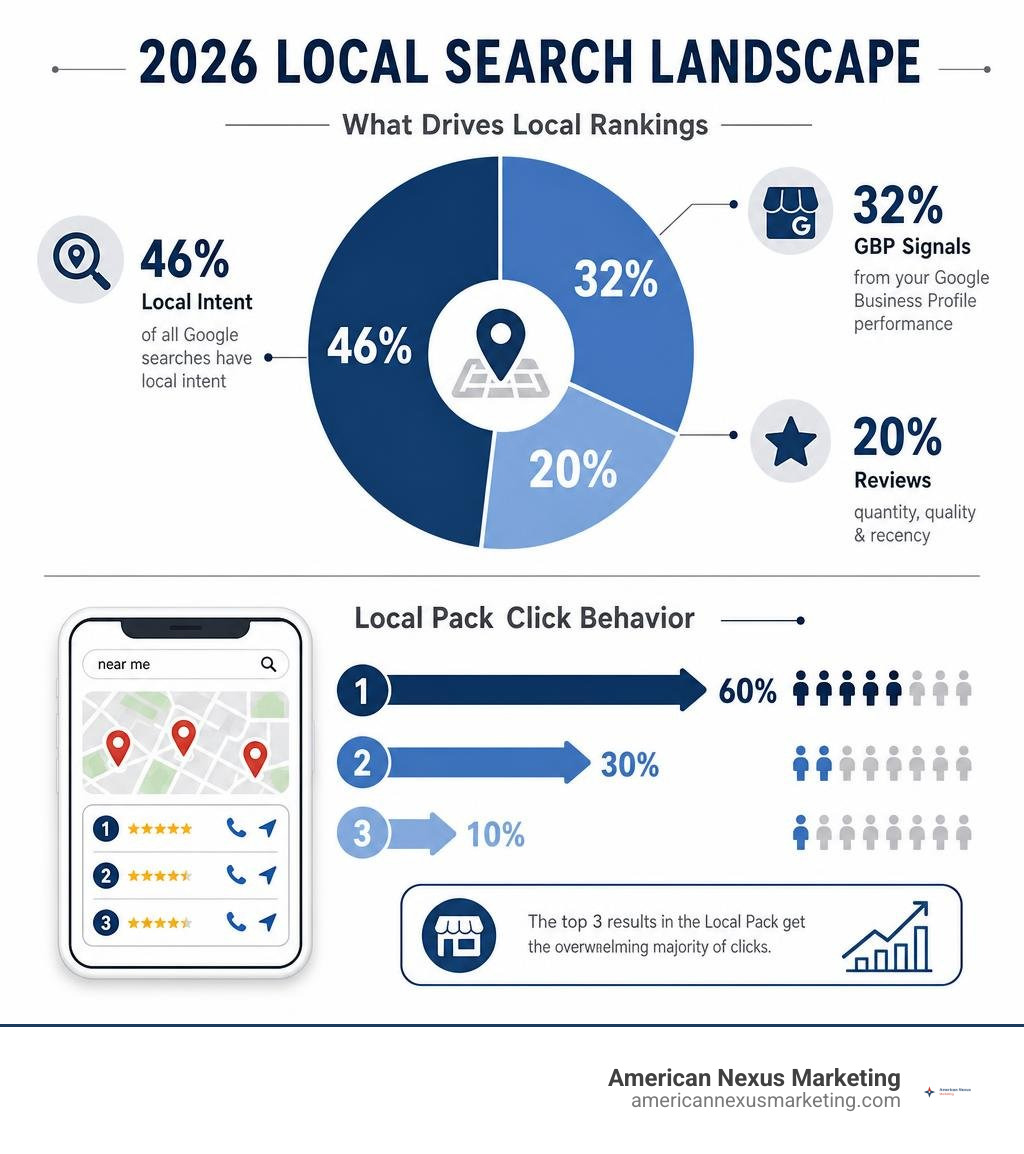
- Why it matters: 46% of all Google searches have local intent, and 76% of people who search for something nearby visit a business within 24 hours
Think about the last time you searched for a plumber, a dentist, or a coffee shop. You probably didn’t scroll through ten blue links. You looked at the map. You picked from the top three results. Then you called.
That three-business map display is called the Local Pack — and it’s where buying decisions get made.
Here’s the striking part: 84% of those searches are discovery searches. The person searching hasn’t already decided who to call. They’re open. That means if your business shows up, you have a real shot at winning that customer.
But most small businesses are invisible in those results. Not because local SEO is complicated or expensive — but because they don’t know where to start.
This guide fixes that.
Quick local seo google search definitions:
Understanding the Foundations of Local Search
To master local seo google search, we first need to understand how Google’s local algorithm thinks. Unlike traditional search, which looks at the entire web to find the most authoritative answer to a question, local search is deeply rooted in physical reality.
When a user types a query with local intent (like “emergency plumber” or “best bakery near me”), Google shifts from its standard search index to its local index. The most prominent manifestation of this is the Local Pack—the map and the three business listings that appear at the top of the search results.
If you want to build a sustainable pipeline of local customers, your primary goal is to get your business inside that Local Pack. To understand how to get there, check out our comprehensive guide on how to Get on the Map: The Ultimate Guide to Improving Local SEO.
How Traditional SEO Differs from Local SEO Google Search
Traditional SEO is a global or national game. It focuses on ranking a website for keywords regardless of where the searcher is physically standing. It relies heavily on content depth, site architecture, and high-authority backlinks from across the web.
Local SEO, on the other hand, is bound by geography. Google draws a digital boundary around your business and evaluates your relevance within that specific zone. While traditional organic search rankings drop off steeply from position one to position three (often losing over 29 percentage points in click-through rate), the Local Pack is far more forgiving. The click-through rate drop from position one to position three inside the Local Pack is only about 2.5 percentage points. This means that as long as you are in the top three, you are in a prime position to win the customer.
To improve your website’s baseline organic health before diving into localized strategies, you can explore these Six Simple Ways to Improve Your Site’s SEO Ranking Today.
The Three Core Pillars: Relevance, Distance, and Prominence
According to official Google documentation on Tips to improve your local ranking on Google – Google Business Profile Help, Google calculates local rankings using three core pillars:
- Relevance: How well does your business profile match what the user is searching for? If your profile is complete and detailed, Google can better match you with highly specific, transactional search terms.
- Distance: How far is your business from the searcher? If a user doesn’t share their location, Google estimates it using background signals like IP addresses or past search history.
- Prominence: How well-known and trusted is your business? This is determined by offline fame, reviews, links, and web-wide directory listings.
To understand how proximity actually works, we have to look at the mechanics of the “proximity cliff.” Data from a detailed proximity study published in the How the Proximity Factor Actually Works on Google Maps shows that proximity decay is highly non-linear:
- Within 600 meters, ranking changes are minimal.
- Between 1.5 km and 4 km, rankings drop off a cliff.
- For emergency services (like residential plumbing), the cliff is incredibly steep, dropping off around 1.2 km to 1.5 km where proximity accounts for up to 92% of the ranking variance.
- For destination businesses (like medical clinics or wedding venues), the cliff is much softer, extending up to 3.5 km because the search intent is “centroid-anchored” (focused on the city center or quality) rather than “user-anchored” (focused on immediate physical proximity).
Understanding these pillars helps us realize that while we cannot change our physical distance from a searcher, we can heavily optimize our relevance and prominence to expand our ranking radius.
Mastering Local SEO Google Search: The 2026 Blueprint
Now that we understand the algorithms, let’s look at the actual blueprint for dominating local search in 2026.
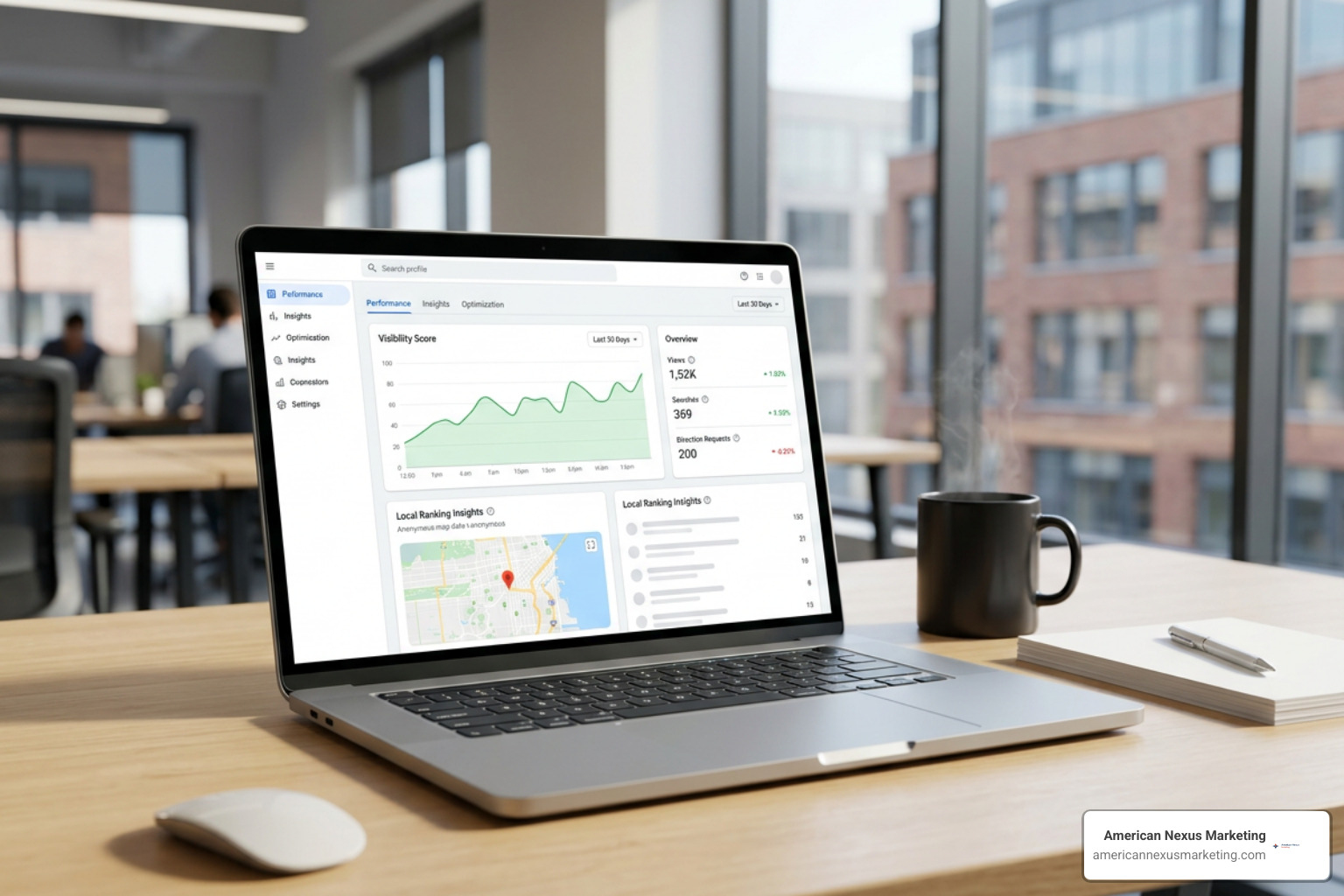
Local search has shifted toward a highly integrated ecosystem where your website, your Google Business Profile, and your AI search footprints must work in perfect harmony. If you want to skip the trial and error and get professional help setting this up, read about Why Your Business Needs the Best Local SEO Expert to Dominate Google Maps.
Google Business Profile (GBP) Optimization
Your Google Business Profile is the absolute foundation of your local presence, accounting for 32% of your Local Pack ranking signals. If you don’t have one, or if yours is incomplete, you are leaving massive amounts of money on the table. In fact, businesses with complete, actively managed GBPs receive 2.7x more visibility and 70% more direction requests than incomplete profiles.
To get started, you can follow our guides on how to Get Listed on Google with a Free Business Profile, read our Google Company Profile 101: Put Your Business on the Digital Map, or check out The No-Nonsense Guide to Create Company Profile on Google.
To optimize your profile for maximum impact:
- Choose the Right Primary Category: This is the single most important field on your profile. If you run a bakery that also serves coffee, set “Bakery” as your primary category and “Coffee Shop” as your secondary category. Mislabeled primary categories can cause instant profile suspension or rank suppression.
- Complete Every Field: Write a detailed business description of at least 700 characters. Add accurate hours, and update them promptly for holidays. The “Business is Open” status is the 5th most important ranking factor; if your profile says you are closed at 8 PM, Google will demote you in real-time for searches happening at 8:01 PM.
- Avoid the 30-Day Photo Danger Zone: Profiles that go more than 30 days without a new photo see measurable visibility declines. Upload 2 to 3 high-quality, non-stock photos per week to signal to Google that your business is highly active.
Review Generation and Management Systems
Review signals account for 20% of your Local Pack ranking. But in 2026, reviews are no longer just about getting a high star rating. Google’s algorithm measures review velocity (how fast you get reviews), recency (how new they are), and the semantic content inside the reviews.
To build an automated review generation system:
- Send SMS Requests Within 24 Hours: Ask your customers for feedback via SMS immediately after service completion. They are far more likely to respond on mobile.
- Encourage Specificity: Don’t just ask for “five stars.” Ask customers to mention the specific service they received and the neighborhood they live in. When a review says, “Great roof repair in coastal Miami,” it feeds Google’s relevance and proximity algorithms.
- Maintain the “Trustworthy” Range: Aim for a steady rating between 4.5 and 4.8. A perfect 5.0 rating with hundreds of reviews can look artificial to both users and algorithms.
- Respond to Every Review Within 24 Hours: Mention your services and location naturally in your responses. Never buy fake reviews; Google’s review fraud detection systems are incredibly advanced, and getting caught can lead to your profile being suppressed or permanently suspended overnight.
Citations, NAP Consistency, and Local Link Building
Citations (listings on directories like Yelp, YellowPages, and TripAdvisor) used to be the gold standard of local SEO. Today, they account for only 6% of Local Pack ranking signals. Google has gotten much better at verifying business legitimacy through its own entity data and advanced verification methods, meaning mass directory submissions offer diminishing returns.
However, baseline NAP (Name, Address, Phone) consistency is still a requirement. If your business name is “Main Street Plumbing” on Google, but “Main Street Plumbers, LLC” on Yelp, Google’s algorithm gets confused about whether these are the same entity.
To clean up your data, read our guide on how to Keep It Consistent: How to Audit Your Business NAP for Better Rankings.
When it comes to local link building, quality beats volume every time. One high-quality link from a local high school sports sponsorship, a local charity, or a neighborhood newspaper is worth more than 50 spammy directory links. Google values local relevance over global authority.
For a deeper dive into these strategies, you can read the comprehensive Local SEO 2026 | 7-Strategy Blueprint or review the Local SEO Ranking Factors: Complete List (2026).
On-Page and Technical Optimization for Local Businesses
Your website is the digital storefront that supports your Google Business Profile. In fact, on-page signals account for 15% of your Local Pack rankings and a massive 33% of your local organic rankings.
The Role of Technical Optimization in Local SEO Google Search
If your website is slow, clunky, or hard to use on a phone, you will struggle to rank. Since 57% of local searches happen on mobile devices, Google uses mobile-first indexing. This means it evaluates the mobile version of your site to determine your rankings.
Key technical requirements include:
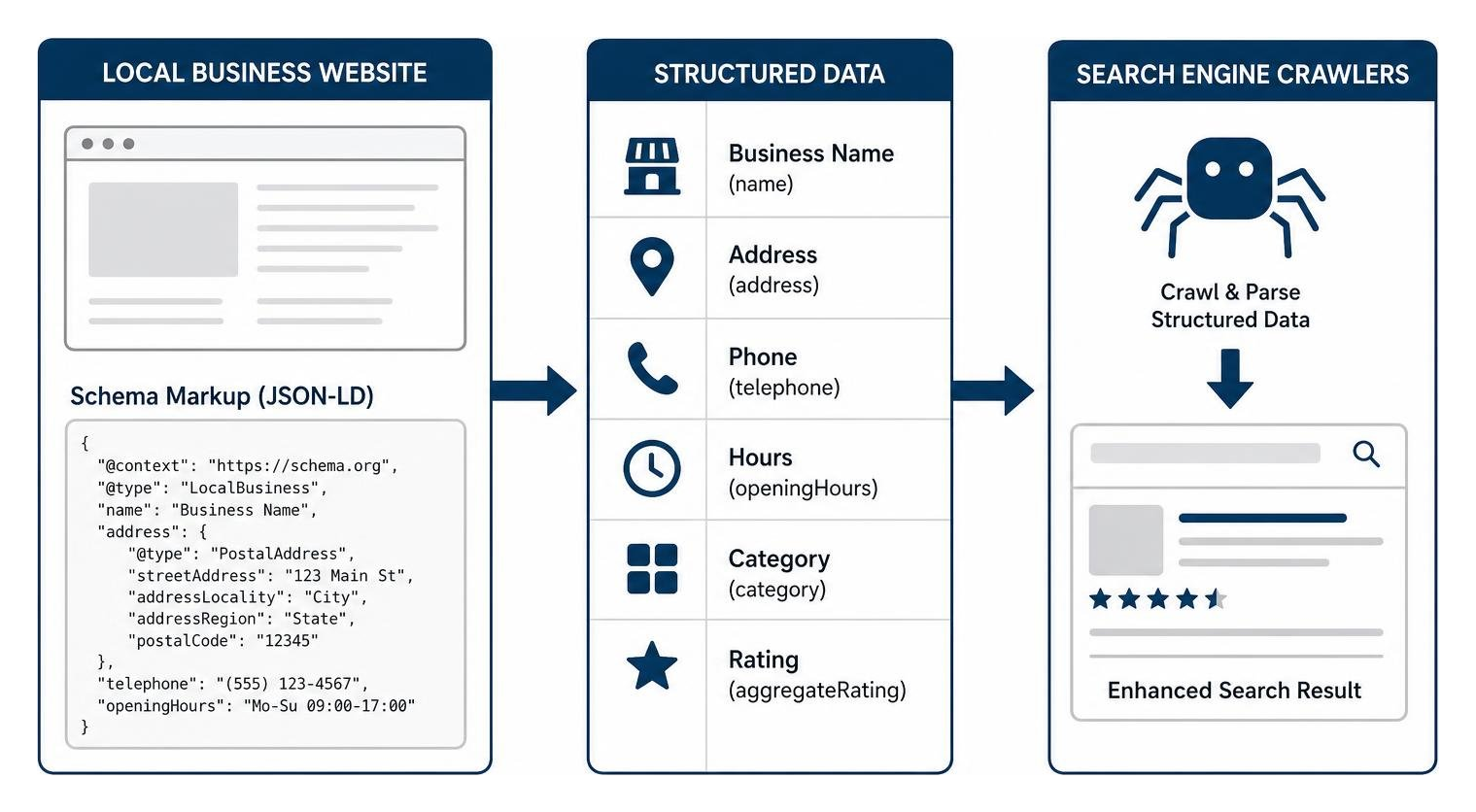
- LocalBusiness Schema Markup: Implement LocalBusiness structured data in JSON-LD format on your homepage. This tells search engine crawlers exactly what your business name, address, phone number, hours, and service areas are in a language they understand natively.
- Core Web Vitals: Ensure your site loads fast. Specifically, pay attention to Interaction to Next Paint (INP), keeping it under 200 milliseconds on mobile to ensure a snappy user experience.
- Clean URL Structures: Use human-readable, descriptive URLs (like
/services/drain-cleaning) instead of random ID strings.
Hyperlocal Content and Service Area Pages (SABs)
If you operate a Service Area Business (SAB)—like a plumber, locksmith, or mobile detailer—you don’t have a physical storefront for customers to visit. You serve them at their locations.
To rank across multiple towns or neighborhoods, you must build high-quality, hyperlocal service area pages. Do not use cheap “city-swap” templates where you copy the exact same page and only change the city name. Google recognizes these as thin content and will suppress them.
Instead, create unique landing pages for each primary city or major neighborhood you serve. Each page should feature:
- At least 1,500 words of unique local content.
- Case studies or project showcases specific to that city (e.g., “Replacing a tile roof damaged by salt corrosion in coastal Miami”).
- Local customer testimonials.
- Hyperlocal FAQs addressing common questions from residents in that specific area.
This builds geographic relevance and helps expand your proximity cliff.
Navigating the AI-First Search Era
The local search landscape is undergoing its biggest shift in a decade. With 30-40% of searches now happening in AI engines like ChatGPT, Perplexity, and Gemini, traditional search patterns are evolving.
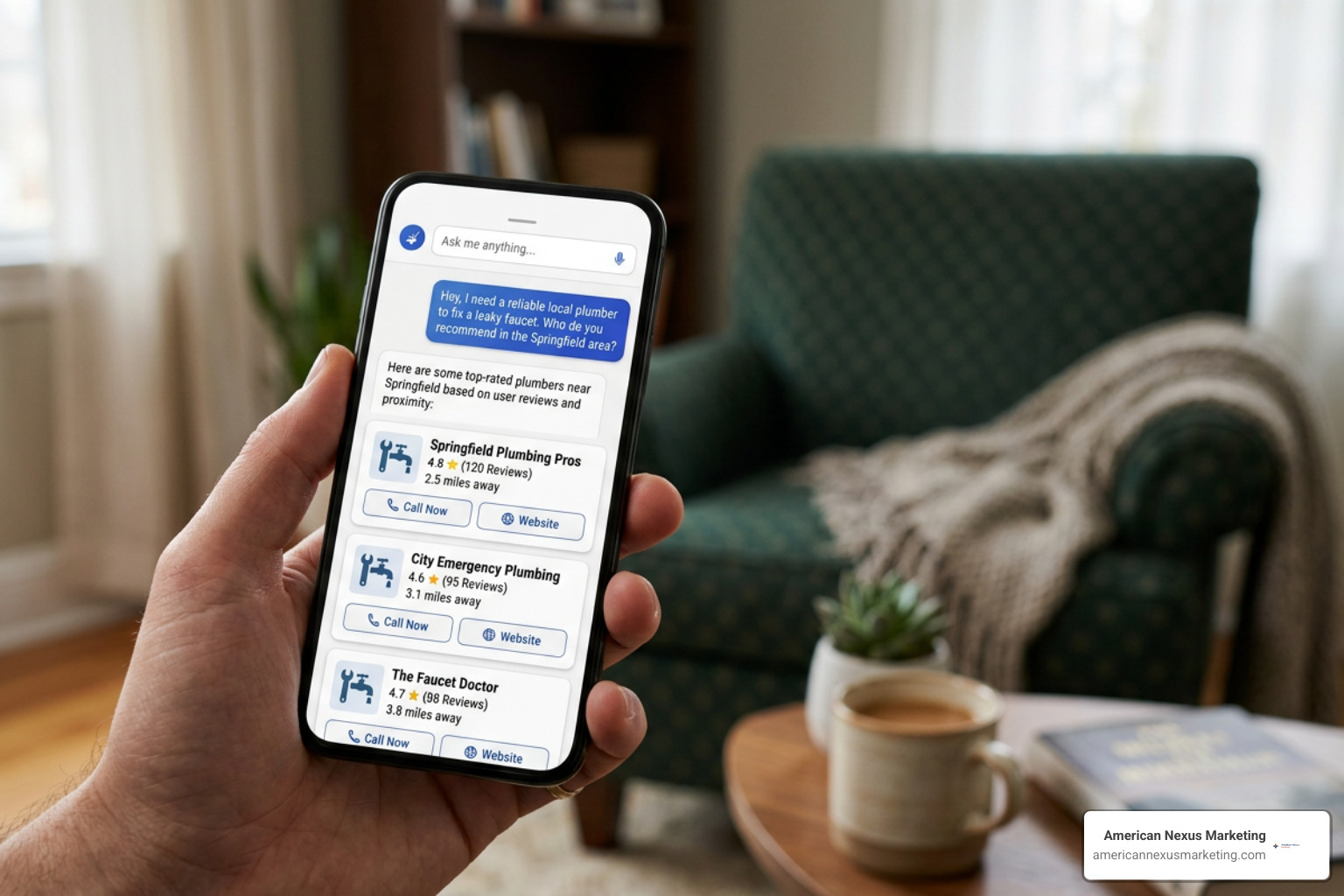
In tests of Google’s AI-powered summaries, traditional organic listings saw 20-35% lower click-through rates because users found their answers directly in the AI summary. This makes optimizing for AI search engines—often called Generative Engine Optimization (GEO)—essential for future-proofing your business.
Optimizing for ChatGPT, Perplexity, and Gemini
AI search engines do not rely on traditional keyword matching. They use Large Language Models (LLMs) to understand conversational queries like, “I have a leaking pipe in my kitchen, who is a highly-rated plumber near me who can come out tonight?”
To ensure your business is recommended by AI engines:
- Pass the AI Recommendation Threshold: Studies show that to be consistently recommended by platforms like ChatGPT or Gemini, a business needs approximately 150 reviews per location, a 90% response rate to those reviews, and an overall rating between 4.5 and 4.8.
- Do Not Block AI Crawlers: Ensure your
robots.txtfile does not block user-agents like GPTBot or PerplexityBot. If AI crawlers cannot read your website, they cannot recommend your business. - Claim Your Bing Places and Apple Maps Profiles: ChatGPT and other LLMs pull real-time map data from Bing Places and Apple Maps (which is the default map app for 55% of US smartphone users). If your profiles on these secondary platforms are empty, AI engines will struggle to verify your location and contact details.
- Write Conversational Content: Structure some of your website content in Q&A format. Gemini frequently pulls answers directly from business FAQs and reviews to answer user queries.
Frequently Asked Questions About Local Search
How long does it typically take to see results from local SEO efforts?
While some technical updates (like fixing a broken Google Business Profile category) can show impact within a few days, a comprehensive local SEO strategy typically takes 3 to 6 months to show significant results. This ranking lag occurs because Google needs time to crawl your new local landing pages, verify your NAP consistency across the web, and measure your review velocity over time.
Do service area businesses (SABs) without a physical address need local SEO?
Yes! Service area businesses need local SEO even more than storefronts because they don’t get natural foot traffic. When setting up your Google Business Profile, you should select the option to hide your physical address and define your service area using a precise zip code or city polygon. This keeps your profile compliant with Google’s guidelines while ensuring you still show up for local searches within your target territory.
How many reviews does a business need to rank well in 2026?
There is no magic number, as it depends heavily on your local competitors. However, to cross the AI recommendation threshold and compete effectively in highly populated areas, you should target at least 150 high-quality, detailed reviews with a consistent rating between 4.5 and 4.8. Focus on review recency and velocity rather than just building a static number and stopping.
Conclusion
Dominating local seo google search in 2026 doesn’t require a massive corporate budget. For small businesses, solo founders, and local service providers, success comes down to mastering the high-impact basics: maintaining an active Google Business Profile, building a systematic review generation process, keeping your NAP data consistent, and optimizing your website for mobile users and AI search engines.
At American Nexus Marketing, we specialize in providing jargon-free, checklist-driven advice to help small businesses win the local search game without breaking the bank.
Ready to claim your spot at the top of the map? Download our free Local SEO Checklist for Small Businesses in 2026 and start optimizing your business today!